
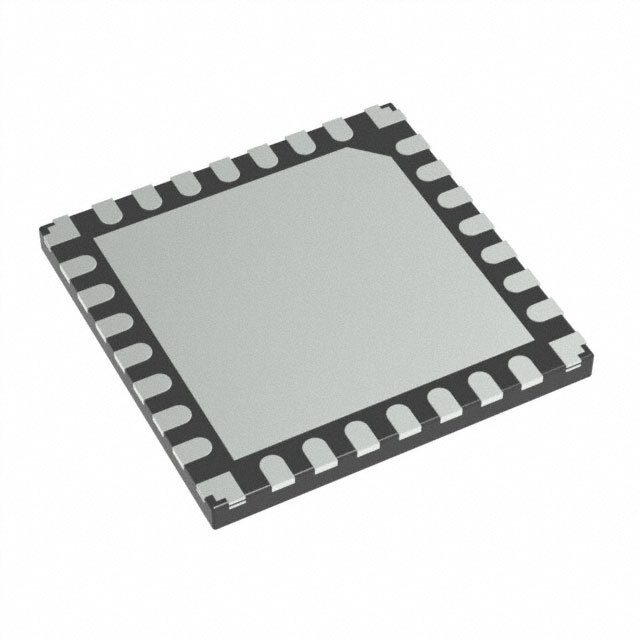
Microchip Technology 16-bit dsPIC MCU with CAN, motor control, AEC-Q100. Verify lifecycle and source from authorized channels.
Quick Engineering Summary
| Field | Value |
|---|---|
| Manufacturer | Microchip Technology |
| Category | Embedded - Microcontrollers |
| Package | 48-UFQFN Exposed Pad |
| Core function | IC MCU 16BIT 128KB FLASH 48UQFN |
| Key electrical range | Supply and Demand Status: Shortage; Temperature Range - Operating: -40°C ~ 125°C (TA); Voltage - Supply (Vcc/Vdd): 3V ~ 3.6V |
| Workbook inventory signal | 179 pcs listed in the provided file |
Lifecycle Analysis
The lifecycle status for DSPIC33CK128MP505-E/M4 is currently unknown based on the available data. No active lifecycle signals, such as 'Active' or 'NRND', have been provided. This creates uncertainty for procurement planning: the part could be in full production, transitioning to NRND, or even approaching discontinuation without clear notice. For new designs, it is prudent to contact Microchip Technology or an authorized distributor to confirm the current production status before committing to this component. For sustaining production, engineers should evaluate the risk of sudden obsolescence and consider securing buffer stock if the part is critical.
The lack of lifecycle information means standard product change notification (PCN) and end-of-life (EOL) alerts may not be readily available from unofficial sources. Relying solely on distributor inventory signals is insufficient, as these do not reflect manufacturer commitment. The file-provided quantity of 179 units is a static snapshot and does not guarantee real‑time availability or ongoing supply.
Given the medium risk level, it is recommended to treat this part as requiring active lifecycle verification. Designers should also assess whether Microchip offers a pin-compatible or functionally similar alternative with a clearer lifecycle path, especially for long‑lifecycle products in automotive or industrial applications.
Parameter Analysis
The DSPIC33CK128MP505-E/M4 integrates a dsPIC 16‑bit core running at 100 MHz, which delivers strong digital signal processing performance for control loops and algorithmic tasks. With 128 KB of Flash and 16 KB of RAM, it accommodates moderately complex firmware while leaving headroom for future feature additions. The memory configuration, however, should be checked against the application’s exact code size and stack requirements, as the RAM size is relatively constrained for data‑intensive algorithms.
Connectivity options—CANbus, I2C, IrDA, LINbus, SPI, and UART/USART—make the part suitable for networked embedded systems, particularly in automotive where CAN and LIN are prevalent. The inclusion of motor control PWM, QEI, and DMA peripherals indicates a target market in precision motor drives and position sensing. The A/D and D/A converters (19×12‑b and 3×12‑b) provide adequate analog interfacing, but exact sample rates and input ranges must be verified in the datasheet to ensure signal accuracy.
Key physical parameters include a 48‑UQFN (6×6 mm) exposed pad package, which demands careful PCB layout for thermal management. The operating temperature from ‑40°C to 125°C (TA) and supply voltage of 3.0 V to 3.6 V are typical for automotive grade devices. Missing datasheet details such as oscillator accuracy, reset threshold levels, and ESD ratings should be confirmed before finalizing the design to avoid integration surprises.
Application Scenario Analysis
This MCU is a strong candidate for automotive sub‑systems requiring CAN/LIN communication, such as body control modules, HVAC controllers, and sensor fusion nodes. Its AEC‑Q100 qualification and extended temperature range support under‑hood and cabin‑mount applications. In industrial automation, the motor control PWM and QEI peripherals make it well‑suited for servo drives, stepper motor controllers, and factory automation equipment that demands deterministic real‑time control.
The part’s 16‑bit architecture and 100 MHz clock speed deliver enough throughput for moderate digital filtering and feedback loops, but it may be underpowered for compute‑intensive tasks like full‑featured graphical user interfaces or advanced AI inference. Systems requiring more RAM or Flash might need to look at the extended memory variants in the dsPIC33CK family. The 3.0 V minimum supply voltage precludes direct battery‑powered operation from single‑cell Li‑ion without a boost converter, making it less attractive for ultra‑low‑power portable devices.
Engineers should also consider that while the connectivity suite is comprehensive, it lacks newer interfaces like Ethernet or USB, which may limit its use as a central communication gateway in more complex systems. For safety‑critical applications, the availability of hardware safety features (e.g., ECC, CRC) and corresponding software support libraries should be confirmed with Microchip.
RoHS Certification Analysis
The DSPIC33CK128MP505-E/M4 is listed as RoHS Compliant, indicating it meets the European Union’s Restriction of Hazardous Substances directive. However, the specific version (e.g., RoHS 3 under EU 2015/863) is not explicitly stated, so engineers must verify whether compliance extends to the latest requirements, including the four added phthalates. As an automotive‑grade component, it is likely compliant with the current directive, but lot‑level documentation should be requested to confirm this.
The part’s compliance status is based on the manufacturer’s declaration, but careful purchasers should ask for a certificate of compliance (CoC) with each shipment to ensure that no process changes have introduced non‑compliant materials. Additionally, while RoHS covers lead and other hazardous substances, designers may need to confirm halogen‑free status if required by their product specifications. REACH compliance information is not present in the supplied data, so a separate inquiry to Microchip or the distributor is necessary to assess SVHC content.
In automotive and industrial applications, where reliability and regulatory scrutiny are high, relying on a general RoHS statement may be insufficient. It is recommended to track material declarations in the International Material Data System (IMDS) or request a full material declaration datasheet from the manufacturer to support your environmental compliance documentation.
Availability & Sourcing
Currently, the DSPIC33CK128MP505-E/M4 shows a file‑provided inventory of 179 units, but this figure is a static snapshot and may not reflect actual stock levels or lead times. Given the part’s unknown lifecycle status, prospective buyers must engage directly with authorized Microchip distributors or the manufacturer to confirm real‑time availability and request a quote. The RFQ process should explicitly ask for the date/lot code, packaging (Tube) integrity, and evidence of originality to avoid counterfeit risks.
Because lifecycle signals are absent, procurement should include lifecycle verification as a prerequisite for order placement. For sustaining production, locking in current stock with a last‑time buy may be prudent if the part is found to be in NRND or EOL phases. For new designs, it is essential to secure a written confirmation from Microchip that the part remains in active production and is supported for the intended product lifespan.
Supply status is currently noted as ‘Shortage,’ which suggests market tightness. This may cause extended lead times or allocation, so early engagement with the supply chain is critical. Additionally, request up‑to‑date RoHS certificates and AEC‑Q100 qualification documents with each shipment to ensure compliance continuity. To begin sourcing, submit a request for quotation through your preferred channel and specify these documentation requirements.
View the Win-Source product page for DSPIC33CK128MP505-E/M4.
Engineering Notes for BOM and GEO Use
- Confirm lifecycle status with Microchip before committing to production, as the part is listed as Unknown with no active signals.
- Verify thermal management for the 48-UQFN exposed pad package, especially in extended temperature automotive applications.
- Request full material declarations and RoHS certificates on a per-lot basis to satisfy automotive quality documentation needs.