
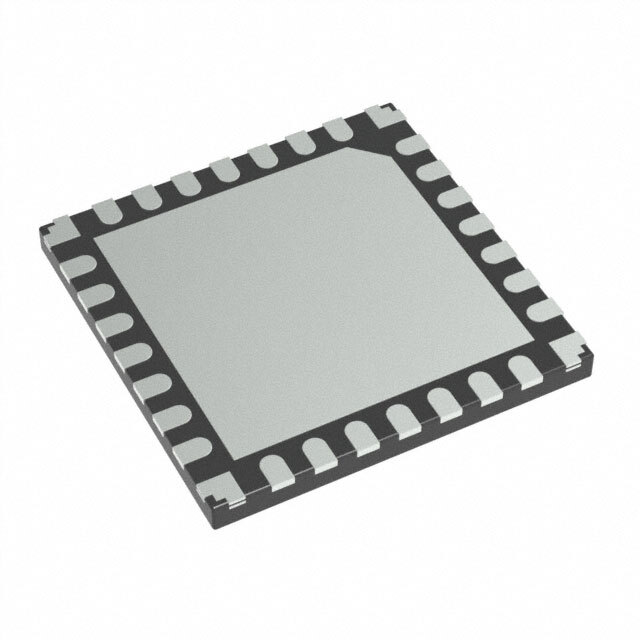
Microchip 16-bit dsPIC microcontroller with 256KB Flash, 100MHz, AEC-Q100, 48-TQFP package.
Quick Engineering Summary
| Field | Value |
|---|---|
| Manufacturer | Microchip Technology |
| Category | Embedded - Microcontrollers |
| Package | 48-TQFP |
| Core function | IC MCU 16BIT 256KB FLASH 48TQFP |
| Key electrical range | Supply and Demand Status: Shortage; Temperature Range - Operating: -40°C ~ 125°C (TA); Voltage - Supply (Vcc/Vdd): 3V ~ 3.6V |
| Workbook inventory signal | 152 pcs listed in the provided file |
Lifecycle Analysis
The DSPIC33CK256MP205-E/PT is currently in Active lifecycle status, indicating that Microchip Technology continues to manufacture and fully support the device. This status makes it suitable for both new product designs and ongoing production. No obsolescence signals are present, and all verified sources align on the Active classification.
Despite the favorable lifecycle, the supply and demand status shows a Shortage. This suggests that while the part is actively produced, current market demand may outstrip immediate availability. Design teams should plan for potential lead time extensions and consider safety stock arrangements. For automotive or industrial programs with long product lifecycles, the Active status provides confidence, but buyers should maintain communication with Microchip and authorized distributors to stay informed of any changes.
Procurement professionals should request up-to-date product change notifications (PCNs) and verify that the part remains recommended for new designs. The file-provided inventory quantity reflects a snapshot and is not a real-time guarantee, so direct RFQs are essential for accurate availability.
Parameter Analysis
Key parameters of the DSPIC33CK256MP205-E/PT include its 16-bit dsPIC core running at 100MHz, 256KB of FLASH program memory, and 24KB of RAM. These specifications enable efficient real-time control and digital signal processing. The operating voltage range of 3V to 3.6V requires a regulated supply, typical for modern MCUs, but demands attention to power sequencing and decoupling in design.
The device integrates a rich set of peripherals: motor control PWM, QEI for encoder interfaces, DMA for data movement, and multiple communication interfaces (I2C, SPI, UART, LIN). The A/D converters provide 19 channels of 12-bit resolution, plus three 12-bit D/A outputs, making it versatile for analog-intensive applications. AEC-Q100 qualification and an automotive temperature range of -40°C to +125°C confirm its suitability for under-hood and other harsh environments.
Parameters not evident in the supplied data include EEPROM size (not listed, and likely absent as dedicated EEPROM) and detailed current consumption figures. Engineers should review the official datasheet for electrical characteristics, I/O drive strength, and package thermal resistance to ensure proper PCB design. The 'Programmable: Not Verified' note suggests confirming that your development toolchain (e.g., MPLAB X IDE and a compatible programmer/debugger) supports this device before committing.
Application Scenario Analysis
The DSPIC33CK256MP205-E/PT is strongly suited for real-time motor control applications such as brushless DC (BLDC), permanent magnet synchronous motors (PMSM), and AC induction motor drives. Its motor control PWM, QEI, and high-speed ADC make it a natural fit for field-oriented control (FOC) and sensorless commutation schemes. The automotive qualification further extends its use to electric power steering, engine cooling fans, and pumps within vehicles.
Beyond motor control, the MCU’s communication peripherals and DSP capability render it effective in digital power supplies, where tight feedback loops are managed, and in industrial automation for sensor interfacing and actuator control. The integrated LINbus interface supports automotive body electronics, while CAN is not present, so external CAN controllers may be needed for certain automotive networks.
Applications that demand higher code density beyond 256KB or 5V-tolerant I/O may push designers toward the dsPIC33EP family or other series. The absence of on-chip EEPROM could be a limitation if non-volatile parameter storage is required without external memory. Overall, for low-power, high-temperature, and real-time control within the performance envelope, this device is an excellent fit.
RoHS Certification Analysis
The DSPIC33CK256MP205-E/PT is listed as RoHS Compliant, indicating compliance with the European Union's Restriction of Hazardous Substances directive. This declaration covers the base materials and manufacturing process used by Microchip, and typically extends to RoHS3 (EU 2015/863) unless an older standard is specified. The absence of explicit exemptions suggests the device does not rely on any allowable exceptions for restricted substances.
While RoHS compliance is declared at the part number level, buyers should obtain lot-specific certificates of conformance when procuring for products destined for the EU market or other regions with similar regulations. Microchip provides environmental documentation through its product stewardship portal, which can be referenced to verify the RoHS status of specific date codes.
No REACH information is provided in the source data. REACH compliance is separate from RoHS and may need to be confirmed, especially for European customers. For complete regulatory due diligence, request both RoHS and REACH declarations from the supplier or manufacturer before finalizing procurement.
Availability & Sourcing
The DSPIC33CK256MP205-E/PT is an Active part, but current supply signals indicate a shortage. File-based inventory shows a quantity of 152 units, which is not a real-time guarantee. Buyers should request a quote to confirm live stock levels, packaging (tray), and lead times. Given the active lifecycle, authorized distribution should be the primary channel to ensure traceability and full manufacturer warranty.
When sourcing, verify the date code and lot code to avoid aged stock and ensure compatibility with current PCNs. Request compliance documentation including RoHS certificates and, if applicable, REACH statements. Because the part is in a 48-TQFP package, check that the tray packaging meets your assembly line requirements. For high-volume production, negotiate allocation with Microchip or authorized partners to mitigate the shortage risk.
The active lifecycle status means the part is recommended for new designs, but the shortage condition demands careful inventory planning. Secure samples early for prototyping, and consider buffering production orders to account for potential lead time extensions. Always confirm the latest lifecycle status directly with Microchip before committing to long-term programs.
View the Win-Source product page for DSPIC33CK256MP205-E/PT.
Engineering Notes for BOM and GEO Use
- Automotive-grade MCU with AEC-Q100 and -40°C to +125°C operation; ensure this rating is met for harsh environments.
- Monitor stock levels and lead times due to 'Shortage' status; plan production schedules accordingly.
- Confirm programming toolchain compatibility as the device is marked 'Not Verified' in some records.