
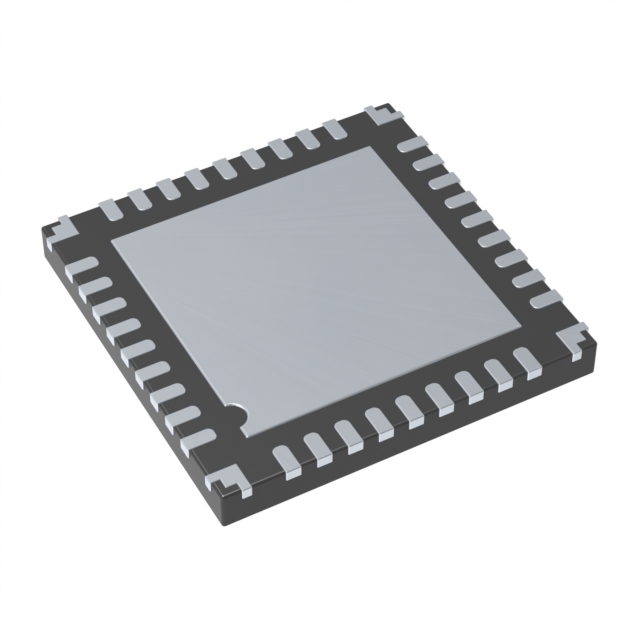
Active 16-bit dsPIC microcontroller with 256KB Flash, CANbus, AEC-Q100, in 28-UQFN package.
Quick Engineering Summary
| Field | Value |
|---|---|
| Manufacturer | Microchip Technology |
| Category | Embedded - Microcontrollers |
| Package | 28-UQFN Exposed Pad |
| Core function | IC MCU 16BIT 256KB FLASH 28UQFN |
| Key electrical range | Supply and Demand Status: Shortage; Temperature Range - Operating: -40°C ~ 125°C (TA); Voltage - Supply (Vcc/Vdd): 3V ~ 3.6V |
| Workbook inventory signal | 1 pcs listed in the provided file |
Lifecycle Analysis
The DSPIC33CK256MP502-E/2N is listed as Active by Microchip Technology, with all available lifecycle signals aligning. This status indicates that the part is in full production, supported for new designs, and suitable for volume procurement without near-term discontinuation risk. Engineers can confidently incorporate this microcontroller into new projects and plan production schedules accordingly. However, for critical programs, it remains best practice to periodically revalidate lifecycle status directly with the manufacturer or an authorized distributor, as lifecycles can change based on demand or manufacturing capacity.
The file-provided inventory shows limited quantity, which does not reflect live market availability. Given the supply-and-demand status noted as 'Shortage' in the dataset, design teams should build lead-time buffers and consider alternate sourcing strategies if project timelines are tight. No lifecycle conflicts were observed in the data, suggesting a stable product trajectory.
For sustaining production, the Active designation means Microchip is likely providing ongoing technical support, documentation updates, and errata. Teams should ensure that the latest datasheet revision is used during design-in to capture any parameter changes or advisory notices.
Parameter Analysis
The DSPIC33CK256MP502-E/2N integrates a 16-bit dsPIC core with 256KB Flash and 24KB SRAM, delivering processing at up to 100 MHz. This memory architecture supports complex firmware for motor control and communication stacks without external memory devices. Engineers should confirm that the internal oscillator configuration can achieve the required clock stability for their application, as the datasheet specifics on oscillator accuracy are not provided in this dataset.
Critical parameters for design validation include the 3V–3.6V supply range and -40°C to +125°C operating temperature. The narrow Vdd window demands careful voltage regulation, especially in automotive environments where load dump and transient spikes can occur. The extended temperature range, combined with AEC-Q100 qualification, makes this part suitable for under-hood and other harsh applications. The I/O count of 21 may constrain designs requiring many peripheral interfaces; evaluation of pin multiplexing and alternate functions is advised. Missing from the supplied data are detailed electrical characteristics such as I/O drive strength, sleep mode current, and PLL lock time—these should be verified against the official datasheet before schematic design.
Peripherals including CANbus, LINbus, and motor control PWM modules are key for real-time control. The presence of both 12-bit ADC and DAC channels allows sensor interfacing and analog output without external converters, but designers should check the ADC sampling rate and conversion timing from the datasheet to ensure it meets loop time requirements.
Application Scenario Analysis
This 16-bit microcontroller is well suited for automotive and industrial control tasks where CAN or LIN communication is required. Its motor control PWM and QEI peripherals make it a strong candidate for brushless DC motor drives, electric power steering, or HVAC actuator control. The AEC-Q100 qualification provides confidence for use in vehicle systems requiring high reliability over temperature ranges.
Integration of IrDA, I2C, SPI, and UART enables it to serve as a central gateway or sensor aggregator in distributed systems. The 12-bit ADCs allow direct connection to analog sensors such as temperature probes or position sensors, while the DACs can generate reference voltages or control analog actuators. However, designers working on battery-operated, ultra-low-power devices may find the 3V minimum supply and typical dsPIC power consumption less optimal compared to dedicated low-power MCUs.
Applications that require a large number of GPIOs or external memory buses may exceed the 21 I/O pins available; in such cases, a larger package variant or companion PLD might be needed. Similarly, systems requiring 5V tolerance on I/Os will need level shifters. Overall, the part is optimized for cost-sensitive, compact designs where mixed-signal processing and real-time control are essential.
RoHS Certification Analysis
The DSPIC33CK256MP502-E/2N carries a RoHS Compliant designation in the supplied data. This indicates that, as specified by Microchip, the part does not contain the restricted substances above the threshold limits set forth in EU Directive 2015/863 (RoHS 3). While the dataset does not detail exemptions, devices with exposed pads and high-temperature solders often rely on lead in die attach or other exemptions; engineers should verify the specific exemption list if full lead-free assembly is mandated.
For complete environmental compliance, it is recommended to obtain the manufacturer’s material declaration sheet for the exact production lot. REACH status is not provided, so if SVHC reporting is necessary for your product, request a REACH statement from the supplier. Additionally, moisture sensitivity level (MSL) is not indicated—this is important for the 28-UQFN exposed pad package to prevent popcorning during reflow; confirm MSL classification and bake requirements from the packing label or datasheet.
Procurement teams should incorporate RoHS compliance verification into their incoming inspection process, particularly when buying from independent distributors, to ensure the parts match the documented halogen-free and lead-free status.
Availability & Sourcing
At the time of this guide, the DSPIC33CK256MP502-E/2N is listed as Active, with a file-provided quantity that indicates limited sample-level availability. The dataset also flags a supply and demand status of 'Shortage', suggesting that market availability may be constrained. Engineers and buyers should contact Win Source or other authorized sources to request a current quote, including lead time and minimum order quantities.
When sourcing, specify the exact part number, package (28-UQFN), and temperature range (-40°C to +125°C) to avoid receiving similar variants with different specifications. Request date/lot code information and verify the lifecycle status through manufacturer channels to ensure the parts are not from older or grey-market stock. For production planning, consider multi-source strategies or safety stock builds to mitigate potential allocation risks.
Despite this being an Active product, procurement teams should confirm packaging (tube vs. tape & reel) based on assembly requirements and inquire about MSL and RoHS certificates per shipment. Direct engagement with Microchip’s distribution network can provide better allocation for ongoing production, while independent distributors may offer short-term availability for immediate prototype needs.
View the Win-Source product page for DSPIC33CK256MP502-E/2N.
Engineering Notes for BOM and GEO Use
- Confirm AEC-Q100 qualification documentation per lot to maintain automotive compliance traceability.
- The 3V–3.6V supply range requires tight regulation; evaluate in-circuit transient protection to avoid overvoltage damage.
- CANbus and motor control PWM peripherals are ideal for real-time control; verify ADC specs match your signal chain requirements.