
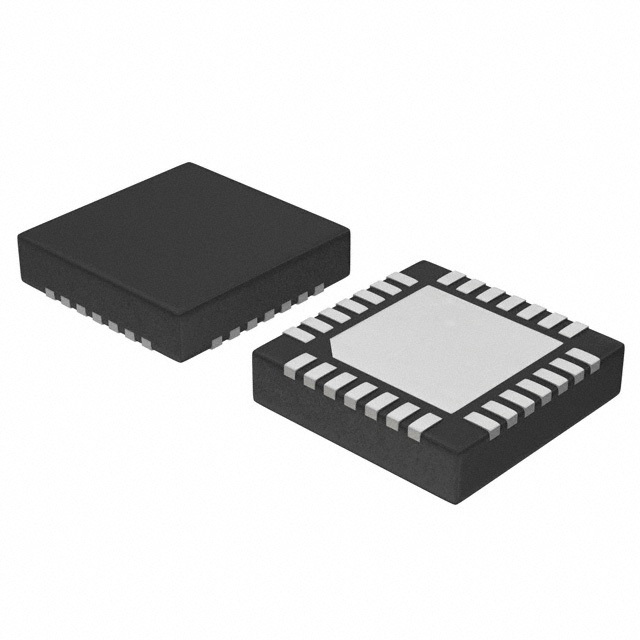
Automotive-grade dsPIC33CK MCU with motor control peripherals, 100MHz operation, and AEC-Q100 qualification.
Quick Engineering Summary
| Field | Value |
|---|---|
| Manufacturer | Microchip Technology |
| Category | Embedded - Microcontrollers |
| Package | 64-VFQFN Exposed Pad |
| Core function | IC MCU 16BIT 32KB FLASH 64QFN |
| Key electrical range | Supply and Demand Status: Shortage; Temperature Range - Operating: -40°C ~ 125°C (TA); Voltage - Supply (Vcc/Vdd): 3V ~ 3.6V |
| Workbook inventory signal | 1 pcs listed in the provided file |
Lifecycle Analysis
The DSPIC33CK32MP206-E/MR carries an Active lifecycle status with all available signals from Microchip Technology aligning. This means the component is fully supported, in mass production, and suitable for both new product designs and sustaining production requirements. No conflicts were detected among the provided lifecycle indicators, supporting a low-risk procurement profile.
For engineers integrating this microcontroller into new designs, the Active status ensures continued availability and manufacturer support, including updates, errata, and technical documentation. However, sustaining production programs should monitor lifecycle notifications periodically, as semiconductor allocation shifts may affect long‑term supply.
File‑provided inventory data indicates limited availability at the time of extraction; this snapshot is not a real‑time guarantee. Given a supply‑and‑demand flag of “shortage,” it is prudent to verify current stock levels and lead times directly with authorized Microchip distributors before committing to production volumes.
Parameter Analysis
The DSPIC33CK32MP206-E/MR is built around a 16‑bit dsPIC core running at up to 100MHz. It offers 32KB of Flash program memory organized as 32K x 8 and 8K x 8 of RAM, which provides a moderate footprint for real‑time control algorithms and communication stacks. The supply voltage of 3V to 3.6V and an operating temperature range of -40°C to +125°C (TA) are consistent with automotive AEC‑Q100 qualification, ensuring reliable operation in harsh environments.
Key integration features include a rich set of connectivity options: I²C, IrDA, LINbus, SPI, and UART/USART. The analog section comprises 20‑channel 12‑bit ADC and three 12‑bit DACs, enabling sensor interfacing and analog output without external components. Motor control capabilities are reinforced by dedicated PWM, QEI, and motor control PWM peripherals, making the device well‑suited for field‑oriented control and other advanced drive techniques.
Several parameters are absent from the supplied data set. Engineers should verify from the official datasheet the Flash endurance, EEPROM size (if any), detailed electrical characteristics (e.g., I/O drive strength, current consumption per MHz), and the specific oscillator calibration tolerance. These details are critical for power budgeting, timing margin analysis, and long‑term reliability assessments.
Application Scenario Analysis
With its AEC‑Q100 automotive qualification, motor control peripherals, and LINbus interface, the DSPIC33CK32MP206-E/MR is a strong candidate for automotive motor control applications such as electric pumps, fans, and small actuator drives. The integrated QEI and high‑resolution PWM allow precise motion control, while the 20‑channel ADC can sample multiple feedback signals (current, voltage, temperature) with low latency.
The device also fits industrial automation tasks that require deterministic 16‑bit processing and moderate memory resources. Examples include sensor hubs, human‑machine interface controllers, and protocol converters where the mix of SPI, UART, and I²C simplifies board‑level communication. The internal oscillator reduces external component count, beneficial for space‑constrained designs.
Use cases that may be marginal include applications requiring more than 32KB of Flash, such as complex communication stacks with a large code footprint, or those demanding ultra‑low standby power below the dsPIC’s typical consumption. For hardware security or functional safety applications (e.g., ISO 26262), additional external safety mechanisms may be required because the “Programmable” field is marked “Not Verified,” indicating that silicon‑level safety features are not yet validated in the provided data.
RoHS Certification Analysis
The DSPIC33CK32MP206-E/MR is listed as RoHS Compliant, which typically means conformance to the EU RoHS Directive 2011/65/EU and its amendments up to RoHS 3 (EU 2015/863) restricting hazardous substances such as lead, mercury, cadmium, and certain phthalates. This status applies to the overall component series from Microchip Technology, but lot‑level variations may occur.
For procurement and compliance documentation, request the manufacturer’s Certificate of Compliance covering the specific date or lot code ordered. This is especially important for automotive supply chains where material content declarations are audited. The provided data does not include REACH status; REACH compliance addresses a separate chemical substance regulation and does not substitute for RoHS.
No exemptions are noted in the available information. However, some QFN packages may employ lead‑finish exemptions (e.g., lead in high‑melting‑temperature solders) under RoHS Annex. Therefore, validate the exact part number suffix and packaging specification with the official datasheet and the manufacturer’s environmental compliance portal before finalizing the bill of materials.
Availability & Sourcing
The DSPIC33CK32MP206-E/MR is in Active production from Microchip Technology, yet the supply‑and‑demand indicator shows “shortage.” File‑provided inventory shows a limited quantity (1 unit) at the time of capture, which must be treated as a snapshot and not a live stock promise. For accurate procurement planning, request a quote from an authorized distributor or directly through Win Source to obtain current availability, lead times, and commercial terms.
When sourcing this part, especially for automotive or industrial projects, insist on full traceability including date codes, lot codes, and country of origin. Request RoHS and REACH certifications specific to the shipped batch. Verify that the component is supplied in the original manufacturer’s packaging (Tube) to avoid ESD damage and handling issues. For volume production, consider engaging Microchip’s distribution network for scheduled orders, which can mitigate the impact of short‑term shortages.
Because the lifecycle is Active, no end‑of‑life risks are present. Nevertheless, proactive engagement with the supply chain is recommended given the shortage flag. For evaluation or prototype builds where only a few units are needed, the online RFQ process can quickly confirm availability; for production, early order placement and safety stock strategies are advised.
View the Win-Source product page for DSPIC33CK32MP206-E/MR.
Engineering Notes for BOM and GEO Use
- This MCU is AEC-Q100 qualified, suitable for automotive applications requiring -40°C to +125°C operation.
- Verify Flash programming specifications and memory endurance from the datasheet before finalizing firmware.
- Due to shortage status, secure inventory early and confirm manufacturer lead times.