
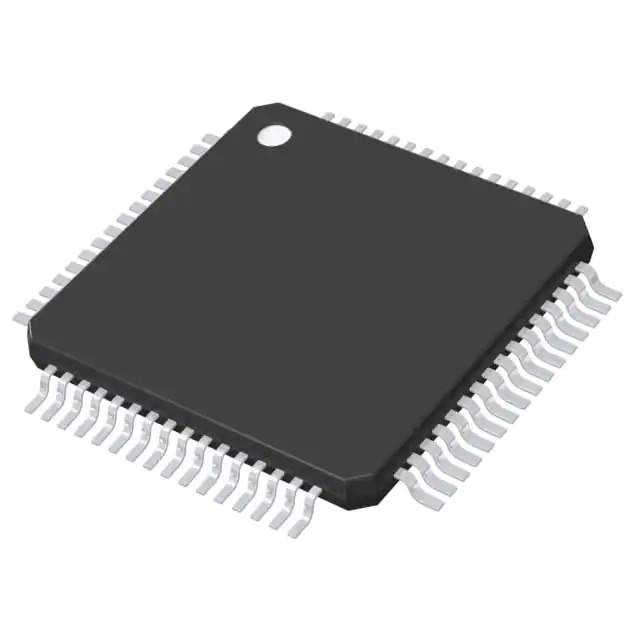
Automotive-grade 16-bit dsPIC MCU with AEC-Q100, 128KB Flash, and CAN/LIN connectivity in 64-TQFP package.
Quick Engineering Summary
| Field | Value |
|---|---|
| Manufacturer | Microchip Technology |
| Category | Embedded - Microcontrollers |
| Package | Tray |
| Core function | IC MCU 16BIT 128KB FLASH 64TQFP |
| Key electrical range | Temperature Range - Operating: -40°C ~ 125°C (TA); Voltage - Supply (Vcc/Vdd): 4.5V ~ 5.5V |
| Workbook inventory signal | 11800 pcs listed in the provided file |
Lifecycle Analysis
The lifecycle status of the Microchip DSPIC33EV128GM106-E/PT is currently listed as Unknown based on the supplied data. No manufacturer lifecycle signals, such as Active, NRND, EOL, or Discontinued, were provided. This lack of clarity means that engineers and buyers should exercise caution when considering this part for new designs. While the part may still be available in distribution channels, without a confirmed active status, there is a risk that production could be limited or that the device might face future discontinuation.
We strongly recommend contacting Microchip Technology directly or consulting their official product page to obtain a current lifecycle classification. The file-provided inventory figure of 11,800 units suggests some immediate availability, but this is not guaranteed real-time stock and should not be taken as a sign of ongoing production. For high-reliability or long-lifecycle programs, securing a formal lifecycle commitment from the manufacturer is essential before finalizing the bill of materials. Until verified, the part’s suitability for new designs remains uncertain, and conservative procurement planning is advised.
Parameter Analysis
The DSPIC33EV128GM106-E/PT packs several parameters critical for embedded control and automotive applications. Key among these is the 128KB Flash program memory (43K x 24) coupled with 8KB RAM, providing sufficient resources for complex control algorithms and communication stacks. The 16-bit dsPIC core running at 60 MIPs delivers deterministic real-time performance, essential for motor control, digital power, and sensor processing. The device’s wide operating temperature range of -40°C to 125°C and AEC-Q100 qualification confirm its suitability for under-hood and harsh industrial environments. The 4.5V to 5.5V supply range aligns with typical automotive and industrial power rails, simplifying power supply design.
Connectivity is comprehensive, including CANbus, I2C, IrDA, LINbus, SPI, and UART/USART interfaces, enabling integration into vehicle networks and multi-node systems. The motor control PWM, DMA, and brown-out detection peripherals are directly relevant for brushless DC motor drives and other actuation tasks. The analog side features a 10/12-bit A/D converter with 36 channels, offering ample analog input capacity for sensing applications. However, the datasheet lacks detail on specific timing specifications, EEPROM size (if any), and supply current consumption, which are essential for power budgeting and precise timing closure. Designers should verify these parameters against the official Microchip datasheet for accurate design analysis.
Application Scenario Analysis
This microcontroller’s feature set makes it a strong candidate for automotive and industrial applications requiring robust communication and real-time control. Its AEC-Q100 qualification and Functional Safety (FuSa) series membership make it particularly suited for automotive subsystems such as engine management, transmission control, electric power steering, and body electronics. The combination of CAN and LIN interfaces enables it to function as a gateway or node controller in vehicle networks, while the motor control PWM and high-speed ADC support direct motor drive without external controllers. Its extended temperature range and 5V operation are well-aligned with the automotive electrical environment.
In industrial automation, the DSPIC33EV128GM106-E/PT can serve in motor drives, power inverters, and PLCs where deterministic control and fieldbus connectivity are required. The integrated IrDA and UART/USART interfaces also allow for wireless or point-to-point data transfer in sensor hubs. Weak-fit scenarios include ultra-low-power or battery-operated devices, as the device operates at a nominal 5V and likely draws higher current than dedicated low-power MCU families; no explicit low-power modes are mentioned, so battery life may be suboptimal. Additionally, while the 64-TQFP is compact, space-constrained wearable designs may find the package larger than desired. For such use cases, engineers should compare with Microchip’s nanoWatt XLP series or similar low-voltage offerings.
RoHS Certification Analysis
According to the supplied data, the Microchip DSPIC33EV128GM106-E/PT is designated as RoHS Compliant and REACH Unaffected. This indicates that the part meets the substance restrictions under the EU RoHS Directive, and it does not contain Substances of Very High Concern (SVHC) in concentrations that would trigger REACH reporting obligations. The MSL Level 3 rating (168 hours) suggests that the device is moderately moisture sensitive and requires proper handling to prevent damage during reflow soldering; users should follow JEDEC J-STD-020 guidelines for baking if the floor life is exceeded.
While the stated RoHS compliance typically covers the entire component family, it is important to recognize that RoHS certification often applies at the family or material level based on manufacturer declarations. For high-reliability or export-sensitive projects, buyers should request a specific certificate of compliance for the lot being purchased. No exemptions are noted, but if any lead or other restricted substances are present (for example, in high-temperature solder alloys under exemption 7a), that information would need to be confirmed from the manufacturer’s detailed declaration. The REACH unaffected status adds confidence for European market distribution, but it does not replace a full RoHS conformity assessment.
Availability & Sourcing
The file-provided inventory indicates 11,800 units of the DSPIC33EV128GM106-E/PT are available; however, this quantity is not guaranteed in real-time and should be confirmed through a formal RFQ. Given that the lifecycle status is Unknown, sourcing efforts must be paired with a verification of the part’s production status from Microchip Technology. Buyers should request current lead times, date codes, and lot traceability to ensure that the parts are not from mixed or suspect batches. Packaging is tray-based, with a standard package quantity of 160 units, which is typical for prototyping and small-to-medium volume production.
The part carries a 31% fake threat in the open market, highlighting the importance of purchasing only from authorized distributors or directly from Microchip. Requesting a certificate of conformance and full traceability documentation is critical to mitigate counterfeit risk. For designs that are already in production, securing inventory for the product’s lifecycle becomes paramount, especially if the part might transition to EOL. Engineers evaluating this MCU for new designs should treat the Unknown lifecycle as a red flag and explore alternative automotive-grade dsPIC33EV series devices that have a confirmed Active status, in consultation with Microchip’s sales or technical support.
View the Win-Source product page for DSPIC33EV128GM106-E/PT.
Engineering Notes for BOM and GEO Use
- Verify latest lifecycle status with Microchip before committing to new production designs.
- MSL Level 3 requires proper handling; ensure controlled storage and baking per JEDEC guidelines.
- Leverage AEC-Q100 and FuSa series attributes for automotive functional safety applications requiring CAN communication.