
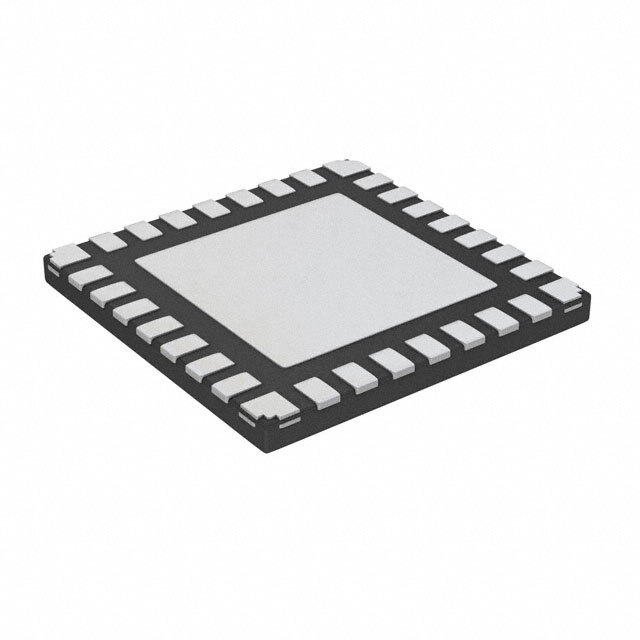
16-bit dsPIC microcontroller with 16KB Flash, 40 MIPs, automotive AEC-Q100 qualified, in 28-UQFN exposed pad package.
Quick Engineering Summary
| Field | Value |
|---|---|
| Manufacturer | Microchip Technology |
| Category | Embedded - Microcontrollers |
| Package | Tube |
| Core function | IC MCU 16BIT 16KB FLASH 28UQFN |
| Key electrical range | Supply Voltage - Operating: 3V ~ 3.6V; Temperature Range - Operating: -40°C ~ 125°C (TA) |
| Workbook inventory signal | 1 pcs listed in the provided file |
Lifecycle Analysis
The DSPIC33FJ16GS502-E/MX is listed as Active by Microchip Technology, indicating that the microcontroller is in full production and supported for new designs. All supplied lifecycle signals align without conflict, reinforcing its availability for ongoing procurement. Engineers can confidently design this dsPIC33FJ16GS502 part into new projects, but should periodically reconfirm status with authorized distributors or manufacturer documentation, especially for high-volume or long-lifecycle programs.
Despite the Active status, the open market fake threat level of 46 percent for this part number highlights a significant counterfeit risk. This risk is not a lifecycle concern but a sourcing integrity issue. When qualifying the DSPIC33FJ16GS502-E/MX, ensure traceability, lot-code verification, and test reports are part of the incoming inspection process. The file-provided inventory quantity of 1 unit serves as a snapshot and does not guarantee real-time stock; always request a current quote.
Parameter Analysis
The DSPIC33FJ16GS502-E/MX integrates a 16-bit dsPIC core operating at 40 MIPs, supported by 16KB of FLASH program memory and 2KB of RAM. These resources are suitable for moderate control algorithms and sensor processing within the constraints of its 28-UQFN package. The operating voltage range of 3.0V to 3.6V and temperature range of -40°C to +125°C, combined with automotive AEC-Q100 qualification, make this Microchip microcontroller robust for harsh environments.
Key I/O and connectivity features include 21 general-purpose I/O pins, I2C, IrDA, LINbus, SPI, and UART/USART interfaces, enabling flexible communication in distributed systems. On-chip data converters—a 16-channel 10-bit ADC and four 10-bit DACs—support analog signal chain integration. However, designers must verify several parameters from the official datasheet: the memory map for EEPROM (listed as unavailable in the summary), precise electrical characteristics for I/O drive strength, and package thermal resistance values, as the 28-UQFN exposed pad requires careful thermal management. Also confirm the oscillator type details and the PLL configuration to achieve the rated 40 MIPs.
Application Scenario Analysis
This dsPIC33FJ16GS502 microcontroller fits well into automotive body electronics, such as LIN bus-based actuator controls, sensor modules, and small motor drives, thanks to its LINbus connectivity, PWM peripherals, and wide temperature grade. The integrated ADCs and DACs also make it suitable for closed-loop control in industrial applications like power supplies or lighting controllers where space and cost are constraints.
Scenarios where the DSPIC33FJ16GS502-E/MX may be less optimal include applications requiring larger memory footprints or 5V I/O tolerance. Its 16KB Flash and 2KB RAM limit complex firmware stacks, and the 3.3V operation may require level translation when interfacing with legacy 5V logic. Additionally, computation-heavy DSP algorithms that demand a floating-point unit or higher MHz performance would be better served by higher-end dsPIC33E or 32-bit MCU families. Engineers should evaluate the real-time control loop requirements against the 40 MIPs performance to ensure margin.
RoHS Certification Analysis
Microchip Technology declares the DSPIC33FJ16GS502-E/MX as RoHS Compliant, with a REACH status of Unaffected. This compliance generally aligns with EU RoHS Directive 2011/65/EU and its amendments, though the exact standard revision is not specified in the provided data. The MSL rating of Level 3 indicates a floor life of 168 hours after opening the moisture barrier bag, necessitating proper baking if exceeded.
For high-reliability procurement, lot-level RoHS certificates should be requested from the distributor, as family-level declarations may not cover all date codes. No exemptions are explicitly noted for this Microchip embedded microcontroller, but users of lead-free soldering processes should verify the package termination finish (e.g., matte tin) from the manufacturer's product change notification. REACH unaffected confirms no SVHCs above threshold, but again, a full material declaration may be prudent for medical or aerospace use.
Availability & Sourcing
With an Active lifecycle status, the DSPIC33FJ16GS502-E/MX should be available through Microchip's authorized distribution network. However, the file-based stock quantity of 1 unit underscores the need to request current availability. Buyers should initiate an RFQ specifying full part number, packaging preference (Tube), and required date code to secure genuine components.
Given the 46 percent fake threat in the open market, sourcing from unauthorized channels poses significant risk. Insist on manufacturer traceability documentation, DC/LTC verification, and consider third-party testing for suspect lots. For volume requirements, explore scheduled orders or buffer stock agreements with authorized distributors to mitigate lead time fluctuations. For NRND or last-time-buy scenarios—though not applicable here—alternative sourcing strategies would apply, but for this active MCU, focus on compliance documentation and authorized procurement.
View the Win-Source product page for DSPIC33FJ16GS502-E/MX.
Engineering Notes for BOM and GEO Use
- The narrow 3.0–3.6V supply range precludes direct 5V interfacing; use level translators if needed and confirm I/O voltage tolerance from datasheet.
- With 16KB Flash and 2KB RAM, optimize code size; consider the DSPIC33FJ16GS502 variant without '-E' if extended temperature is not required.
- The 40 MIPs dsPIC core handles moderate DSP tasks, but verify timing for fast control loops against instruction execution times and peripheral latency.