
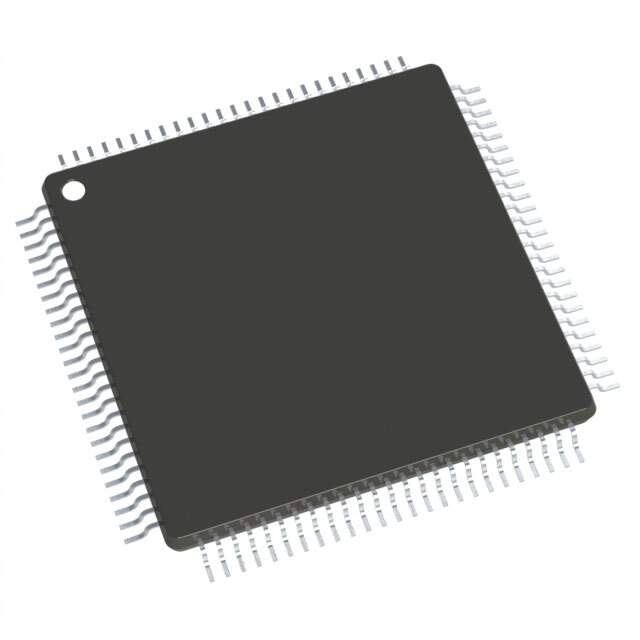
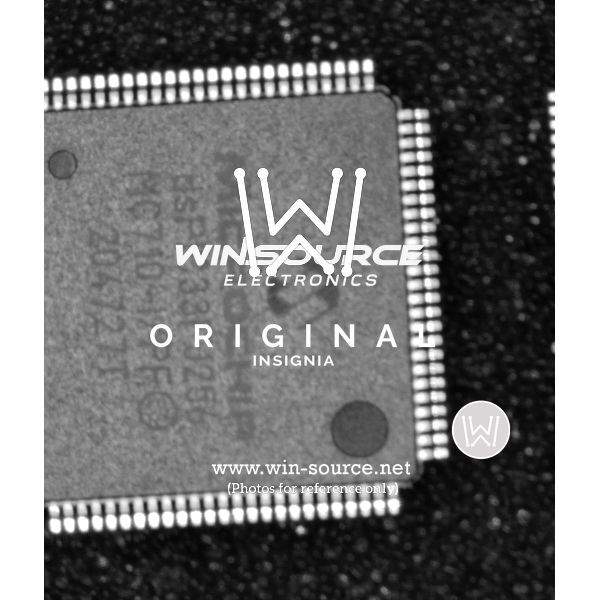
16-bit dsPIC Microcontroller with 256KB Flash, 100-TQFP Package
Quick Engineering Summary
| Field | Value |
|---|---|
| Manufacturer | Microchip Technology |
| Category | Embedded - Microcontrollers |
| Package | 100-TQFP (14x14) |
| Core function | IC MCU 16BIT 256KB FLASH 100TQFP |
| Key electrical range | Operating Temperature Range: -40°C ~ 85°C (TA); Supply and Demand Status: Balance; Supply Voltage: 3 V ~ 3.6 V |
| Workbook inventory signal | 6450 pcs listed in the provided file |
Lifecycle Analysis
The DSPIC33FJ256GP710-I/PF from Microchip Technology is currently flagged as Active according to the manufacturer's lifecycle status signals. This classification generally means the part is in full production and recommended for new designs, with ongoing availability from authorized channels. However, a contradictory Estimated EOL Date of 2019 appears in the provided data, suggesting that at some point the part may have been considered for discontinuation or that the date is a legacy entry. Engineers should not rely solely on the Active label without direct confirmation from Microchip, especially for new product introductions.
For sustaining production, the part remains a viable choice given the Active status and a file-provided inventory quantity of 6450 units. Nonetheless, this inventory figure is a point-in-time snapshot and does not reflect real-time stock levels or distributor commitments. Before committing to a design win, procurement teams should validate the current life expectancy with Microchip and explore any published product change notifications (PCNs) that might affect long-term supply.
Conservative practice for this DSPIC33FJ256GP710-I/PF is to treat the lifecycle as stable but under monitoring. If the part is destined for a design with a lifespan beyond five years, a formal last-time buy or end-of-life plan should be requested from Microchip to avoid supply chain disruptions. No pin-to-pin replacement data is available, so any migration would require a redesign.
Parameter Analysis
The DSPIC33FJ256GP710-I/PF is a 16-bit dsPIC digital signal controller, blending microcontroller ease with DSP performance. Key parameters include a 40 MIPs core speed, 256KB of Flash program memory, and 30KB of RAM, making it suitable for computationally intensive tasks like digital filtering and motor control algorithms. The operating voltage range of 3.0V to 3.6V is narrow, so power supply design must ensure tight regulation to avoid brown-out conditions, especially given the on-chip Brown-out Detect/Reset peripheral.
Peripheral integration is a strong point: connectivity options span CAN, I2C, IrDA, LIN, SPI, and UART/USART, covering most industrial and automotive communication needs. The 32-channel A/D converter supports 10-bit and 12-bit modes, sufficient for precision sensing in control loops. Additional peripherals like PWM outputs, DMA, I2S audio interface, and AC’97 codec support enable applications ranging from power conversion to audio processing. The 85 I/O lines in a 100-TQFP package offer generous interfacing, but the package size (14x14 mm) requires careful PCB layout for signal integrity.
Missing from the provided data are crucial dynamic characteristics such as power consumption per MIPs, specific timing parameters, and full electrical specifications for I/O drive strengths. Engineers must consult the official Microchip datasheet for tables on current draw, AC/DC characteristics, and recommended operating conditions to ensure thermal margins and avoid latch-up issues. The internal oscillator simplifies clocking but external clock options should be verified for applications demanding high precision.
Application Scenario Analysis
The DSPIC33FJ256GP710-I/PF is tailored for real-time control applications where a fast 16-bit processor with DSP extensions is required. Strong-fit scenarios include industrial motor drives (BLDC, PMSM) using PWM modules and CAN connectivity, digital power supplies leveraging the high-speed ADC and PWM, and automotive subsystems like body control modules that need LIN or CAN buses. The combination of DMA and large Flash/RAM also suits data logging and sensor fusion nodes.
In consumer electronics, the device can serve audio processing roles via I2S and AC’97, though the 40 MIPs ceiling may be marginal for advanced codecs. Its wide connectivity suite makes it a candidate for home automation gateways bridging multiple bus protocols. However, applications demanding ultra-low power consumption or cost-sensitive designs may find the part over-specified; the dsPIC33F family is more powerful than typical 8-bit MCUs and carries a corresponding premium in both price and energy use.
Weak-fit scenarios include simple supervisory tasks or battery-powered devices with sleep budgets under a few microamps, where a low-power Cortex-M0+ or 8-bit MCU might be more efficient. The -40°C to +85°C industrial temperature range limits use in extreme environments without qualification. Before finalizing a design, verify that the specific peripheral mix and memory size match the application’s real-time constraints, and confirm long-term availability if the project lifespan extends beyond 2025.
RoHS Certification Analysis
The DSPIC33FJ256GP710-I/PF is listed as RoHS Compliant, indicating that Microchip Technology has designed this component to meet the restrictions on hazardous substances per the EU directive. The data also shows Halogen Free compliance, further supporting its use in environmentally regulated markets. No specific exemptions are noted, suggesting full compliance with the standard RoHS requirements for lead-free soldering and restricted materials.
However, the exact version of the RoHS directive (e.g., EU 2015/863 amending Annex II to Directive 2011/65/EU) is not specified in the provided attributes. Given the part's introduction date of 2007, it likely complies with earlier RoHS versions, but the compliance statement may be based on family-level declarations rather than lot-specific testing. Procurement teams should request a Certificate of Compliance (CoC) for each production batch, especially if the end product will be sold in regions with evolving regulations like China RoHS or REACH.
From a sourcing perspective, the RoHS and Halogen Free statuses reduce the risk of customs rejections and support ISO documentation. Still, engineers must validate that the actual supplied components bear the correct markings and date codes consistent with the manufacturer’s current material declarations. For high-reliability applications, additional testing for substances like brominated flame retardants may be warranted even if the manufacturer claims compliance.
Availability & Sourcing
With an Active lifecycle status, the Microchip DSPIC33FJ256GP710-I/PF should be readily available through authorized distributors and direct from the manufacturer. File-provided inventory shows 6450 units, but this figure is not a live stock commitment and must be verified when placing an order. Buyers should initiate an RFQ to lock in current pricing and delivery schedules, as the semiconductor supply chain can fluctuate unexpectedly.
For procurement, request full traceability documentation including date codes, lot codes, and country of origin (noted as China). Packaging is tray, suitable for automated assembly, but confirm the exact reel or tray configuration with the distributor to avoid line setup issues. Moisture sensitivity level (MSL) is not explicitly stated, so request this information to ensure proper storage and baking procedures—especially given the storage condition recommendation of dry cabinet with humidity protection.
Given the legacy EOL confusion, it is critical to ask Microchip for a formal lifecycle confirmation before committing to a high-volume production run. For sustaining programs, consider purchasing buffer stock after verifying RoHS and halogen-free certificates. A proactive approach ensures that the DSPIC33FJ256GP710-I/PF can be sourced with confidence; request a quote today to secure inventory and compliance documentation.
View the Win-Source product page for DSPIC33FJ256GP710-I/PF.
Engineering Notes for BOM and GEO Use
- Verify current lifecycle status directly with Microchip, as a historical EOL date estimate (2019) may conflict with the Active signal.
- 16-bit dsPIC core with 40 MIPs, 256KB Flash, extensive connectivity (CAN, I2C, SPI, UART) and peripherals is ideal for real-time control applications.
- Ensure RoHS and halogen-free compliance documentation is lot-specific before high-volume procurement, especially given the part's age.