
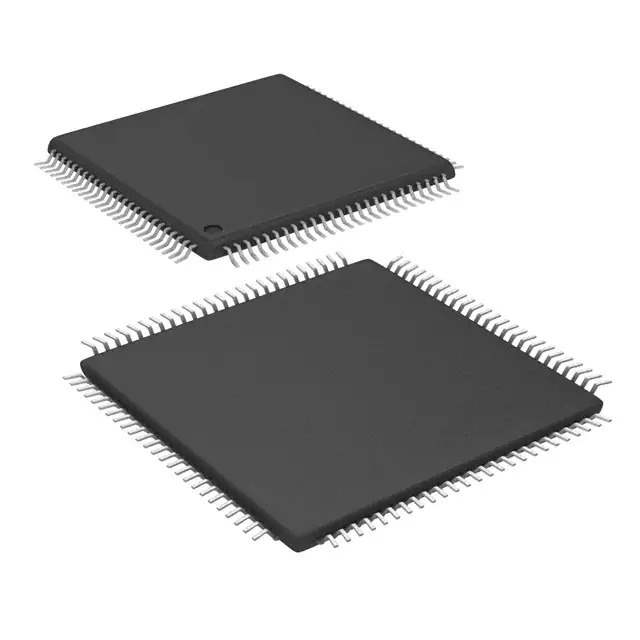
Sourcing guide for DSPIC33FJ256MC710A-I/PT: lifecycle, parameters, apps, RoHS, and availability details.
Quick Engineering Summary
| Field | Value |
|---|---|
| Manufacturer | Microchip Technology |
| Category | Embedded - Microcontrollers |
| Package | Tray |
| Core function | IC MCU 16BIT 256KB FLASH 100TQFP |
| Key electrical range | Temperature Range - Operating: -40°C ~ 85°C (TA); Voltage - Supply (Vcc/Vdd): 3V ~ 3.6V |
| Workbook inventory signal | 2500 pcs listed in the provided file |
Lifecycle Analysis
The Microchip DSPIC33FJ256MC710A-I/PT is currently listed as Active across all available lifecycle signals. This status indicates that the microcontroller remains in full production and is suitable for new designs as well as sustaining production. With no conflicts among the manufacturer's product status, lifecycle status, and Excel lifecycle parameter, engineers can confidently incorporate this dsPIC33F family member into long-life projects.
However, it is prudent to revalidate the lifecycle status directly on the Microchip product page before committing to high-volume procurement, as lifecycle changes can occur without immediate notice in third-party catalogs. The file-provided inventory shows 2500 units, which suggests reasonable channel availability, but this is not a real-time guarantee and should be confirmed with authorized sources.
Parameter Analysis
The DSPIC33FJ256MC710A-I/PT integrates a 16-bit dsPIC core with 40 MIPs peak performance, 256KB of Flash program memory, and 30KB of RAM, providing a solid platform for computationally intensive real-time control. Motor control applications directly benefit from the dedicated motor control PWM, Quadrature Encoder Interface (QEI), and DMA, which offload timing-critical tasks from the CPU. With 85 I/O pins and a rich set of serial interfaces including CANbus, I2C, SPI, UART, and LINbus, the part can manage complex sensor networks and communication stacks. The on-chip 24-channel 10/12-bit ADC enables multi-parameter analog sensing without external multiplexers in many designs.
For thermal and electrical integration, the operating temperature range of -40°C to 85°C and a tight 3.0V–3.6V supply voltage must be respected; designers should account for brown-out detection and power sequencing. Since the datasheet lists no on-chip EEPROM, and the 'Programmable' field is marked 'Not Verified', it is recommended to verify available non-volatile storage options and endurance ratings directly with Microchip’s latest documentation.
Application Scenario Analysis
The dsPIC33FJ256MC710A-I/PT is a strong candidate for industrial motor drives, servo systems, and robotics where its motor control PWM and QEI peripherals streamline vector control and position feedback. The CAN and LIN interfaces extend its suitability to automotive body electronics, HVAC compressors, and electric vehicle subsystems operating within its temperature range. Home appliances that require precise motor commutation, such as washing machines or dishwashers, can also leverage its peripheral set. The 85 I/O count supports moderately complex HMI and control panel designs.
However, this microcontroller is not a natural fit for ultra-low-power or battery-operated applications, given its supply voltage range and active current profile that is not optimized for sub-microampere sleep modes. For applications with aggressive cost constraints, engineers should compare feature set against smaller dsPIC variants to avoid over-specification. In all use cases, the lack of on-chip EEPROM may necessitate external memory or firmware workarounds for non-volatile parameter storage.
RoHS Certification Analysis
The DSPIC33FJ256MC710A-I/PT is classified as RoHS Compliant, with an associated REACH Unaffected status. This indicates that the part meets EU RoHS requirements, and no substances of very high concern are present above thresholds. However, the specific RoHS directive revision (e.g., RoHS 2, RoHS 3) is not detailed in the supplied data; procurement teams should request full material declarations and certificates of compliance for the actual production lot.
The moisture sensitivity level is MSL 3, meaning the component has a floor life of 168 hours after the sealed bag is opened, provided storage conditions remain within 30°C/60% RH. Proper baking and handling procedures must be followed to avoid popcorning during reflow. For designs targeting the European market, retaining lot-level RoHS and REACH documentation is recommended to satisfy import and audit requirements.
Availability & Sourcing
As an active part, the DSPIC33FJ256MC710A-I/PT is generally available through authorized Microchip distributors and through broader market channels. The file-provided stock quantity of 2500 units offers a baseline indication of channel inventory, but this figure is not guaranteed real-time and should be verified with a formal RFQ. The part is supplied in tray packaging with a standard package quantity of 119 pieces per tray; tape-and-reel options were not indicated in the source data, so bulk orders may need to be planned accordingly.
Of particular note, open-market analytics report a 39% fake threat rate for this device, underscoring the importance of sourcing from authorized or qualified suppliers and requesting full traceability documentation, including date and lot codes, and compliance certificates. For production readiness, buyers should request a current quote and confirm available stock, lead times, and any minimum order quantities. Given the part’s active lifecycle, securing inventory now is a low-risk proposition, but routine lifecycle re-verification is advised to guard against future NRND transitions.
View the Win-Source product page for DSPIC33FJ256MC710A-I/PT.
Engineering Notes for BOM and GEO Use
- The motor control PWM, QEI, and DMA peripherals make this dsPIC ideal for real-time industrial servo and motor drive systems.
- With a 39% reported counterfeit risk, always source from authorized distributors and require full traceability and RoHS/REACH documentation.
- Verify on-chip EEPROM availability and 'Not Verified' programmable status against the latest datasheet before committing to non-volatile storage requirements.