
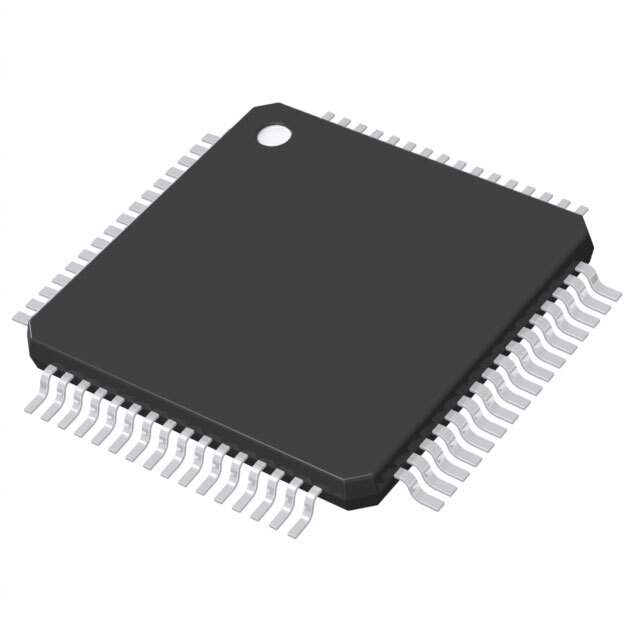
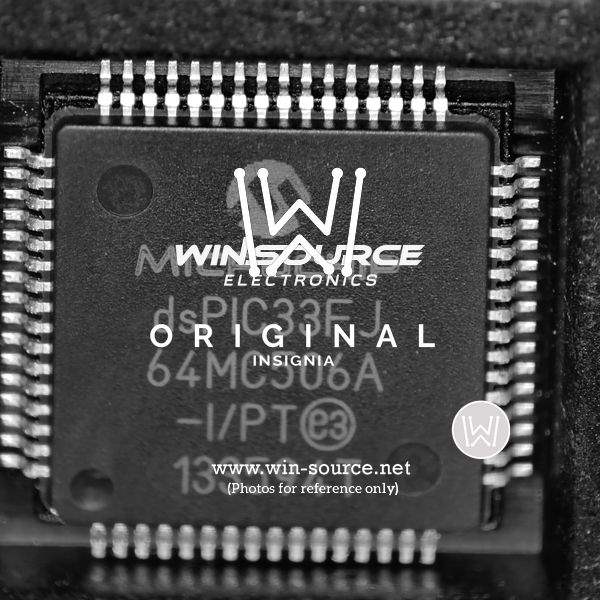
16-bit dsPIC microcontroller with 64KB flash, 40 MIPs, and extensive connectivity for motor control applications.
Quick Engineering Summary
| Field | Value |
|---|---|
| Manufacturer | Microchip Technology |
| Category | Embedded - Microcontrollers |
| Package | 64-TQFP |
| Core function | IC MCU 16BIT 64KB FLASH 64TQFP |
| Key electrical range | Supply and Demand Status: Balance; Temperature Range - Operating: -40°C ~ 85°C; Voltage - Supply (Vcc/Vdd): 3V ~ 3.6V |
| Workbook inventory signal | 500 pcs listed in the provided file |
Lifecycle Analysis
The DSPIC33FJ64MC506A-I/PT is currently listed as Active by Microchip Technology, with all available lifecycle signals in agreement. This status indicates that the device is in full production, supported by the manufacturer, and suitable for both new designs and ongoing production orders. For engineers planning new PCB designs, this Active status provides confidence that the part will remain available for the foreseeable future without immediate need for redesign or last-time buys.
However, as with any semiconductor component, it is prudent to monitor the manufacturer’s product change notifications (PCNs) and lifecycle updates. While the current risk level is low, long-term programs should establish a second-source or migration strategy early to mitigate potential supply chain disruptions. The provided inventory file indicates a quantity of 500 units, but this snapshot is not a real-time guarantee, and availability should be confirmed with authorized distributors before committing to production schedules.
Procurement teams can proceed with standard quoting and order placement, but should request up-to-date lifecycle attestations from the supplier to ensure alignment with the design’s lifetime. No lifecycle conflicts are evident, making this a straightforward sourcing exercise under normal conditions.
Parameter Analysis
The DSPIC33FJ64MC506A-I/PT integrates a 16-bit dsPIC core running at 40 MIPs, offering a strong balance of processing throughput and deterministic control for algorithm-intensive tasks. The 64KB of flash program memory and 8KB of RAM provide sufficient headroom for moderate complexity motor control or sensor processing firmware. Engineers should evaluate code size and stack usage against these limits, particularly if implementing advanced control loops or communication stacks.
Key peripherals include motor control PWM channels with complementary outputs and dead-time insertion, making it well-suited for three-phase motor drives. The presence of CANbus, I2C, SPI, and UART interfaces enables flexible system communication. The 16-channel ADC with 10-bit or 12-bit resolution supports multi-channel sensor sampling, though the exact sampling rate and impedance requirements are not provided here and must be verified against the datasheet to ensure analog front-end compatibility.
Critical parameters to confirm from the full datasheet include supply current at maximum speed and temperature, I/O drive strength, and power dissipation to support thermal analysis. The industrial temperature range (-40°C to +85°C) covers most embedded environments, but package thermal resistance (Theta-JA) and recommended footprint are essential for PCB layout. The 64-TQFP package with 0.5mm pitch requires careful soldering, and the MSL level 3 indicates a floor life of 168 hours once the dry pack is opened.
Application Scenario Analysis
This dsPIC device is purpose-built for motor control and power conversion applications. Its motor control PWM module with complementary outputs, paired with QEI inputs for encoder feedback and DMA for efficient data transfer, makes it an excellent fit for brushless DC (BLDC) motor drives, servo controls, and industrial automation equipment. The integrated CANbus and LINbus peripherals further position it for automotive and industrial networking nodes.
In sensor processing scenarios, the 16-channel, 10/12-bit ADC is advantageous for multi-axis motion sensing, environmental monitoring, or instrumentation where several analog signals need simultaneous acquisition. The internal oscillator simplifies the bill of materials for cost-sensitive designs, though external clocking may be required for tighter timing accuracy.
This MCU may be less suitable for applications demanding large program memory (above 64KB) or those requiring extensive floating-point operations, as the dsPIC core lacks a hardware floating-point unit. Its 3.0V–3.6V supply voltage limits direct battery operation in portable devices without a regulator. Additionally, for ultra-low-power products, the current consumption figures (not provided here) must be carefully reviewed against energy budgets, as the device is likely optimized for performance rather than sleep-mode efficiency.
RoHS Certification Analysis
The DSPIC33FJ64MC506A-I/PT is listed as RoHS Compliant, indicating that it meets the European Union’s Restriction of Hazardous Substances directive (2011/65/EU and its amendment 2015/863). This covers restrictions on lead, mercury, cadmium, and other substances in electrical and electronic equipment. The compliance attribute, as provided, is typically at the part-family level, and while Microchip Technology’s packaging and materials are generally RoHS-compliant, final lot-level certifications should be obtained for high-reliability or regulated markets.
The component also carries an MSL (Moisture Sensitivity Level) of 3, which necessitates baking and handling per J-STD-033 before reflow if the 168-hour floor life is exceeded. This is an important logistics consideration for high-volume assembly. No explicit REACH statement or halogen-free declaration appears in the supplied data; if these are required, purchasers should request the manufacturer’s full environmental compliance documents.
For designs that must meet specific green standards, it is advisable to confirm compliance through the manufacturer’s official environmental datasheet or PPAP documentation, as declarations can be updated over time. Nevertheless, with an Active lifecycle and RoHS Compliant status, the DSPIC33FJ64MC506A-I/PT poses no immediate compliance barrier for most commercial and industrial products.
Availability & Sourcing
Sourcing the DSPIC33FJ64MC506A-I/PT should be approached through authorized distribution channels to mitigate the noted 44 percent fake threat in the open market. Authorized sources provide traceability, date and lot code verification, and manufacturer warranty backing, which are critical for production runs. The device is supplied in trays with a manufacturer pack quantity of 160, suitable for medium-volume SMD assembly.
The file-provided inventory quantity of 500 units is a snapshot and may not reflect real-time availability; therefore, buyers should request a quote for current stock and lead times. Given the Active lifecycle, standard procurement processes are appropriate, but it is wise to discuss allocation and long-term supply agreements with distributors for high-volume needs.
When requesting quotes, specify the exact part number, required quantity, and target pricing expectations while also inquiring about the full environmental compliance documentation (RoHS, REACH, MSL handling). The MSL 3 requirement means that dry-pack integrity and baking procedures should be confirmed with the supplier to avoid moisture-related assembly defects. For engineering sampling, ensure the samples are from recent production date codes to reflect current silicon revision. By following these sourcing practices, engineers and buyers can secure genuine, compliant parts for their applications.
View the Win-Source product page for DSPIC33FJ64MC506A-I/PT.
Engineering Notes for BOM and GEO Use
- Verify memory and peripheral usage against the datasheet, especially ADC sampling rate and PWM resolution for motor control applications.
- Procure exclusively through authorized Microchip distributors to avoid counterfeit risk, which is reported at 44% in open markets.
- Confirm MSL 3 handling procedures with your assembly partner to prevent moisture-related reflow defects.