
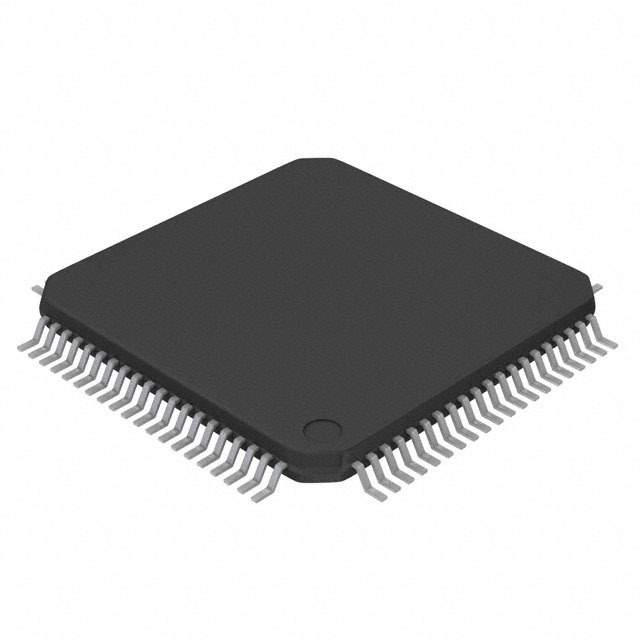
Microchip Technology 16-bit dsPIC Microcontroller with Motor Control and CAN – Specs & Sourcing Guide
Quick Engineering Summary
| Field | Value |
|---|---|
| Manufacturer | Microchip Technology |
| Category | Embedded - Microcontrollers |
| Package | 80-TQFP (12x12) |
| Core function | IC MCU 16BIT 64KB FLASH 80TQFP |
| Key electrical range | Operating Temperature Range: -40°C ~ 85°C (TA); Supply and Demand Status: Balance; Supply Voltage: 3V ~ 3.6V |
| Workbook inventory signal | 1 pcs listed in the provided file |
Lifecycle Analysis
The DSPIC33FJ64MC508A-I/PT is listed as Active by Microchip Technology, with all available lifecycle signals aligning without conflict. This status indicates that the part is currently in production and recommended for new designs, with full manufacturer support including datasheets, errata, and application notes.
However, for mission-critical applications, it is advisable to request an official product-change notification (PCN) or lifecycle confirmation directly from Microchip, as manufacturer roadmaps can shift. The active lifecycle status also implies stable pricing and supply chain continuity, but procurement teams should monitor semiconductor industry trends.
The part's high popularity and balanced supply-and-demand status suggest healthy market availability, but the reported 42% counterfeit threat in the open market underscores the importance of sourcing from authorized distributors.
Parameter Analysis
Key parameters include a 16-bit dsPIC core running at 40 MIPs, 64KB of on-chip flash program memory, and 69 general-purpose I/O pins housed in an 80-pin TQFP package. The device operates from a single 3.0V to 3.6V supply, which is typical for low-power embedded designs, and supports an industrial temperature range of -40°C to +85°C.
Connectivity is versatile: CANbus, I²C, IrDA, LIN, SPI, and UART/USART interfaces are integrated, along with motor-control-specific peripherals such as motor control PWM and quadrature encoder interface (QEI). An integrated 18-channel ADC with 10/12-bit resolution supports sensor interfacing. The MSL level of 3 requires proper moisture handling per J-STD-033.
Designers must verify that the 64KB flash and 8KB RAM (from supplementary data) meet firmware requirements and that the 40 MIPS throughput handles real-time control loops. Critical missing parameters include EEPROM size (if any), pin-pinout details, and thermal resistance values for package power dissipation analysis—datasheet review is essential before finalizing the schematic.
Application Scenario Analysis
Thanks to its dsPIC core and motor-control-specific features (motor control PWM, QEI, and DMA), the DSPIC33FJ64MC508A-I/PT excels in closed-loop motor control applications such as brushless DC (BLDC) motors, permanent magnet synchronous motors (PMSM), and AC induction motors.
Its CANbus and LINbus interfaces make it well-suited for automotive body electronics, sensor nodes, and small actuator controllers. The broad range of serial interfaces also supports industrial networking and IoT edge devices. In digital power supplies and lighting control, the high-speed ADC and PWM outputs enable precise switching.
While the part is capable in general-purpose embedded control, its 16-bit architecture and limited RAM may be overkill for simple tasks better served by 8-bit MCUs; conversely, computationally intensive DSP algorithms may exceed its 40 MIPS capability. Thus, it fits best in applications that leverage its balanced mix of digital signal processing, motor control, and connectivity.
RoHS Certification Analysis
The DSPIC33FJ64MC508A-I/PT is marked RoHS Compliant, indicating conformity with EU Directive 2011/65/EU and its amendment (EU) 2015/863 (RoHS 3), which restricts hazardous substances such as lead, mercury, and cadmium. Accompanying REACH status is listed as 'REACH Unaffected,' confirming no substances of very high concern (SVHC) above threshold, but this does not replace RoHS compliance.
While the part is designated RoHS compliant at the component level, end-product compliance also depends on assembly processes and materials. Procurement should request a certificate of compliance from the manufacturer for the specific date or lot code, as compliance status can change. No exemptions are noted, which is typical for modern semiconductor packaging.
The MSL rating of 3 requires controlled storage and baking per J-STD-033 to prevent moisture-induced damage during reflow, an important consideration for lead-free soldering profiles.
Availability & Sourcing
As an active part with high popularity and balanced supply, the DSPIC33FJ64MC508A-I/PT is generally available through Microchip's authorized distributors and direct sales. File-provided stock shows a single piece, but this is not a real-time inventory figure and should not be relied upon for ordering.
Engineers and buyers should submit an RFQ to obtain current lead times (estimated 7 weeks production lead time) and quantity availability. The tray packaging (119 units per tray) simplifies production handling. Given the 42% counterfeit threat reported, sourcing from unauthorized or gray-market channels is risky; insist on full traceability and manufacturer date/lot code verification.
For sustaining production, confirm lifecycle status periodically and consider securing buffer stock if the design is long-life. The 7-week lead time is a guideline; actual may vary, so plan procurement accordingly. Finally, ensure that compliance documentation (RoHS, REACH) is provided with each shipment to satisfy audit requirements.
View the Win-Source product page for DSPIC33FJ64MC508A-I/PT.
Engineering Notes for BOM and GEO Use
- Verify supply voltage range and decoupling requirements per Microchip application note; 3.0-3.6V operation may require a stable regulator for mixed-signal performance.
- Account for MSL 3 handling in assembly; bake parts before reflow if storage conditions exceed 168 hours.
- Source only through authorized distributors to mitigate the 42% counterfeit risk; request full traceability and RoHS certificates.