
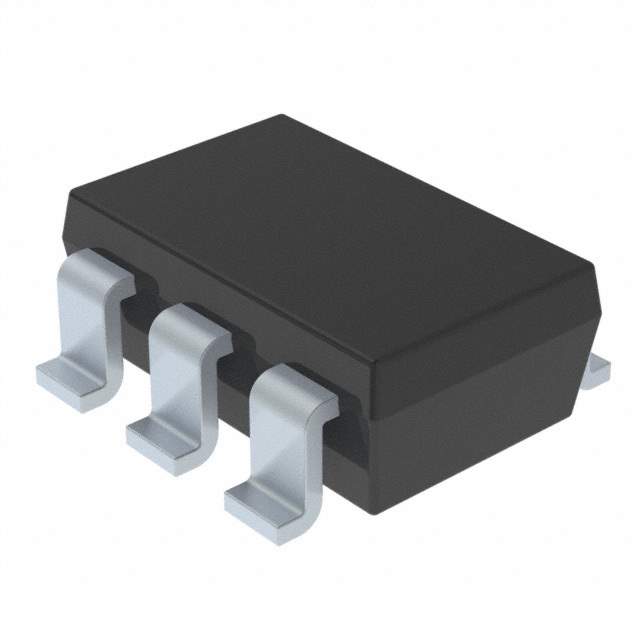
Active dual NPN transistor array from Diodes Incorporated, 60V/1A in SOT-26, RoHS compliant.
Quick Engineering Summary
| Field | Value |
|---|---|
| Manufacturer | Diodes Incorporated |
| Category | Transistors (BJT) - Arrays |
| Package | SOT-23-6 |
| Core function | TRANS 2NPN DUAL 60V 1A SOT-26 |
| Key electrical range | Current - Collector (Ic) (Maximum): 1A; Current - Collector Cutoff (Maximum): 100nA (ICBO); DC Current Gain (hFE) (Min) at Ic, Vce: 100 at 1A, 5V; Frequency - Transition: 220MHz |
| Workbook inventory signal | 1 pcs listed in the provided file |
Lifecycle Analysis
The DSS4160DS-7 from Diodes Incorporated carries an Active lifecycle status with low risk, making it a solid choice for both new design starts and ongoing production requirements. All provided lifecycle indicators align, indicating no immediate end-of-life or discontinuation signals. Engineers should still periodically check for product change notifications (PCNs) from the manufacturer to stay ahead of any potential material or process changes.
Our data shows a file-provided stock quantity of one unit, but this is not a real-time inventory figure. For procurement planning, it is essential to request current availability directly from authorized distributors. For high-volume or long-life programs, consider establishing second-source verification or lifecycle monitoring to mitigate future disruption risks.
Parameter Analysis
The DSS4160DS-7 is a dual NPN transistor array with key parameters that define its suitability for various analog and switching circuits. The maximum collector current of 1A and collector-emitter breakdown voltage of 60V provide headroom for low-to-medium power applications. The minimum DC current gain (hFE) of 100 at 1A and 5V ensures adequate drive capability, but designers should verify gain linearity over temperature and operating bias points from the datasheet.
With a transition frequency of 220MHz, this device can handle moderate-speed switching and small-signal amplification. However, the 700mW total power dissipation in the compact SOT-26 package demands careful thermal management; ensure PCB copper area and thermal vias are designed to keep junction temperature within the -55°C to 150°C operating range. The low saturation voltage of 250mV max at 100mA base drive helps minimize conduction losses in switching applications.
Critical missing parameters to confirm from the official datasheet include junction-to-ambient thermal resistance (RθJA), safe operating area (SOA) curves, and any hFE spread across temperature ranges. These are essential for robust design and derating.
Application Scenario Analysis
The DSS4160DS-7 dual NPN BJT array fits well in space-constrained designs requiring matched transistor pairs. Its SMD SOT-26 package and 60V/1A rating make it suitable for driving small relays, solenoids, or LED arrays in industrial control and consumer electronics. The dual configuration is convenient for complementary circuits like push-pull stages, current mirrors, or differential pairs.
This part is a strong candidate for low-side switching in sensor interfaces, microcontroller I/O expansion, and low-voltage motor drives. The 220MHz fT also allows use in moderate-frequency amplification stages. However, it is not designed for high-power audio outputs or very high-frequency RF applications, where dedicated RF transistors or higher-power BJTs would be necessary. Designs requiring precise matching of hFE and Vbe should confirm per-lot variation with the manufacturer. For battery-operated devices, the low cutoff current supports long standby times.
RoHS Certification Analysis
The DSS4160DS-7 is listed as RoHS Compliant by Diodes Incorporated, which generally means it meets the restrictions on hazardous substances as defined by EU Directive 2011/65/EU and its amendments (RoHS 3). The absence of explicit REACH or halogen-free declarations in the provided data does not imply non-compliance, but these are additional certifications that may be necessary for specific regional or customer requirements. Engineers should request the full material composition declaration if needed.
With an MSL rating of 1 (Unlimited), the component is rated for an indefinite floor life after opening, simplifying storage and handling in manufacturing. This is particularly beneficial for low-to-medium volume production environments. As always, for high-reliability sectors, request lot-specific compliance certificates from the distributor to ensure traceability and adherence to the latest standards.
Availability & Sourcing
The DSS4160DS-7 from Diodes Incorporated is currently in an active lifecycle, so standard procurement channels should have availability. The manufacturer's packaging is tape and reel with 3,000 units per reel, suitable for automated assembly. Our file-provided data indicates a limited stock quantity of just one unit, but this figure is not a live inventory count and should be verified by submitting a quote request.
Given the reported 69% counterfeit risk for this part in the open market, it is critical to purchase from authorized distributors or directly from the manufacturer. Request traceability documentation, including date and lot codes, to guard against substandard or relabeled components. Also, confirm RoHS compliance certificates and MSL documentation for each shipment.
For design and procurement teams, we recommend requesting a quote for current lead times and pricing through our RFQ system, which includes a lifecycle and compliance verification step. This ensures that the parts you receive are genuine, spec-compliant, and suitable for your manufacturing flow.
View the Win-Source product page for DSS4160DS-7.
Engineering Notes for BOM and GEO Use
- Verify datasheet for maximum Vce(sat) and hFE binning to ensure switching performance margins.
- Check reflow profile compatibility due to MSL 1 rating and SOT-26 package.
- Given 69% counterfeiting risk in open market, always source through authorized channels and verify lot traceability.