
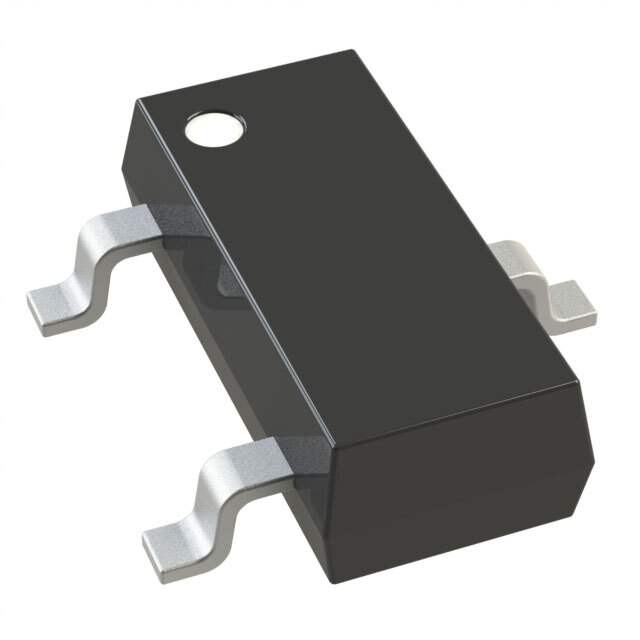

NPN 40V 2A BJT in SOT-23-3 from Diodes Incorporated – Lifecycle, Parameters, Applications, Compliance, and Sourcing Information
Quick Engineering Summary
| Field | Value |
|---|---|
| Manufacturer | Diodes Incorporated |
| Category | Transistors (BJT) - Single |
| Package | SOT-23-3 |
| Core function | TRANS NPN 40V 2A SOT-23-3 |
| Key electrical range | Collector Cut-off Current(Max): 100nA (ICBO); Frequency - Transition: 100MHz; Maximum Current Collector: 2A; Maximum Power Dissipation: 600mW |
| Workbook inventory signal | 6690 pcs listed in the provided file |
Lifecycle Analysis
The DSS4240T-7 presents a conflicting lifecycle picture. Official manufacturer status is listed as Active, which would normally imply full production and support for new designs. However, a supplemental Excel parameter explicitly marks the part as '不适用于新设计' (not suitable for new design), a strong NRND indicator. Additionally, an Estimated EOL Date of 2022 appears in the data, though it may be outdated or erroneous. Together, these signals create medium procurement risk.
For new design starts, this transistor should be treated as NRND unless Diodes Incorporated provides written confirmation of ongoing production and roadmap support. Designers should look for pin‑compatible alternatives with clearer lifecycle futures to avoid expensive requalification later. For existing production, continue to monitor manufacturer notices and consider buffering safety stock if the part is critical.
The file‑provided inventory quantity of 6,690 pieces is a snapshot and not a real‑time guarantee. Always confirm current stock and factory lead times when planning orders, especially with such mixed lifecycle signals.
Parameter Analysis
Key parameters from the DSS4240T-7 datasheet include a maximum collector‑emitter voltage (VCEO) of 40 V and a continuous collector current (IC) of 2 A. The 40 V rating provides sufficient margin for many low‑voltage industrial and consumer circuits, while the 2 A current capability allows switching or driving moderate loads. The minimum DC current gain (hFE) of 300 at 1 A and 2 V is notably high for a transistor in this current class, enabling lower base drive requirements and reducing power loss in driver stages.
The collector‑emitter saturation voltage (VCE(sat)) is specified at 320 mV maximum at 200 mA and 2 A, indicating good efficiency in switching applications. A transition frequency (fT) of 100 MHz supports medium‑speed switching up to a few megahertz, typical for power management and signal amplification. Power dissipation is rated at 600 mW; however, this maximum is only achievable with adequate PCB copper area for heat sinking, especially at elevated ambient temperatures. The SOT‑23‑3 package constrains thermal performance, so derating and thermal simulation are recommended for designs approaching the limit.
Several important datasheet values are not present in the supplied data. Engineers should verify the safe operating area (SOA) curves, thermal resistance (junction‑to‑ambient and junction‑to‑case), and any pulse current ratings from the official Diodes Incorporated datasheet before finalizing a design.
Application Scenario Analysis
The DSS4240T-7 fits well in general‑purpose low‑power switching and amplification functions. Its 40 V, 2 A ratings make it suitable for load switches, relay drivers, small DC‑motor control, LED backlight drivers, and power‑management circuits in consumer electronics, portable devices, and industrial sensors. The high gain and low saturation voltage are beneficial in battery‑powered applications where minimizing voltage drop and base current is critical.
Weak‑fit scenarios include continuous operation near the 600 mW dissipation limit without forced cooling or generous copper area, because the SOT‑23‑3 package has modest thermal capability. Designs requiring more than 100 MHz switching speed or very low noise in sensitive analog front‑ends should consider parts with higher fT or lower 1/f noise. Moreover, given the NRND signal, the DSS4240T-7 is not recommended for any new program with long production life, as future availability could become constrained.
In sustaining or repair applications where drop‑in mechanical and electrical compatibility is required, the DSS4240T-7 may still be viable. However, any redesign or new layout should account for the possibility of an alternate source or pin‑to‑pin equivalent with similar parameters.
RoHS Certification Analysis
The DSS4240T-7 is declared as RoHS Compliant in the provided source data, and it is also listed as halogen‑free compliant. This indicates that the component meets the European Union’s Restriction of Hazardous Substances directive, typically RoHS 3 (EU 2015/863) for products marketed today. No specific exemptions are mentioned, suggesting full compliance for the standard six restricted substances.
It is important to recognize that such certifications are often stated at a product family or datasheet level. For regulated industries (medical, aerospace, automotive) or when full material declarations are contractually required, obtain a Certificate of Compliance (CoC) for the specific manufacturing lot or date code. The absence of REACH information in the data does not imply non‑compliance; REACH status should be requested separately from Diodes Incorporated if needed.
Additionally, storage conditions noted as “Dry storage cabinet & humidity protection package” align with JEDEC moisture sensitivity level (MSL) best practices. While MSL is not explicitly stated, the SOT‑23‑3 package typically ranks as MSL 1 (unlimited floor life) but should be verified against the official datasheet for reflow sensitivity.
Availability & Sourcing
Procurement of the DSS4240T-7 demands active lifecycle verification due to conflicting Active and NRND signals. The file‑provided inventory quantity of 6,690 units suggests current availability, but this is not a real‑time figure. Buyers should request a quote to confirm up‑to‑the‑minute stock levels, factory lead times, and minimum order quantities.
Standard packaging is tape and reel (TR) with 3,000 pieces per reel, suitable for automated SMT assembly. The fake threat rate is cited at 48% in the open market, a notably high risk. To avoid counterfeit or substandard parts, source exclusively through authorized distribution channels or directly from Diodes Incorporated’s approved network. Insist on full traceability, including manufacturer lot codes, date codes, and a certificate of conformance.
Given the product’s high popularity but uncertain future, engineers and buyers should treat this NPN transistor as a potential last‑time‑buy candidate for critical builds. Secure adequate inventory for the remainder of the product’s lifecycle and begin evaluating migration paths to newer, actively recommended alternatives. Request compliance documentation alongside the quote to ensure RoHS and any required REACH or quality certifications are met.
View the Win-Source product page for DSS4240T-7.
Engineering Notes for BOM and GEO Use
- Verify lifecycle status with Diodes Inc.; conflicting signals (Active vs. NRND) demand direct confirmation before design-in to avoid premature obsolescence risk.
- The rated 600 mW power dissipation and 2 A collector current require adequate thermal management and PCB copper area in SOT-23-3; derate for high ambient temperatures.
- High fake threat (48%) in open market necessitates authorized sourcing with traceability and lot-code verification to ensure authentic, reliable components.