
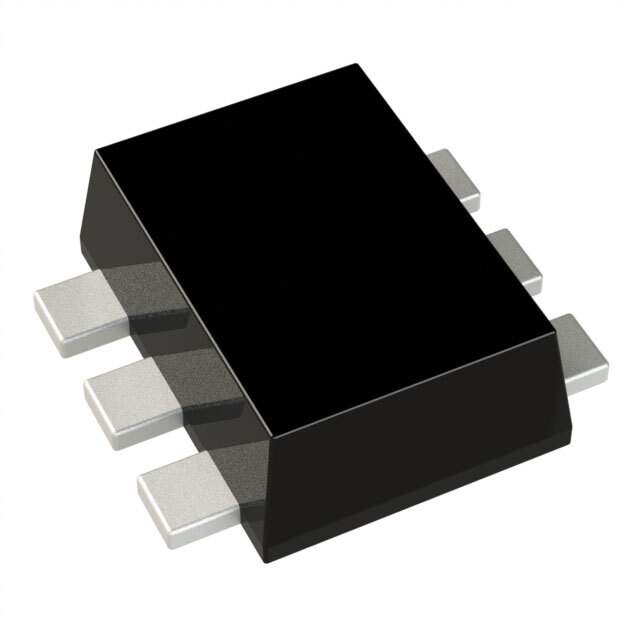
PNP Transistor (BJT) SOT-563 – Lifecycle, Specs & Sourcing Analysis
Quick Engineering Summary
| Field | Value |
|---|---|
| Manufacturer | Diodes Incorporated |
| Category | Transistors (BJT) - Single |
| Package | SOT-563 |
| Core function | TRANS PNP 60V 1A SOT-563 |
| Key electrical range | Collector Cut-off Current(Max): 100nA; Frequency - Transition: 150MHz; Maximum Current Collector: 1A; Maximum Power Dissipation: 600mW |
| Workbook inventory signal | 20180 pcs listed in the provided file |
Lifecycle Analysis
The lifecycle status of DSS5160V-7 is ambiguous. A specification field shows 'Active', yet the lifecycle assessment block returns 'Unknown' with no supporting signals. This conflict demands conservative procurement. For new designs, treat the part as high-risk until Diodes Incorporated officially confirms its production status. An estimated EOL date of 2027 appears in the data, hinting at a possibly limited remaining life, though it should not be relied upon without validation.
Given the introduction date of 2009, this transistor has been on the market for many years. File-provided inventory suggests over 20,000 units exist, but this is a snapshot and not a guarantee of future availability. If you are designing this part into a new system, secure a written lifecycle statement from the manufacturer or an authorized distributor. For existing production, consider procuring buffer stock and exploring second-source options as a precaution.
The high fake threat percentage (51 pct.) in the open market underscores the need for traceable, authorized supply channels. Do not treat DSS5160V-7 as a drop-in for a new design without lifecycle clarity.
Parameter Analysis
DSS5160V-7 is a PNP transistor with key ratings: a maximum collector-emitter breakdown voltage (VCEO) of 60V, a continuous collector current of 1A, and a maximum power dissipation of 600mW at an ambient temperature of 25°C. The transition frequency of 150MHz makes it suitable for moderate-speed switching, while the minimum DC current gain (hFE) of 150 at 500mA and 5V ensures sufficient amplification in linear circuits. The low collector-emitter saturation voltage of 330mV at 100mA/1A helps minimize conduction losses in switching applications.
When evaluating this transistor for a design, the SOT-563 surface-mount package requires careful PCB layout for thermal management, especially near the 600mW limit. Ensure junction temperature stays within the -55°C to 150°C operating range by accounting for trace copper area and ambient conditions. The 100nA collector cut-off current is low, which benefits low-power or battery-operated designs. Missing from the provided data are crucial parameters like base-emitter on voltage (Vbe(on)), turn-on and turn-off times, and safe operating area curves—these must be verified in the official datasheet.
For procurement, note the country of origin is China and the ECCN is EAR99, easing export compliance. The part is commonly used and in high demand on the Win Source platform, which may indicate a stable supply network.
Application Scenario Analysis
As a general-purpose PNP BJT in a compact SOT-563 package, DSS5160V-7 fits well in space-constrained designs needing low to medium power switching or amplification. Strong-fit applications include load switching under 1A (e.g., relay drivers, LED control, small motor drivers), signal amplification in consumer electronics, and battery management circuits where the low saturation voltage improves efficiency. The 60V rating makes it suitable for 12V, 24V, or 48V rail systems, common in industrial and automotive accessories.
It may also serve in complementary push-pull output stages for audio or driver circuits paired with an NPN transistor, though its 150MHz transition frequency limits it to modest bandwidths. Weak-fit scenarios encompass high-power (>600mW continuous), high-current (>1A steady-state), or high-frequency (>150MHz) applications, where a higher-spec device would be required. The device is not specifically rated for automotive AEC-Q101 qualification based on the available data, so it should not be assumed for automotive-grade designs without further documentation.
Designers should also consider the part's common-use status and high open-market fake threat when sourcing for sensitive or safety-critical applications. Always cross-check the datasheet for specific switching characteristics if timing is critical.
RoHS Certification Analysis
According to supplier data, DSS5160V-7 is RoHS compliant and halogen-free. These environmental attributes align with global regulations restricting hazardous substances in electronic equipment. However, the provided compliance information lacks detail on the specific RoHS directive version (e.g., RoHS 2, RoHS 3) and any applicable exemptions. Without REACH or full material declaration data, a thorough compliance review is advisable.
RoHS compliance is stated at the part level, but lot-to-lot consistency should be verified through certificates of compliance from the supplier or manufacturer. Halogen-free labeling further indicates the absence of chlorine and bromine flame retardants, which may be relevant for certain eco-labels or corporate sustainability goals. If this transistor is intended for products sold in the EU, request the EU Declaration of Conformity and confirm that the compliance documentation covers the specific production batches you are purchasing.
Given the moderate risk of counterfeit components, RoHS documentation also serves as a traceability check. Insist on compliance reports that tie back to the manufacturer's lot code, especially when procuring from independent distributors.
Availability & Sourcing
File-provided data indicates a stock quantity of 20,180 units of DSS5160V-7, suggesting current availability through Win Source. However, this figure is not a real-time inventory and should be confirmed via RFQ. The supply and demand status is classified as 'Balance', which points to a stable market condition presently. The device is flagged as common-used and high popularity, which often means multiple distributors carry it, though the lifecycle ambiguity may narrow options.
Given the lifecycle uncertainty, request a quote that includes traceability documentation: date/lot codes, manufacturer’s original packaging (tape and reel per spec), and compliance certificates. For active procurement or new designs, a full lifecycle verification from Diodes Incorporated or an authorized channel is critical before placing production orders. The recommended storage conditions (dry cabinet with humidity protection) should be specified when ordering to maintain solderability.
If the lifecycle is confirmed as NRND or approaching EOL, consider purchasing buffer stock and evaluating alternative parts. For EOL or discontinued statuses, source only from trusted suppliers with rigorous counterfeit mitigation. The 51% fake threat rating underscores the importance of avoiding unvetted open-market sources. To proceed, click to request a quote and ask the supplier to confirm the latest lifecycle status and available stock.
View the Win-Source product page for DSS5160V-7.
Engineering Notes for BOM and GEO Use
- Confirm lifecycle directly with Diodes Incorporated; conflicting Active/Unknown signals require a formal manufacturer statement before design-in.
- The 60V VCEO and 1A IC suit many general-purpose switching applications, but verify derating and safe operating area in the full datasheet.
- Despite RoHS compliance, request lot-specific certificates to guard against supply chain and regulatory risks.