
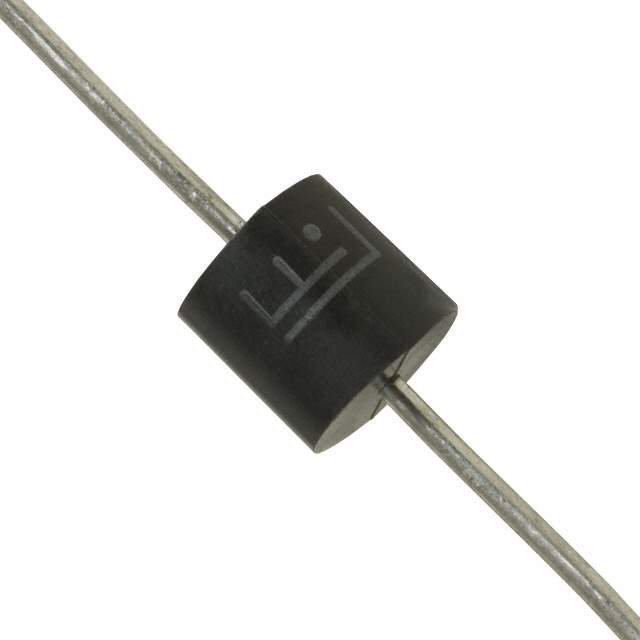
45 V reverse ceiling, 20 A average rectified ceiling, 580 mV at 20 A, in P600 axial through-hole
Quick Engineering Summary
| Field | Value |
|---|---|
| Manufacturer | Littelfuse Inc. |
| Category | Diodes, Rectifiers - Single |
| Package | Tape & Reel (TR),Cut Tape (CT) |
| Core function | DIODE SCHOTTKY 45V 20A P600 |
| Key electrical range | Current - Average Rectified (Io): 20A; Current - Reverse Leakage @ Vr: 1.2 mA @ 45 V; Operating Temperature - Junction: -55°C ~ 155°C; Voltage - DC Reverse (Vr) (Max): 45 V |
| Reported stock | 1 pcs reported — confirm on RFQ |
The real limit is 45 V, not 20 A
The constraint is voltage headroom. With a 45 V DC reverse ceiling, this Schottky rectifier belongs on low-voltage outputs and freewheel paths, not on nodes where startup, fault, or ringing can push reverse excursions past 45 V.
The 20 A average rectified rating is a ceiling too, but it does not save a design that is already tight on reverse margin. Put that beside the listed 580 mV maximum forward drop at 20 A and the real question becomes thermal: can the design absorb the dissipation implied by that current and drop in a P600 axial body when the listing gives no thermal resistance and no derating curve? That leaves DST2045AX easy to screen electrically and harder to close on heat.
Wrong for high-voltage rails, useful in heavy low-voltage rectification
Wrong for high-voltage rails. It is also the wrong choice when the layout needs an SMD footprint, because DST2045AX is through-hole in a P600 axial package and fits power sections that can accept leaded assembly and some lead length rather than dense surface-mount layouts.
It does fit straightforward low-voltage power rectification where Schottky behavior matters more than compact packaging. The 1.2 mA reverse leakage at the 45 V ceiling puts a real number on top-end reverse loss, so standby-sensitive designs need to count it. The junction range of -55°C to 155°C keeps it in play for harsh ambient equipment, but that span does not prove the package can shed heat at 20 A without more thermal detail.
Buy it only with supply lined up
Active is fine.
Stock is the issue: inventory is listed as 1, while standard package is 500 and packaging is Tape & Reel or Cut Tape. EU RoHS is compliant, and MSL 1 (Unlimited) removes one handling nuisance for stores and assembly.
The missing numbers are the ones that finish the decision
The weak point is documentation depth. The headline specs are usable, but the absent items are the ones that turn a shortlist into a released power stage.
Reverse-recovery time is not given, even though the speed field says fast recovery =< 500ns, > 200mA (Io); that is a category label, not a usable trr value. Junction capacitance is absent, so switching-node loading and ringing sensitivity stay open. Thermal resistance and any derating curve are absent, leaving the 580 mV @ 20 A figure without the context needed to size copper, lead length, or airflow. A pinout drawing is also not here, and with an axial part, that still matters for mechanical fit and assembly orientation.
View the Win-Source product page for DST2045AX.
Key Takeaways for Engineers & Buyers
- Hold reverse stress below the 45 V ceiling; this part does not close higher-voltage rail decisions.
- Budget conduction loss around 580 mV at 20 A, because that pair sets the thermal burden more than the package name does.
- Do not release a build on stock quantity 1; place DST2045AX only after supply is lined up.