
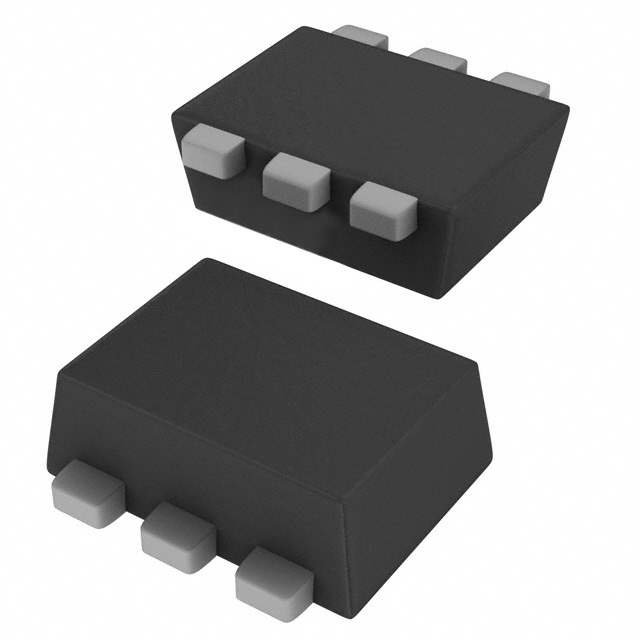
40V VCEO ceiling, 200mA collector limit, 300mW dissipation cap in a SOT-963 complementary BJT pair
Quick Engineering Summary
| Field | Value |
|---|---|
| Manufacturer | Diodes Incorporated |
| Category | Transistors (BJT) - Arrays |
| Package | SOT-963 |
| Core function | TRANS NPN/PNP 40V 200MA SOT-963 |
| Key electrical range | Frequency - Transition: 300MHz; Maximum Current Collector: 200mA; Maximum Power Dissipation: 300mW; Supply and Demand Status: Balance |
| Reported stock | 310000 pcs reported — confirm on RFQ |
Can you start a new design with it?
Can I use this in a new design? Yes, if the job is specific: one NPN and one PNP in SOT-963, with a 40V collector-emitter breakdown ceiling, 200mA maximum collector current, and 300mW maximum power dissipation. That is enough to put DST3946DPJ-7 on the list for compact level shifting, small-signal switching, or bias networks where board area matters more than current headroom.
What remains open is stage behavior once the circuit moves beyond headline limits. The listing gives 300MHz transition frequency and hFE of 100 @ 10mA, 1V, but not the curves that show how gain and saturation shift across current and temperature. Lifecycle is Active with no conflict, and EU RoHS is stated, so commercial risk is low. The engineering risk is in the missing detail, not the status.
Not for power stages; fine for dense small-signal work
Power or heat-heavy work is not its lane. The 200mA collector figure is a ceiling, not a normal operating point, and the 300mW dissipation limit is likely to bite first in a tiny SOT-963 body. If the circuit spends real time in saturation or has weak copper spreading, thermal margin disappears quickly.
It fits better where a complementary pair saves placement area and routing in dense SMT designs. The listed VCE(sat) maxima of 300mV @ 5mA, 50mA and 400mV @ 5mA, 50mA place the characterization squarely in low-current switching territory rather than load driving. The 40V VCEO ceiling leaves room for modest analog and interface rails, but it does not make this a high-voltage switch.
The real limit is heat, not voltage
Heat is the constraint these numbers create. A 300mW maximum power dissipation and 200mA maximum collector current in SOT-963 tell the story more clearly together than either number does alone: DST3946DPJ-7 can solve a space problem, but only when the circuit keeps conduction loss under control, because the current line by itself does not describe a comfortable operating point.
The saturation data reinforces that. A maximum VCE(sat) of 300mV @ 5mA, 50mA / 400mV @ 5mA, 50mA gives a practical sense of voltage loss in the low-current region where this pair is most likely to work, and it also marks the point where dissipation starts to matter if the design holds the transistors on instead of pulsing them. Don’t size the job from the 200mA line and ignore the package.
The 300MHz transition frequency is still worth keeping in view. It supports fast small-signal use, but without capacitance data or switching curves it does not settle edge-rate behavior, storage effects, or how cleanly the pair will behave in a real interface stage. That missing context is why DST3946DPJ-7 is easy to shortlist and harder to sign off.
Buy it as a reel part
Yes, buyable.
Packaging is Reel - TR, stock is listed at 310000, and supply-demand status is Balance. That points to automated SMT use rather than hand-loaded service stock.
What the listing still doesn’t answer
40V is clear. What is not clear is the implementation detail around it. There is no pinout or package drawing here, so footprint orientation and assembly checks still depend on the datasheet. There is no collector cutoff current value, leaving leakage behavior open at temperature.
The listing also omits thermal resistance and any derating curve, and those are the numbers that decide how much ambient headroom the 300mW limit really leaves. For switching work, junction capacitance and switching waveforms are missing too. That’s the gap between a good shortlist and a released schematic for DST3946DPJ-7.
View the Win-Source product page for DST3946DPJ-7.
Key Takeaways for Engineers & Buyers
- Keep VCEO below the 40V ceiling; this listing does not give avalanche or transient detail.
- Budget heat against the 300mW dissipation limit before using the 200mA collector ceiling.
- Lock reel usage early if DST3946DPJ-7 is going into volume SMT assembly.