
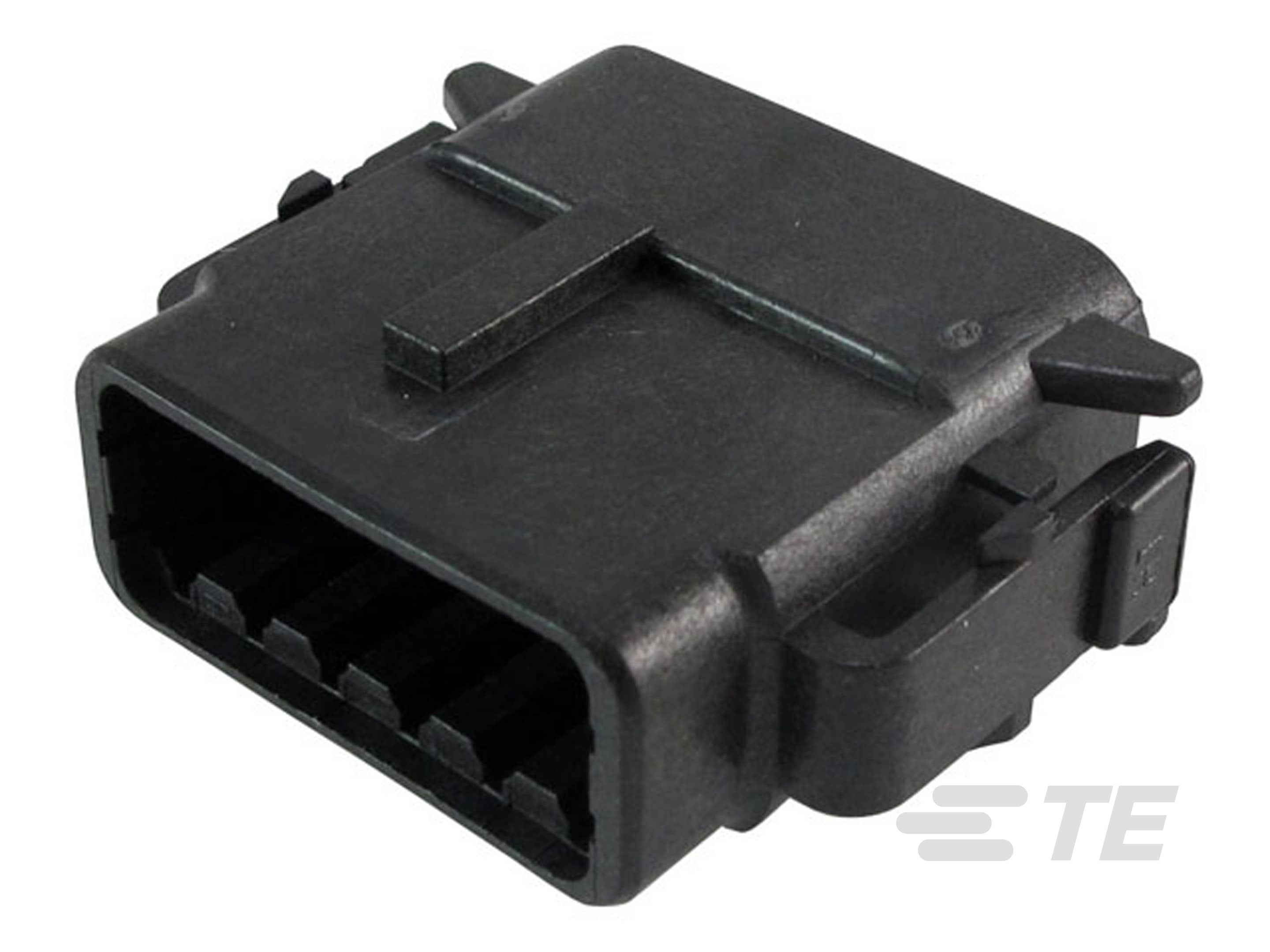
8 positions, 0.359" (9.12mm) pitch, free-hanging receptacle, -55°C to 125°C operating range
Quick Engineering Summary
| Field | Value |
|---|---|
| Manufacturer | TE Connectivity |
| Category | Rectangular Connector Housings |
| Package | Box |
| Core function | REC, 8P, BLK, BUSBAR 1X8, NICKEL |
| Key electrical range | Supply and Demand Status: Shortage; Temperature Range - Operating: -55°C ~ 125°C |
| Reported stock | 88 pcs reported — confirm on RFQ |
Not for dense boards; right for in-line harnesses
This is the wrong part for a board edge, a sealed module footprint, or any spot that needs a finished connector instead of a housing. In the right place, it fits cleanly: DT04-08PB-P021 is a free-hanging, in-line receptacle housing with crimp termination and a latch holder, so it belongs in a wire-to-wire or harness build where retention is handled in the cable assembly.
The fit is specific. Eight positions across 2 rows gives you a moderate circuit count without pushing into a long single-row body, and the male pin contact style means the mating system has to follow that geometry rather than a generic rectangular shell. The glass-filled polyamide body and the -55°C to 125°C operating range make it plausible for harsh harness locations, but they do not answer current loading, sealing, or contact resistance.
0.359" pitch is the layout number that decides the harness
0.359" (9.12mm) pitch sets the scale before anything else does. It drives connector family size, wire breakout spacing, and how much room the harness needs before it reaches a clamp or enclosure wall. Add the 0.175" (4.45mm) row spacing and the packaging picture sharpens quickly: this is not the housing for squeezing eight ways into a cramped electronics bay where every millimeter around the exit is contested.
The temperature number matters too, but as a ceiling. The housing is rated for -55°C to 125°C, which supports cold-start and underhood-style swings, yet the assembly limit still drops to the weakest element if the contact, wire, or seal stack carries a lower limit.
Eight positions matters more than it first appears because it fixes circuit count and mating pattern in one move. That makes DT04-08PB-P021 easy to place when the harness is already partitioned into eight ways, and awkward when the design is still bouncing between six, eight, and twelve, because the shell choice will force branch geometry long before anyone gets to electrical fine points. In practice, the mechanical envelope decides this part first.
And the buy risk is availability, not status
And that leads straight to supply. DT04-08PB-P021 is Active, but the immediate issue is availability: it is flagged Shortage and the listed stock is 88. That may cover a prototype. It is not much for a running line.
View the Win-Source product page for DT04-08PB-P021.
The missing items are the ones that close the review
Key details are missing.
There is no pinout or cavity drawing here, so harness packaging cannot be finished from this page. There is no mating-part detail and no contact electrical rating, so current-path decisions cannot rest on the housing data alone.
Another gap matters: no sealing or ingress information is shown, despite the in-line harness form factor that often puts this family in exposed locations. EU RoHS is listed, which is enough for compliance screening, but not for those mechanical and environmental calls.
View the Win-Source product page for DT04-08PB-P021.
Key Takeaways for Engineers & Buyers
- Lock the harness layout to 8 positions on 2 rows before releasing DT04-08PB-P021.
- Check cable dress against 0.359" (9.12mm) pitch and 0.175" (4.45mm) row spacing.
- Cover the shortage now; 88 pieces on hand is not much for a running line.