
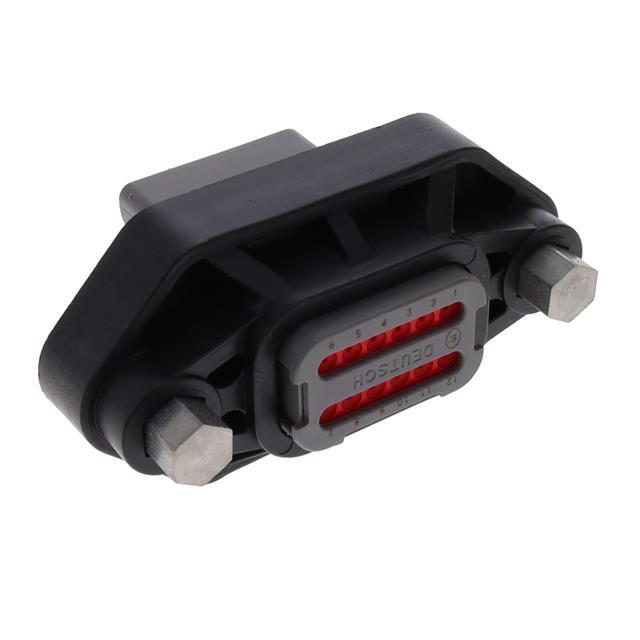
12 positions, panel mount, 0.359" pitch, -55°C to 125°C range; supply is the real constraint.
Quick Engineering Summary
| Field | Value |
|---|---|
| Manufacturer | TE Connectivity |
| Category | Rectangular Connector Housings |
| Package | Box |
| Core function | REC, 12P, BLK, E, ENH KEY, CAP, |
| Key electrical range | Supply and Demand Status: Shortage; Temperature Range - Operating: -55°C ~ 125°C |
| Reported stock | 1 pcs reported — confirm on RFQ |
125°C is useful, but it doesn’t settle the connector choice
125°C is the ceiling that gets attention. It keeps DT04-12PB-BL11 in the conversation for underhood or outdoor equipment that runs hotter than ordinary cabinet environments, but the listed -55°C to 125°C range does not prove every seal, contact, and panel interface in the assembly is equally comfortable there.
What closes the first design decision is the rest of the package: sealed construction, panel mount, and a 12-position receptacle body with male pins. That combination points to harness-to-panel interconnects that need environmental protection and positional density, not loose internal board wiring or places where an unsealed housing would already do the job. Active lifecycle supports new design-in, and EU RoHS is straightforward. Supply is the catch.
12 positions on 0.359" pitch set the packaging reality
12 positions can consolidate a small harness branch. The 0.359" (9.12mm) pitch and 0.175" (4.45mm) row spacing make the tradeoff clear: this is not a fine-pitch signal shell for a crowded electronics bay.
Those dimensions drive panel real estate, mating clearance, and harness dress-out before anyone gets distracted by housing color or polymer. In a 2-row receptacle body, DT04-12PB-BL11 fits where serviceable, keyed, field-tolerant interconnects matter more than compact PCB-adjacent packaging. The glass-filled polyamide housing supports that read, and the latch holder fastening type makes retention part of the mechanical system. The listing still leaves contact current, interface sealing performance, and insertion force unresolved.
So the fit is panel harnessing, not generic box-to-box use
So that narrows the fit. DT04-12PB-BL11 belongs where the enclosure wall is part of the connector strategy, because panel mount and sealed construction answer dirt, splash, and harness handling in a way generic box-to-box housings do not, while crimp termination keeps it squarely in the wire-harness world rather than board assembly.
The male-pin receptacle format narrows it further, since mating orientation and touch-safe expectations have to align with the rest of the interconnect scheme. If the design needs a free-hanging inline housing, a board header, or a compact internal jumper, this is the wrong shape of solution before you even get to the missing mating details. It fits ruggedized panel entry and bulkhead-style harness transitions.
Buy it only against a real build
Buy to demand.
Stock is listed at 1 and status is Shortage, so DT04-12PB-BL11 works for an approved BOM but not as a casual bench-order part. Tie purchases to scheduled builds and secure the mating half at the same time.
The missing mechanical details are what still block release
The weak point is documentation depth, not the basic identity of the part. DT04-12PB-BL11 is clearly a sealed, panel-mount, 12-position receptacle housing, but the listing stops short of the details that finish a connector decision, and those omissions matter more than the broad description once the design moves from concept to release.
Start with the panel cutout and housing drawing. Panel mount is stated, yet without mounting geometry you cannot release enclosure metalwork or molded wall features. Then there is the pinout or cavity arrangement beyond position count and row count; 12 positions in 2 rows tells you density, not cavity identification or keying orientation at drawing level.
Mating-part detail is another hard stop. The description mentions enhanced key and cap, but this page does not spell out the compatible mate or the exact cap arrangement, which is where assembly mistakes begin. Sealing detail is also thin: sealed is useful, but there is no interface seal description, no environmental rating, and no retention or insertion data. Those are the concrete gaps still blocking release for DT04-12PB-BL11.
View the Win-Source product page for DT04-12PB-BL11.
Key Takeaways for Engineers & Buyers
- Lock the panel interface around the 12-position, 2-row housing before releasing the harness drawing.
- Match the crimp contact system to the male-pin receptacle format; this housing alone does not close terminal selection.
- Treat shortage and stock of 1 as a line-risk signal; place coverage early for DT04-12PB-BL11.