
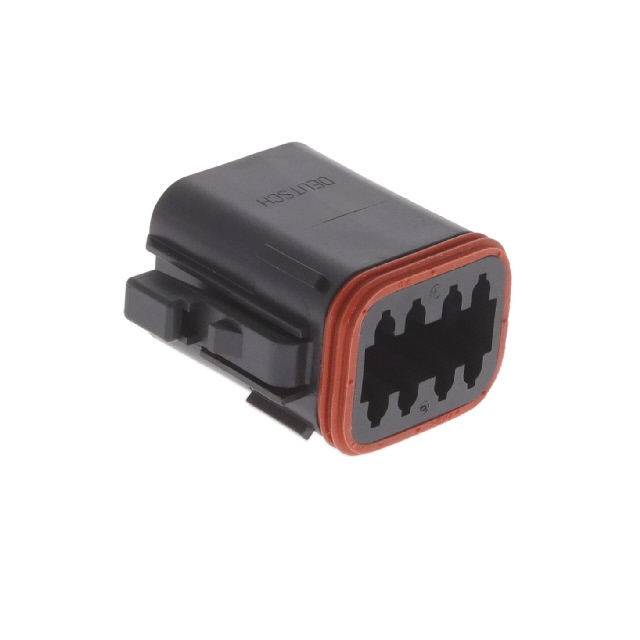
12-position free-hanging plug housing with IP68/IP6K9K sealing and -55°C to 125°C operation
Quick Engineering Summary
| Field | Value |
|---|---|
| Manufacturer | TE Connectivity |
| Category | Rectangular Connector Housings |
| Package | Bulk |
| Core function | CONN PLUG HSG 12POS |
| Key electrical range | Supply and Demand Status: Shortage; Temperature Range - Operating: -55°C ~ 125°C |
| Reported stock | 20 pcs reported — confirm on RFQ |
125°C is the ceiling that keeps this in harsh harnesses
125°C is the listed operating ceiling, with -55°C at the cold end, and that range is the main reason to consider DT06-12SA-CE05. It answers the ambient survivability question for an exposed in-line harness more clearly than the color or even the latch style, but it does not answer current loading, contact heating, or sealing life because those numbers are not here.
From there, the rest of the fit is straightforward. It is a 12-position, 2-row plug housing for crimped female sockets, free hanging rather than board mounted, with latch lock retention and a blocked gasket, cap, and reduced wire seals. That points to cable-to-cable or cable-to-equipment interconnects where washdown, dust ingress, and temperature swing matter more than density.
The weak point is supply, not the housing format
Shortage is the problem, even before lifecycle. Unknown lifecycle would be manageable on its own, but 20 in stock makes this a controlled buy.
For a running harness, secure the build quantity now. For a new release, don't let the BOM depend on spot availability. EU RoHS is compliant, but that does nothing for supply.
12 positions and IP6K9K decide where DT06-12SA-CE05 belongs
12 positions sounds routine until it is paired with IP68 and IP6K9K. That combination pushes DT06-12SA-CE05 toward sealed harness branches and away from benign cabinet wiring, where a simpler housing could cover the same basic connection with less sourcing friction.
The format tells a consistent story. The plug housing, female socket contact system, crimp termination, and free-hanging mounting type all point to field wiring and harness assembly rather than a PCB edge, a panel feedthrough, or any design that wants soldered termination. The latch lock matters too, because a sealed connector that backs out under vibration becomes an expensive leak path. The blocked gasket and reduced wire seals reinforce the same point: ingress control is being handled at the cable interface, not only at the mating face.
Just as important is what the listing leaves out. There is no contact size, no accepted wire range, no mating half callout, and no housing dimensions or drawing. Those are not small omissions on a 12-position sealed connector; they determine whether the harness shop can terminate it, whether bundle diameter fits the reduced seals, and whether the package clears adjacent hardware. DT06-12SA-CE05 may be the right shell for a harsh-environment loom, but those missing details still decide whether it can be released without rework.
The missing details are the ones that stop release
The constraint is mechanical definition, not electrical rating. The listing omits the pinout or cavity map, the dimensional drawing, the supported wire range, and the mating connector reference.
Those gaps still block a final harness decision on DT06-12SA-CE05. Without them, you can't finish the crimp selection, seal fit, or packaging check.
View the Win-Source product page for DT06-12SA-CE05.
Key Takeaways for Engineers & Buyers
- Lock the mating scheme around 12 positions and 2 rows before releasing harness drawings.
- Use DT06-12SA-CE05 only where IP68 or IP6K9K sealing is actually required.
- Reserve stock early; available quantity is 20 and supply is marked Shortage.