
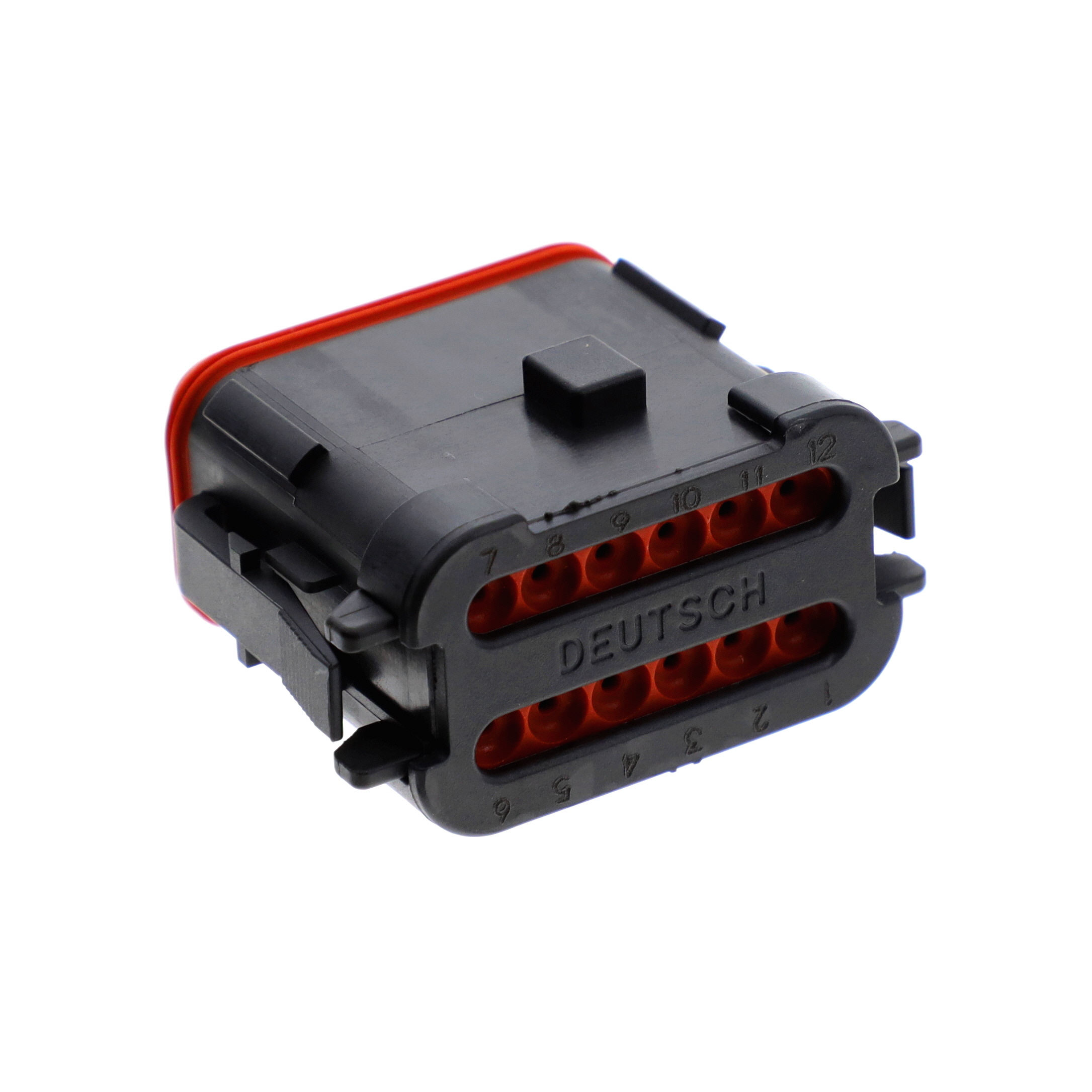
12 positions, free-hanging plug, crimp female sockets, -55°C to 125°C, with IP68 and IP6K9K called out
Quick Engineering Summary
| Field | Value |
|---|---|
| Manufacturer | TE Connectivity |
| Category | Rectangular Connector Housings |
| Package | Bulk |
| Core function | CONN PLUG HSG 12POS |
| Key electrical range | Supply and Demand Status: Shortage; Temperature Range - Operating: -55°C ~ 125°C |
| Reported stock | 2003 pcs reported — confirm on RFQ |
Not for board I/O; right for sealed inline harnesses
Wrong for board mounting, direct solder termination, or a finished connector assembly. DT06-12SC-CE06 is only the housing, free-hanging in-line, and it takes crimped female socket contacts.
It fits cable-to-cable harness work where dirt and washdown matter more than board space. The 12 positions across 2 rows point to moderate harness density, and the latch lock matters because a loose inline connector turns into a field return fast. With lifecycle still Unknown, DT06-12SC-CE06 belongs in sustaining designs first and stays a cautious new design-in candidate until lifecycle is confirmed.
125°C is the ceiling that keeps it in harsh zones
125°C is the ceiling, with -55°C at the cold end. That puts DT06-12SC-CE06 in equipment that sees real outdoor or under-hood temperature swing, while current, contact heating, and voltage spacing remain unspecified here.
The constraint is supply, not the housing itself
The constraint is supply. Stock quantity is 2003, package is Bulk, and supply status is Shortage, so an existing production harness should have its required quantity reserved now.
Bulk packaging works well enough for bench builds and harness cells, but it will not solve handling for you. RoHS does not get in the way: EU RoHS is stated, and no exemption detail is listed.
The sealing claim is useful, but the missing details still matter
The weak point is the missing connector definition, not the temperature range. IP68 and IP6K9K are meaningful claims, and reduced wire seals clearly place DT06-12SC-CE06 in sealed harness work, but that still leaves open which wire range, contact size, and cavity layout you are actually committing to.
That gap matters more than the color or the plastic callout. A housing can look right on a BOM and still stop a build when the chosen contacts do not match the intended conductor, or when the mating half and polarization were assumed instead of checked. The concrete missing items here are the pin or cavity drawing, the mating connector reference, the accepted wire and contact range for the reduced wire seal version, and any dimensional drawing that fixes envelope and latch clearance.
Without those details, you can place DT06-12SC-CE06 in the right class of design, but you can't release the harness definition with confidence.
View the Win-Source product page for DT06-12SC-CE06.
Key Takeaways for Engineers & Buyers
- Confirm the mating half and keying before releasing DT06-12SC-CE06 into a 12-position harness.
- Lock contact and wire-seal selections to the reduced wire seal version before crimp tooling is assigned.
- Cover the shortage now: reserve required quantity against the listed 2003 pieces if this is for an active build.