
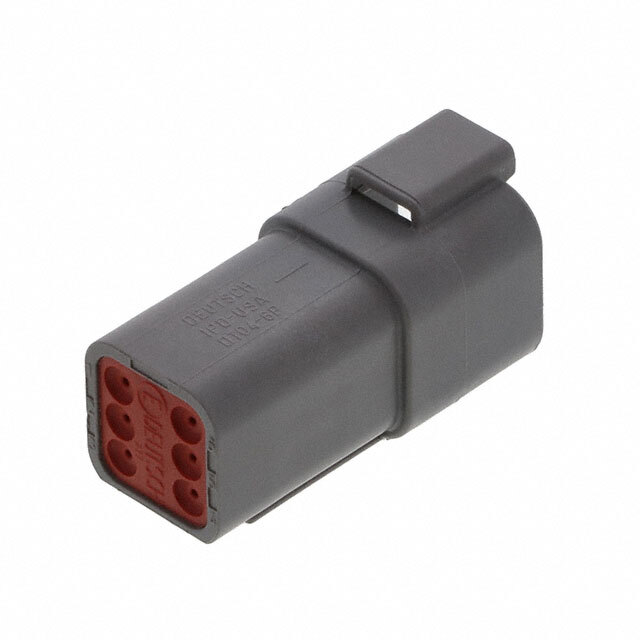
IP68/IP6K9K sealed 2-position plug housing for free-hanging use, rated -55°C to 125°C
Quick Engineering Summary
| Field | Value |
|---|---|
| Manufacturer | TE Connectivity |
| Category | Rectangular Connector Housings |
| Package | Bulk |
| Core function | CONN PLUG HSG 2POS |
| Key electrical range | Supply and Demand Status: Shortage; Temperature Range - Operating: -55°C ~ 125°C |
| Reported stock | 1699 pcs reported — confirm on RFQ |
Use it, but buy it deliberately
Use it.
There is no lifecycle reason to screen this out of a new harness. DT06-2S-CE04 is an Active 2-position plug housing, and the fit is clear: free-hanging, crimp-terminated, female-socket construction with latch lock and sealing called out as IP68 and IP6K9K. That combination points to inline cable assemblies that need to stay mated and stay sealed, not a board interface and not a quick bench lash-up. EU RoHS is straightforward here and doesn't complicate release.
The stronger case comes from how the mechanical and environmental details line up. A -55°C to 125°C operating range gives it room for harsh equipment, while the free-hanging format and latch lock suit harnesses that see movement and vibration. Still, this page defines a housing, not a complete interconnect system, so it does not establish current capacity, contact resistance, or mating durability. Get that distinction wrong and the shell can look qualified while the contact system and wire choice still decide whether the harness survives the field.
125°C is the ceiling that keeps it in harsh harnesses
125°C is the ceiling.
The listed operating range is -55°C to 125°C, and that keeps DT06-2S-CE04 in consideration for underhood, outdoor, or washdown-adjacent cable runs where ordinary housings get brittle at one end or soften at the other.
The other decisive limits are mechanical and environmental, not electrical. IP68 and IP6K9K are enclosure-level claims for the assembled connector system, so they support use where water ingress and high-pressure cleaning matter, but the listing does not show the mating half, contact system, or assembly conditions behind those ratings. The latch lock supports retention in a vibrating inline harness, and the glass-filled polyamide body marks this as a mechanical shell first. Current, voltage, and creepage limits are not listed for DT06-2S-CE04.
Not for boards or dense multiway I/O
Not for boards, panel receptacles, or dense multiway I/O.
DT06-2S-CE04 fits simple sealed cable-to-cable links where 2 positions, crimp termination, and a latch lock matter more than compactness.
The shortage flag is the buying constraint
And that's the real constraint. The 1699 pieces on hand matter less than the Shortage demand signal. DT06-2S-CE04 is sold in Bulk, so the risk is replenishment timing and line interruption, not lifecycle instability. For existing production, secure build quantity against current stock before releasing another harness revision that depends on it.
What's missing is concrete connector detail: no pin or cavity drawing, no mating-part reference, no contact size or wire-range detail, and no dimensional information for the housing envelope. Those gaps block packaging, harness tooling, and seal-stack decisions for DT06-2S-CE04.
View the Win-Source product page for DT06-2S-CE04.
Key Takeaways for Engineers & Buyers
- Lock wire and seal selection to the reduced-wire-seal version before releasing DT06-2S-CE04.
- Reserve stock early if DT06-2S-CE04 is for a running line; demand is flagged as shortage.
- Pull the mating-part and cavity details for DT06-2S-CE04 before freezing the harness drawing.