
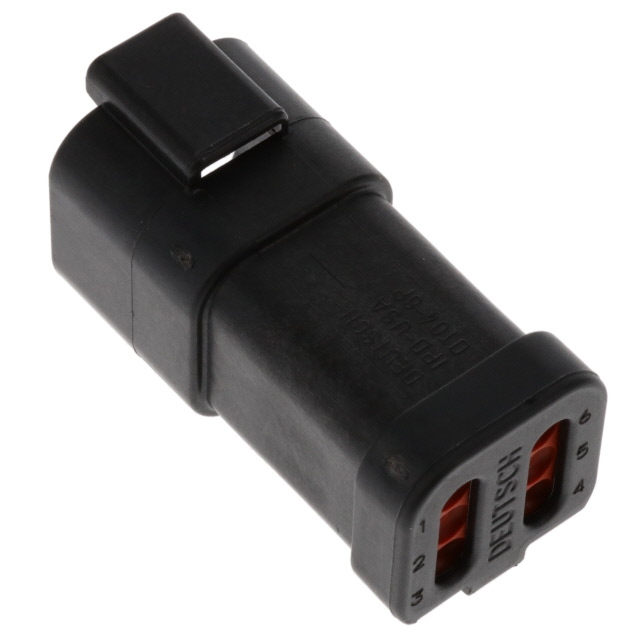
IP68/IP6K9K sealing, 2 positions, free-hanging plug housing, and -55°C to 125°C operating range
Quick Engineering Summary
| Field | Value |
|---|---|
| Manufacturer | TE Connectivity |
| Category | Rectangular Connector Housings |
| Package | Bulk |
| Core function | CONN PLUG HSG 2POS |
| Key electrical range | Supply and Demand Status: Normal; Temperature Range - Operating: -55°C ~ 125°C |
| Reported stock | 1 pcs reported — confirm on RFQ |
2 positions decide the job
2 positions is the first filter. It puts this housing in a small sealed harness branch, not anywhere circuit growth is likely. With 1 row, a plug body, and female socket contacts on crimp termination, it fits a compact wire-to-wire in-line connection.
This is a valid new design-in choice. Active lifecycle, normal supply status, and EU RoHS support that. The catch is supply visibility: one stock figure says 1 and another says 708. That conflict does not rule out DT06-2S-EP06, but availability needs to be locked before a build is frozen around it.
The real limits are sealing and temperature
The constraint is environmental coverage without the electrical detail to finish the call. IP68 and IP6K9K, together with the sealed gasket, place DT06-2S-EP06 in wet or washdown-exposed routing, but they say nothing about current capacity, contact resistance, or mating durability because those numbers are not here.
The -55°C to 125°C operating range is the other hard boundary. It answers whether the housing material belongs in cold-start outdoor equipment or hot under-hood routing, but it does not settle terminal heating, wire insulation limits, or full connector performance across temperature.
Free-hanging only, and that matters
125°C is the upper temperature ceiling, and that broad range keeps ambient from ruling out many vehicle and industrial harness locations. The mounting style does. Free Hanging (In-Line) narrows the fit fast: this housing belongs in cable-to-cable runs and serviceable branch connections, not at a board edge, not in a panel cutout, and not anywhere mechanical retention depends on a chassis mount.
Latch Lock helps in vibration-prone routing, while the glass-filled polyamide body points to a connector built to take more handling than a light indoor signal shell. Use DT06-2S-EP06 where the harness carries the mechanics and the seal carries the environment.
The buying risk is not lifecycle; it's definition
The weak point is missing detail. The strong point is product status: DT06-2S-EP06 is Active, sold in Bulk, and clearly identified enough to place in a harness BOM.
What is missing is what closes the release. You have plug, female socket, crimp, latch lock, and 2 positions, yet there is no pinout or cavity drawing here, no dimensional drawing, and no terminal or wire-range detail. Those are not small omissions. They decide whether the housing clears adjacent hardware, whether service tooling fits the crimp system, and whether the selected contacts match the conductor set already frozen elsewhere in the harness.
The stock picture also needs one clean answer. A quantity of 1 in one field and 708 in another can stall a line if someone assumes the larger number is immediately available in the same pack condition. Reconcile that first, then pull the full connector documentation before letting DT06-2S-EP06 spread across variants.
What the listing still doesn't tell you
Wrong for a released interface on listing data alone. Right for a plausible housing shortlist once the drawing, pin or cavity layout, and compatible terminal and wire-range details are in hand.
View the Win-Source product page for DT06-2S-EP06.
Key Takeaways for Engineers & Buyers
- Lock the mating connector and terminal set before release; this housing only tells you plug, female socket, and crimp.
- Resolve the stock split between 1 and 708 before committing DT06-2S-EP06 to a running line.
- Pull the drawing and cavity details for DT06-2S-EP06; the housing listing does not close panel, harness, or service tooling fit.