
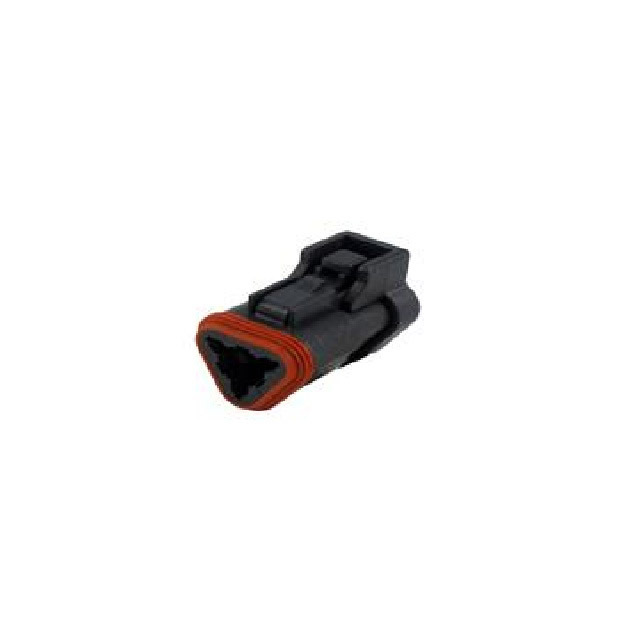
-55°C to 125°C, 3 positions, free-hanging plug housing with crimp female sockets and sealed entry
Quick Engineering Summary
| Field | Value |
|---|---|
| Manufacturer | TE Connectivity |
| Category | Rectangular Connector Housings |
| Package | Bulk |
| Core function | CONN PLUG HSG 3POS |
| Key electrical range | Supply and Demand Status: Shortage; Temperature Range - Operating: -55°C ~ 125°C |
| Reported stock | 1 pcs reported — confirm on RFQ |
125°C is useful, but sealing is the real reason to pick it
125°C is the ceiling at the top of the -55°C to 125°C operating range. That settles the ambient range question, but not contact heating, because DT06-3S-EP11 is only the housing.
The stronger reason to choose it is the sealing package: blocked gasket, IP68, IP6K9K, and shrink boot adapter. For cable-to-cable or in-line harness work exposed to washdown, dust, and rear-entry sealing demands, that matters more than the temperature line. Latch lock adds retention in a vibrating loom. What you still do not get here is any electrical ceiling such as current or voltage, so DT06-3S-EP11 does not close conductor sizing or creepage decisions on its own.
The constraint is availability, not lifecycle
Supply is the constraint. Active status supports new design-in, but stock is 1 and the demand signal is Shortage, so those numbers drive the real decision.
Don’t release it into an unconstrained build unless incoming supply is already covered. Bulk packaging suits harness production and service stock, though it also points to piece-level handling rather than reel-fed convenience. EU RoHS is compliant, so compliance is not the blocker here.
View the Win-Source product page for DT06-3S-EP11.
This is a harness shell, not an electrical answer
It’s a harness shell.
Use it when the housing solves the problem. DT06-3S-EP11 is a free-hanging in-line plug housing with 3 positions, 2 rows, crimp termination, and female socket contacts, which puts it squarely in sealed wire-to-wire harness assemblies and field-serviceable cable ends rather than anything panel-mounted or board-mounted.
The 3-position count is a hard fit limit. If the circuit may grow, this housing fixes you at a very small cavity count from the start. The 2-row layout matters mechanically as well, affecting mating geometry and harness breakout, yet the listing gives no drawing, no cavity map, and no keying detail, so packaging and service-access questions stay open.
The contact system narrows the process window too. Crimp termination places DT06-3S-EP11 in a harness build flow with the right applicators and inspection discipline, not in a quick hand-solder repair path. Female socket contacts narrow the mating side you need, but without the mating connector callout or pinout detail, the full interconnect stack is still unresolved. That is exactly where wrong-part builds begin, especially in sealed families with multiple keyed shells that look interchangeable until final assembly.
What is still missing before release?
What does a buyer or engineer need first? A drawing. DT06-3S-EP11 still lacks the dimensional outline, pin or cavity identification, and mating or keying detail needed to settle enclosure clearance and harness orientation.
The listing also does not include contact size compatibility or any electrical rating for the assembled connector system. Since DT06-3S-EP11 is only the housing, those omissions matter more than another feature line.
View the Win-Source product page for DT06-3S-EP11.
Key Takeaways for Engineers & Buyers
- Lock the BOM to a 3-position plug housing with female crimp contacts; this is not a complete connector set.
- Check the mating half and cavity layout before release; the listing gives 3 positions and 2 rows, but no drawing or keying detail.
- Cover the shortage now: stock is 1, so place only against confirmed incoming supply or approved buffer.