
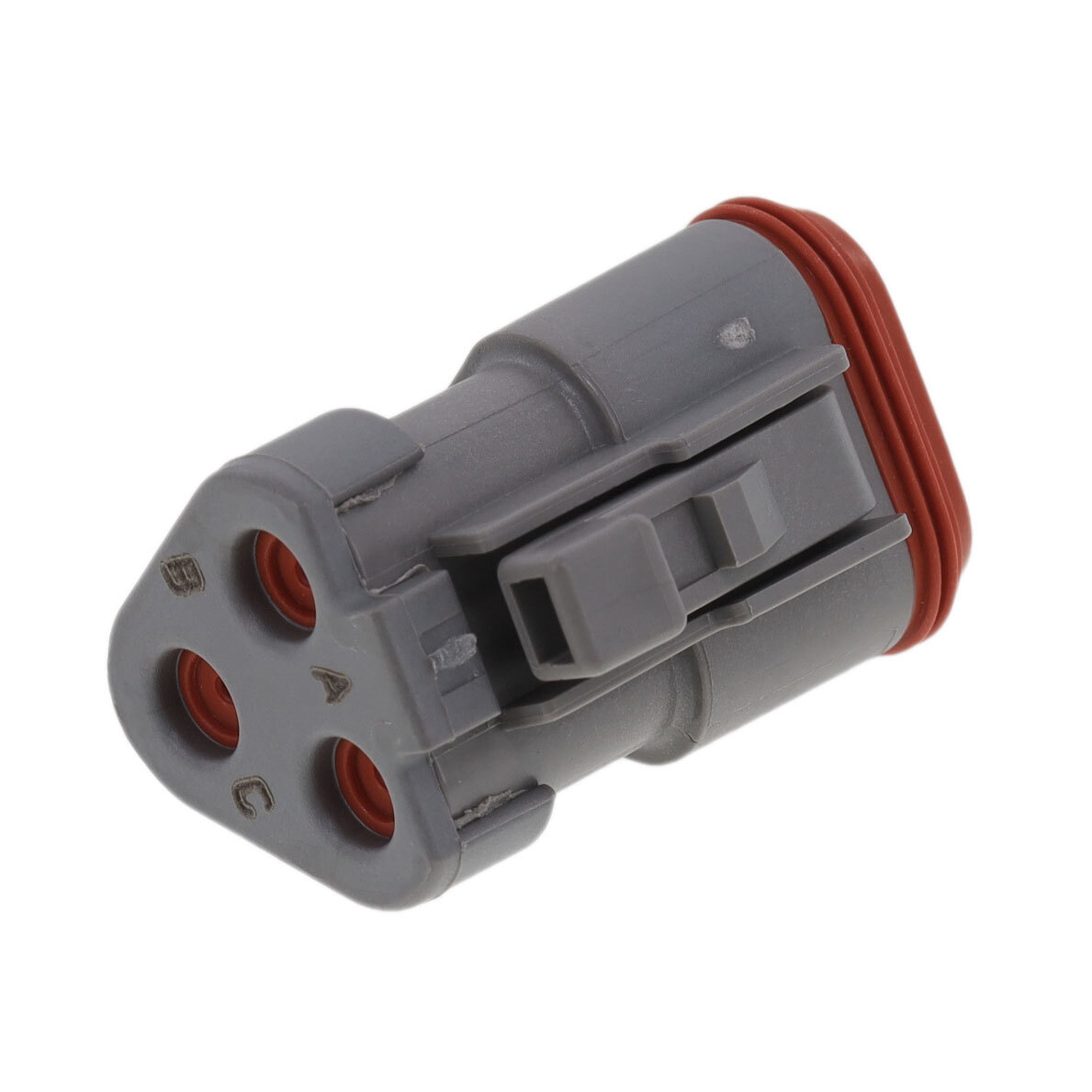
IP68/IP6K9K sealed 3-position plug housing, free-hanging crimp style, -55°C to 125°C
Quick Engineering Summary
| Field | Value |
|---|---|
| Manufacturer | TE Connectivity |
| Category | Rectangular Connector Housings |
| Package | Bulk |
| Core function | CONN PLUG HSG 3POS |
| Key electrical range | Supply and Demand Status: Shortage; Temperature Range - Operating: -55°C ~ 125°C |
| Reported stock | 1032 pcs reported — confirm on RFQ |
Can you start a new build on this housing?
Can we release it into a new build? Yes, with one caveat: supply is the issue, not lifecycle. DT06-3S-P032 is listed Active, the lifecycle signals agree, and EU RoHS is compliant, so there is no status conflict pushing it into sustaining-only use.
What closes the decision is the hardware itself. This is a 3-position plug housing with female socket contact style, crimp termination, and free-hanging mounting, which puts it in cable-to-cable or cable-end harness work rather than on a board or in a hand-soldered assembly. The blocked gasket with IP68 and IP6K9K tells you it is built for sealed interconnects where water and washdown exposure are part of the job, but it does not answer the current path, contact resistance, or mating system details.
The sealing is the point, not the position count
That is also why the environmental ratings matter more than the fact that it has 3 positions. IP68 and IP6K9K define the use case: sealed harnessing in dirty or wet service, with a latch lock that is better suited to field assembly than a loose friction fit. If ingress is the problem, DT06-3S-P032 belongs on the shortlist.
The -55°C to 125°C operating range is a ceiling that settles one question and leaves another open. It sets the environmental limit for the housing across cold-start and hot-soak conditions, but it does not tell you what the contacts can carry there, how sealing ages across cycles, or what insertion force looks like after exposure. The glass-filled polyamide body supports the case for a mechanically durable harness connector, while the listing still stops short of the dimensions and mating details that decide packaging.
What the shortage changes
1032 is enough to matter, but the shortage flag matters more. For DT06-3S-P032, the buy decision is simple: if this is for a running line, place coverage early and keep the approved build tied to the exact housing, because the constraint is availability timing, not a lifecycle warning.
Wrong for board work; right for sealed inline harnesses
Not for PCB placement. Not for solder termination either.
DT06-3S-P032 is a free-hanging rectangular connector housing with crimp contacts and a latch lock, so it fits inline harness assemblies where the connector body lives on the cable, not on the board or panel.
The 2-row, 3-position format works when circuit count is small and the enclosure or harness branch does not justify a larger shell. Black color and bulk packaging are secondary details, but bulk still has a practical consequence: this part is aimed at production handling, kitting, or harness bench work rather than tray-managed automated placement. That changes receiving, line-side presentation, and traceability.
The missing pieces are concrete. This listing does not give the pinout or cavity arrangement beyond 3 positions and 2 rows, so keying and wire routing are still open. It does not give a drawing, so envelope and latch-clearance checks are still open. It does not identify the mating connector or terminal part numbers, and without those, the seal claim is not enough to release a harness build around DT06-3S-P032.
View the Win-Source product page for DT06-3S-P032.
Key Takeaways for Engineers & Buyers
- Lock the mating connector and terminal set before releasing DT06-3S-P032 to layout.
- Treat the -55°C to 125°C range as the environmental limit for the housing, not proof of full harness qualification.
- Cover the shortage signal now if DT06-3S-P032 is going onto a running build.