
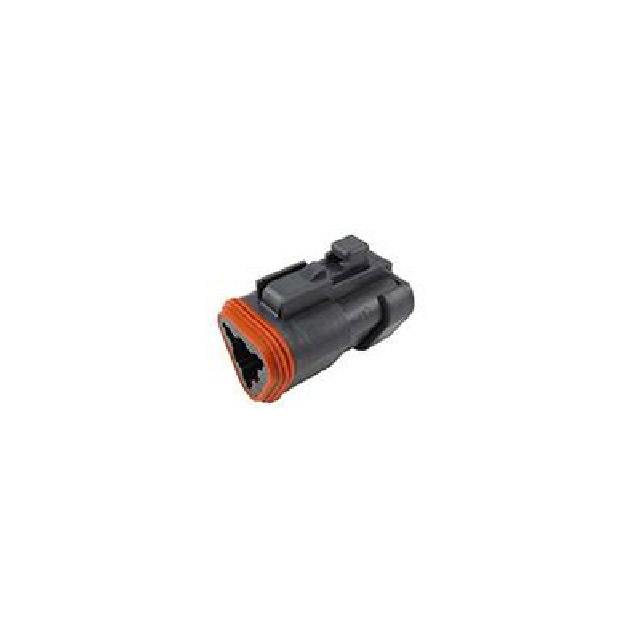
4-position free-hanging plug housing with -55°C to 125°C operation, IP68, and IP6K9K sealing
Quick Engineering Summary
| Field | Value |
|---|---|
| Manufacturer | TE Connectivity |
| Category | Rectangular Connector Housings |
| Package | Bulk |
| Core function | CONN PLUG HSG 4POS |
| Key electrical range | Supply and Demand Status: Shortage; Temperature Range - Operating: -55°C ~ 125°C |
| Reported stock | 1 pcs reported — confirm on RFQ |
125°C is the number that keeps this in the harness
125°C is the ceiling that keeps this housing credible in hot, exposed cable runs. The operating range is -55°C to 125°C, but current, contact heating, and mating-cycle life are still open because only the housing is described here.
Can you actually buy enough of it?
Can you get enough parts? Not on faith alone. DT06-4S-CE01 is flagged Shortage, one stock signal shows 1, and another shows 1122; that conflict is the real buying problem, not RoHS.
Handle it as a controlled purchase, not a casual add to a new BOM. For an existing production build, reserve supply against exact harness demand and clear the quantity mismatch first. EU RoHS is compliant, but that won't be what stops the line.
Wrong for board I/O; right for sealed inline cable joints
Not for board mounting. This is a free-hanging, in-line plug housing with 4 positions in 2 rows, female socket contacts, crimp termination, and a latch lock, so it belongs in a cable harness rather than on board I/O.
That fit is narrow in a useful way. IP68 and IP6K9K sealing, along with the cap and reduced wire seals, point straight at wet and dirty service where washdown, spray, or road grit would punish an unsealed rectangular housing. The glass-filled polyamide body pushes the same message from a different angle: this part is meant to take mechanical handling in a harness, not sit sheltered inside an enclosure.
The limits are just as clear. There is no contact system detail beyond female socket, no wire range, no mating connector callout, and no dimensional drawing here, so the part is easy to place in the right class of design while still being impossible to release cleanly without the full TE Connectivity document set.
The gaps are mechanical, not cosmetic
The weak point is documentation depth. The strong point is that the listed features already narrow the application to sealed inline harness work.
The missing items that still decide release are concrete: the mating half and keying details, the housing drawing, the accepted wire-seal and contact range, and the pin or cavity layout. Without those, you can't finish harness packaging or service access, even though the category, sealing level, and temperature range already make the use case clear.
View the Win-Source product page for DT06-4S-CE01.
Key Takeaways for Engineers & Buyers
- Confirm the mating half and keying before releasing DT06-4S-CE01 to production.
- Lock the crimp contact and wire-seal combination that matches the reduced wire seals.
- Resolve the stock mismatch between 1, 1122, and shortage before scheduling builds.