
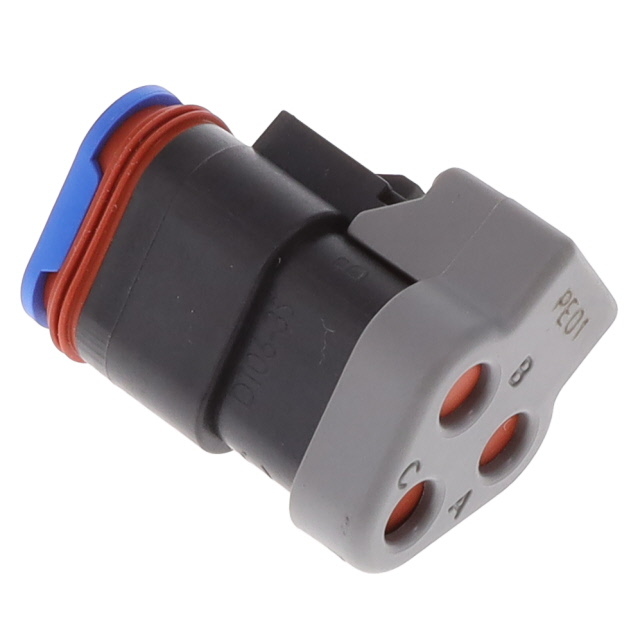
4-position free-hanging plug housing with crimp female socket interface, -55°C to 125°C, IP68/IP6K9K
Quick Engineering Summary
| Field | Value |
|---|---|
| Manufacturer | TE Connectivity |
| Category | Rectangular Connector Housings |
| Package | Bulk |
| Core function | CONN PLUG HSG 4POS |
| Key electrical range | Supply and Demand Status: Limited; Temperature Range - Operating: -55°C ~ 125°C |
| Reported stock | 1 pcs reported — confirm on RFQ |
Can you start a new build on DT06-4S-E003?
Can you release a new build on it today? Probably not. The housing format fits a sealed inline harness connector, but the lifecycle is Unknown and supply is marked Limited. That is enough to keep it out of a fresh release unless the mating side already forces this exact housing.
The part itself is clear enough: a 4-position plug housing in 2 rows, free hanging, with crimp termination, female socket contacts, and latch lock retention. EU RoHS is compliant. For sustaining designs, that set of facts works if the harness and mating geometry are already fixed. For a new program, the unresolved lifecycle and the stock mismatch matter more than the black plastic body or the cover feature.
This is not a board connector, and that matters
Wrong first: this is not for board mount, panel mount, or a finished contact system straight out of the bag. It is a free-hanging in-line plug housing only, and the listing calls for crimp termination with female socket contacts, so the design effort sits in the harness and contact choice rather than in a PCB footprint.
That makes it a sensible fit for cable-to-cable or cable-to-device interconnects where sealing and retention come first. IP68 and IP6K9K point to exposed or washdown environments, while the latch lock tells you retention is mechanical rather than threaded or board-supported. If that basic packaging concept is wrong, the connector choice starts fighting the product before electrical validation even begins.
The 4 positions and 2-row layout settle one mechanical question and leave several others open. They define cavity count and arrangement, so you can screen mating compatibility at a high level, but they do not give you cavity numbering, keying detail, or the housing drawing. In practice, that means DT06-4S-E003 belongs in sealed inline harnesses, not general-purpose interconnect work.
The weak point is supply, not temperature
Availability is the problem, not temperature. The -55°C to 125°C operating range is the reassuring number here because it places DT06-4S-E003 in cold-start and hot-soak environments that would rule out lighter-duty housings.
What that range does not settle is current loading, contact heating, or sealing life over repeated mate and unmate cycles, because this record covers the housing and does not include contact ratings or durability data. The immediate issue is simpler: one stock field shows 1, another shows 1938, and supply is marked Limited. Freeze the required quantity before release. If this is for an existing production harness, secure line quantity first and let the lifecycle question run in parallel.
The missing details are the ones that close the harness review
4 positions. That is enough to shortlist DT06-4S-E003, not enough to finish the job. The missing items are the housing drawing, pin or cavity numbering, the mating part definition, and the contact wire-range detail.
Those gaps are not cosmetic. The drawing decides envelope and clip clearance, the cavity map decides harness build accuracy, and the mating definition decides whether the latch and seal system are actually compatible with the rest of the connector set. Without that information, this page tells you where DT06-4S-E003 belongs, but it does not close the harness release.
View the Win-Source product page for DT06-4S-E003.
Key Takeaways for Engineers & Buyers
- Lock the harness to a 4-position, 2-row plug interface before releasing DT06-4S-E003.
- Match DT06-4S-E003 only to crimped female socket terminations and a latch-lock mating scheme.
- Resolve the stock split on DT06-4S-E003 now: one field shows 1, another shows 1938.