
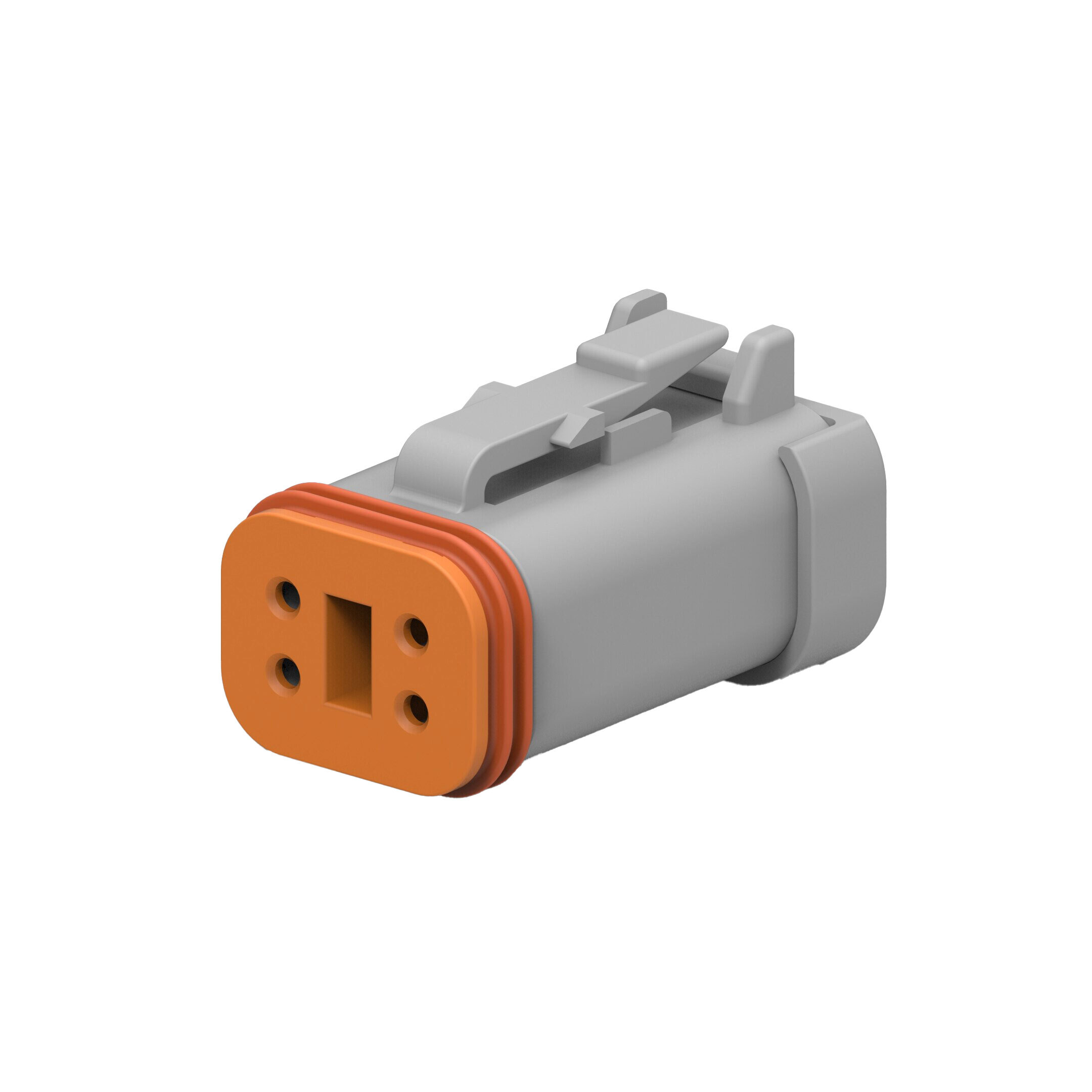
4 positions, free-hanging plug housing, IP68/IP6K9K features, and -55°C to 125°C operating range
Quick Engineering Summary
| Field | Value |
|---|---|
| Manufacturer | TE Connectivity |
| Category | Rectangular Connector Housings |
| Package | Bulk |
| Core function | CONN PLUG HSG 4POS |
| Key electrical range | Supply and Demand Status: Normal; Temperature Range - Operating: -55°C ~ 125°C |
| Reported stock | 1 pcs reported — confirm on RFQ |
Not for board I/O; right for sealed cable plugs
Wrong for board mount, panel receptacles, or assembled connectors with contacts already loaded. DT06-4S-EP11 is a rectangular connector housing only: plug style, free hanging, with crimp termination and female socket contacts. It belongs in cable-to-cable or inline harness work, not on a PCB edge or enclosure wall.
The new-design case is simple. Lifecycle is Active, supply-and-demand is marked Normal, and the feature set is what earns attention: blocked gasket, IP68, IP6K9K, and a shrink boot adapter. Those are not decorative line items. They place this housing in builds where sealing and cable-end strain management matter more than density.
4 positions decides the harness, not just the BOM line
4 positions is the first hard filter. If the circuit count is not exactly 4, DT06-4S-EP11 is out before sealing or material even enters the discussion. The 2-row layout matters too, because it fixes the mating geometry and the harness breakout pattern; assume one row and the interface fails even if the contact system looks familiar.
The latch lock is another real decision point. It sets retention around a positive-locking cable plug, not a friction-fit service connector. That's useful on equipment that sees handling or washdown, but the mating half and service access have to respect that lock style rather than treat it like a casual disconnect.
-55°C to 125°C is the ceiling that broadens the fit
125°C is the upper limit, and paired with -55°C it keeps DT06-4S-EP11 in play across cold-start outdoor equipment and hot under-enclosure harness runs where a lighter-duty housing would be questioned first.
That range does not finish the environmental review on its own. It establishes a housing built for harsh temperature exposure, but it says nothing about contact resistance drift, sealing performance after cycling, or how the mating pair behaves at the same extremes. Combined with IP68 and IP6K9K, though, it clearly points to sealed inline interconnects for exposed cable assemblies rather than sheltered cabinet wiring.
The material stack supports that reading. Polyamide (PA), nylon, glass filled is a practical choice for mechanical durability, and the shrink boot adapter signals a harness where the cable exit needs to stay sealed instead of merely covered. Just as important are the gaps: no contact size, no wire range, no mating connector callout, and no dimensional drawing. Those omissions stop release, because they determine whether the crimp system fits the conductor and whether the housing actually clears the space claim in the loom.
Can you keep a line running on it?
Which stock number do you trust first? One field shows 1, while the row quantity shows 1570. For DT06-4S-EP11, clear that mismatch before committing it to a running build. Bulk packaging works for production kitting once availability is reconciled.
View the Win-Source product page for DT06-4S-EP11.
Key Takeaways for Engineers & Buyers
- Lock the mating interface around the 4-position, 2-row plug format before releasing the harness.
- Use DT06-4S-EP11 only where crimp female socket contacts and latch lock retention match the cable build.
- Resolve the stock mismatch between 1 and 1570 before putting DT06-4S-EP11 on a running line.