
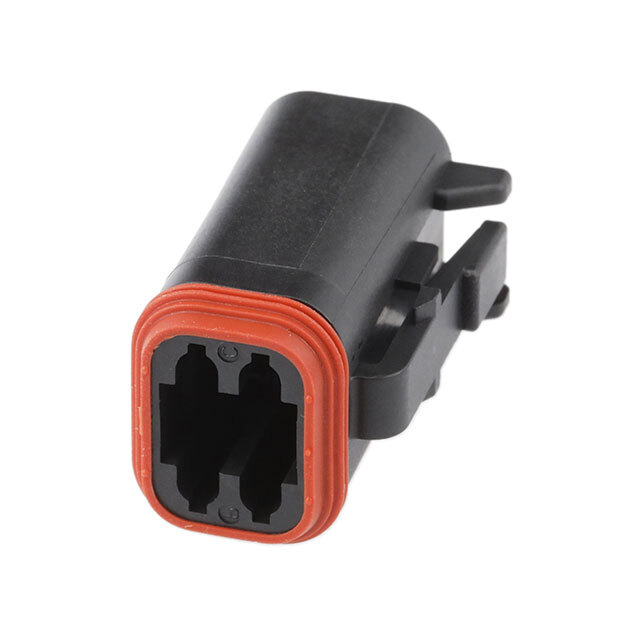
6-position, 3-row free-hanging plug housing with IP68/IP6K9K and -55°C to 125°C operation
Quick Engineering Summary
| Field | Value |
|---|---|
| Manufacturer | TE Connectivity |
| Category | Rectangular Connector Housings |
| Package | Bulk |
| Core function | CONN PLUG HSG 6POS |
| Key electrical range | Supply and Demand Status: Shortage; Temperature Range - Operating: -55°C ~ 125°C |
| Reported stock | 1 pcs reported — confirm on RFQ |
6 positions decide the use case
6 positions in 3 rows sets the use case fast. This is a plug housing for a compact wire-to-wire or inline harness junction where circuit count is fixed and the connector stays in the cable rather than on a panel or board.
Female socket contacts with crimp termination put it squarely in harness assembly and service work. The latch lock and free-hanging mounting type rule out any design expecting board retention or chassis mounting from the housing alone. Active lifecycle supports new design-in, and EU RoHS is straightforward.
The weak point is supply, not the housing
Shortage is the weak point, not lifecycle. With stock listed as 1, DT06-6S-CE02 is a poor choice for an immediate production release unless your line already has committed supply.
The stronger signal is that the part remains Active, with nothing here pointing to a forced exit. If this connector family is already qualified in a production harness, keep it there and secure material early. For a fresh program, don't mistake a one-piece stock position for continuity.
The sealing and temperature numbers set the real boundary
And that boundary is environmental, not electrical, because this listing is for a housing. The stated -55°C to 125°C operating range is a ceiling and floor for the connector assembly environment, which settles the basic ambient-fit question for cold-start and hot-zone harness routing, but it says nothing about contact heating, current rise, or voltage withstand because those numbers are not here.
IP68 and IP6K9K do most of the practical sorting. They make DT06-6S-CE02 a sensible choice when the connector sits in washdown, splash, or dirt-heavy service, where an unsealed rectangular housing would quickly become a field-return problem. Still, those ratings do not close the sealing review for the finished interconnect, because the listing gives no mating-half detail, no cavity-level sealing construction beyond reduced wire seals, and no drawing that shows how the seal system is implemented.
That missing detail matters. Reduced wire seals may help harness packaging, but without the dimensional drawing, pinout, and mating-interface detail, you still cannot finish the cable OD check, service-access check, or connector envelope review around DT06-6S-CE02.
What the listing still doesn't answer
The constraint is mechanical closure. This page gives category, position count, mounting style, and environmental claims, but it does not include the pinout or cavity layout drawing, the housing dimensions, the mating connector reference, or any contact current and voltage limits tied to the assembled connector.
Those are decisive. They determine harness breakout, keep-out space, and whether DT06-6S-CE02 can sit in the exact branch where you want it.
View the Win-Source product page for DT06-6S-CE02.
Key Takeaways for Engineers & Buyers
- Lock the harness to a 6-position, 3-row female-socket crimp plug before releasing the BOM.
- Treat IP68 and IP6K9K as housing-level fit checks; confirm the full sealed connector stack in the mating build.
- Cover the shortage now: reserve stock or move DT06-6S-CE02 to sustaining demand only until supply improves.