
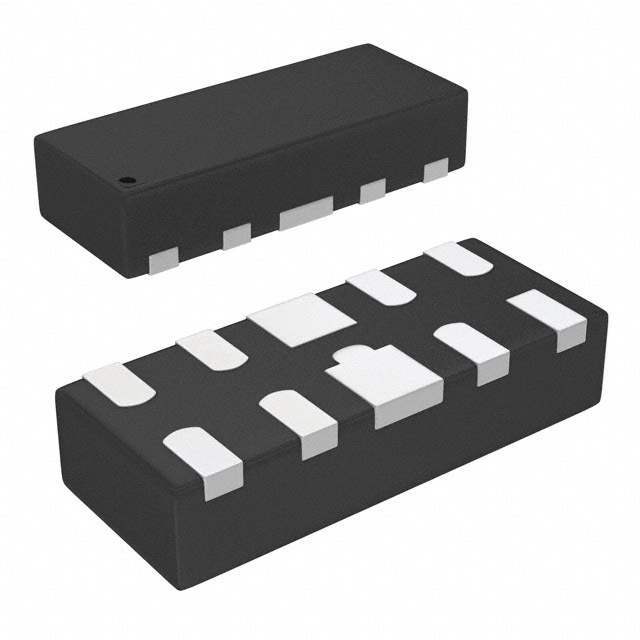
5.5V standoff, 50.4V breakdown, 5.5A peak pulse, 8-SMD no-lead package, -40°C to 85°C
Quick Engineering Summary
| Field | Value |
|---|---|
| Manufacturer | Diodes Incorporated |
| Category | TVS - Diodes |
| Package | 8-SMD, No Lead |
| Core function | TVS DIODE 5. |
| Key electrical range | Capacitance @ Frequency: 2 pF @ 1 MHz; Current - Peak Pulse (10/1000µs): 5.5A; Operating Temperature: -40°C ~ 85°C; Voltage - Breakdown (Min): 50.4V |
| Reported stock | 2927 pcs reported — confirm on RFQ |
2927 pieces don't cancel the status conflict
2927 pieces are on hand. That does not outweigh the fact that DT1140-04LPQ-7 is called Active in one place and Obsolete in another.
For a new design, that conflict is the first decision point because it blocks the easy assumption that this is a clean current-production TVS you can place and forget. Sustaining use is easier to defend than a fresh design-in until the status is reconciled. EU RoHS is fine, but compliance is not the issue; the real question is whether DT1140-04LPQ-7 is a supported line item or leftover stock with no clear forward path.
The rail window is narrow and the listing is inconsistent
The constraint is voltage, not pulse current. The listed reverse standoff is 5.5V max, so treat 5.5V as the ceiling for the protected line in normal operation, not a comfortable operating point. If your rail lives near that edge, this number alone does not tell you leakage behavior or margin drift.
The record also pulls in two directions. It gives a 50.4V minimum breakdown, while the product description says 10VC and the category points to a low-voltage TVS role. Those numbers do not sit together cleanly, and that changes whether DT1140-04LPQ-7 belongs on a low-voltage data line or is simply mischaracterized in the listing. The 5.5A peak pulse is a ceiling tied to a 10/1000µs waveform, so it does not settle repetitive stress, line surge profile, or thermal headroom by itself.
The package story needs correction
The weak point is obvious. DT1140-04LPQ-7 is described as 8-SMD, No Lead, yet another field says Requires Holder and another says Header, Male Pins, Shrouded (4 Side).
That is enough to stop layout. A compact surface-mount TVS may still be the right read, but the pinout and package mapping need to be nailed down first.
Use it on low-voltage protection only if the missing data lands
Not yet.
DT1140-04LPQ-7 is wrong for any design that needs a settled mechanical definition today, and it is also wrong for a review that depends on surge behavior beyond one peak-pulse number. It may fit compact low-voltage transient protection, because the description points to a 5.5V working standoff and a 10V clamp class in a no-lead package, while the listed capacitance of 2 pF @ 1 MHz suggests the part is at least intended for lines where loading matters.
The missing and conflicting items are the whole story now. The listing does not give reverse-recovery time, junction capacitance versus bias, thermal resistance, pinout, or a package drawing. More importantly, it does not give a clean clamping-voltage field that matches the rest of the record. Those details decide whether DT1140-04LPQ-7 protects a signal line without loading it, whether the footprint is correct, and whether the part survives the actual surge shape your product has to pass.
View the Win-Source product page for DT1140-04LPQ-7.
Key Takeaways for Engineers & Buyers
- Resolve the Active versus Obsolete status before releasing DT1140-04LPQ-7 on a new BOM.
- Keep DT1140-04LPQ-7 on rails that stay below the 5.5V reverse standoff ceiling.
- Ask for the real clamp and package data; 50.4V breakdown does not match a 10V clamp description.