
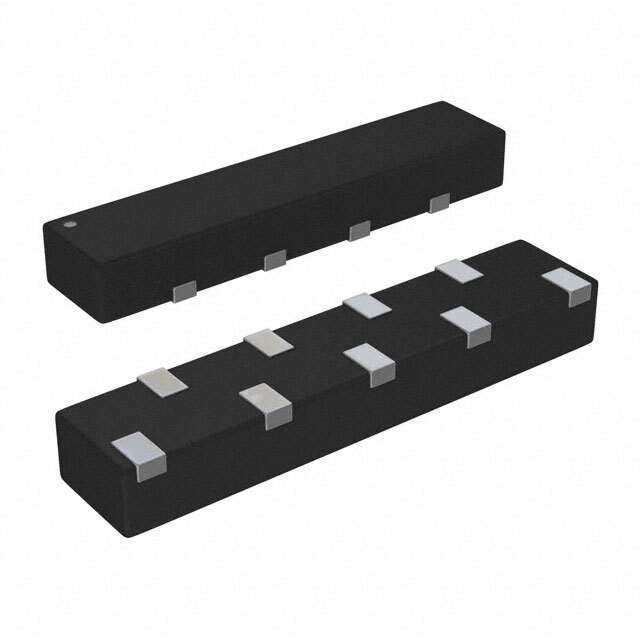
3.3V standoff, 10V max clamp, 8 channels, 0.6pF, U-DFN3810-9, -55°C to 85°C
Quick Engineering Summary
| Field | Value |
|---|---|
| Manufacturer | Diodes Incorporated |
| Category | TVS - Diodes |
| Package | Tape & Reel |
| Core function | TVS DIODE 3. |
| Key electrical range | Capacitance @ Frequency: 0.6pF @ 1MHz; Current - Peak Pulse (10/1000µs): 5.5A (8/20µs); Power - Peak Pulse: 55W; Power Line Protection: No |
| Reported stock | 85000 pcs reported — confirm on RFQ |
The weak point is missing detail, not lifecycle
The thin spot is technical detail, not commercial viability. Even so, the call is straightforward: DT1240A-08LP3810-7 is Active and makes sense for new design-in when compact high-speed I/O protection is the job.
That case rests on the listed combination of 8 unidirectional channels, a steering rail-to-rail topology, and 0.6pF @ 1MHz. For dense connector-side protection on the named DVI, HDMI, and USB interfaces, that matters because the wrong protection device can hurt signal integrity before surge performance ever becomes the limiting factor. The 3.3V reverse standoff is a ceiling on normal line bias, not blanket clearance for every 3.3V rail, and the 10V max clamping figure answers only the listed clamp ceiling, not whether the downstream PHY survives the pulse shape that matters in your design.
Keep the role narrow. DT1240A-08LP3810-7 belongs on signal lines, not power lines, and the listing says so plainly. EU RoHS compliance and MSL 1 (Unlimited) remove two common adoption frictions, while the package format and stock position make it practical to move onto an active line without waiting on a lifecycle surprise.
The clamp ceiling is the real design constraint
The numbers set the limit. At 5.5A, the listed clamping ceiling is 10V, and that decides whether the interface can tolerate DT1240A-08LP3810-7 ahead of it.
The 55W peak pulse rating is also a ceiling. Treat it as a surge limit, not continuous dissipation.
0.6pF is why this part belongs on fast ports
0.6pF @ 1MHz is the hook. It puts DT1240A-08LP3810-7 in the conversation for the named DVI, HDMI, and USB interfaces, where protection parts often lose on signal integrity before they lose on surge handling.
U-DFN3810-9 fills in the rest. With 8 unidirectional channels, this is a connector-adjacent board-level protector for tightly packed signal groups, not a general-purpose device placed deeper in the system. The listed -55°C ~ 85°C (TA) range defines the ambient window only; it does not answer junction rise under repeated stress, and that gap matters in a cramped enclosure with limited copper for heat spreading.
Can you keep a line running on it?
First question: can you actually buy it in production quantity? Yes. Inventory is 85000.
Tape & Reel and a standard package of 5,000 pcs fit normal SMT flow, so if DT1240A-08LP3810-7 clears the rail and clamp ceilings, buy to reel quantity and avoid a mid-build packaging split.
What the listing still doesn't tell you
And that still leaves the real technical gaps. DT1240A-08LP3810-7 needs the full datasheet to close several decisions: trr is absent, junction capacitance versus bias is absent beyond the single 0.6pF @ 1MHz point, thermal resistance is absent, and neither pinout nor package drawing appears here.
Those are decisive details. The capacitance curve shows how well the low-capacitance claim holds at actual rail bias, the thermal data sets pulse-to-pulse heating risk, and the pinout and drawing determine whether the 9-UDFN footprint lands cleanly under the connector escape.
View the Win-Source product page for DT1240A-08LP3810-7.
Key Takeaways for Engineers & Buyers
- Match every protected rail on DT1240A-08LP3810-7 to the 3.3V reverse standoff ceiling before layout starts.
- Check the interface tolerance against the 10V max clamping limit at 5.5A before signing off HDMI or USB protection.
- Pull the full datasheet for pinout and thermal data before committing the 9-UDFN footprint.