
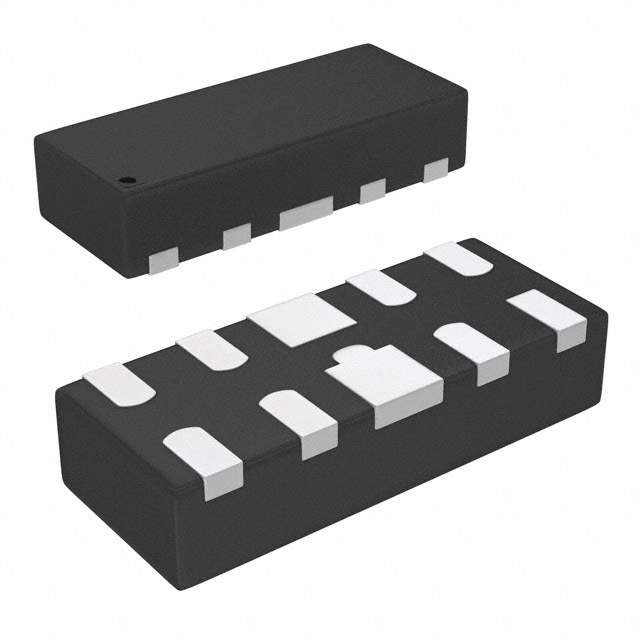
3.3V reverse standoff, 8.8V max clamp, 4 unidirectional channels in U-DFN2510-10 for HDMI protection
Quick Engineering Summary
| Field | Value |
|---|---|
| Manufacturer | Diodes Incorporated |
| Category | TVS - Diodes |
| Package | 10-UFDFN |
| Core function | TVS DIODE 3. |
| Key electrical range | Current - Peak Pulse (10/1000μs): 5.5A (8/20μs); Power - Peak Pulse: 60W; Power Line Protection: Yes; Supply and Demand Status: Balance |
| Reported stock | 204000 pcs reported — confirm on RFQ |
The clamp window is tight enough to matter
The numbers create a narrow operating window: 3.3V reverse standoff, 6V minimum breakdown, and 8.8V maximum clamping. That leaves little room for guesswork about where this device belongs. The HDMI callout makes the target use plain, and DT1240V3-04LP-7 fits 3.3V signal protection rather than some broader higher-rail role. The 6V breakdown figure is a trigger threshold, not a normal operating point.
The other decision-maker is surge handling. A 5.5A peak pulse on an 8/20µs waveform and 60W peak pulse power set the upper limits for what the part is meant to absorb, but they do not answer repetitive stress, board heating, or how much margin remains once the protected line is clamped at 8.8V during a real event. That distinction matters more than the headline ratings, because a compact protector can look comfortable on paper and still leave the downstream receiver exposed if its own tolerance is tight.
For a new design, the case is straightforward. DT1240V3-04LP-7 makes sense for compact HDMI protection when the protected pins can live with that clamp level and when a 10-UFDFN footprint earns its keep through channel density. Active lifecycle and EU RoHS are useful. They aren't the hard part.
Can you keep a running line on it?
Can you buy it and keep building with it? Yes. DT1240V3-04LP-7 is Active, stock is 204000, packaging is Reel, and MSL 1 (Unlimited) removes a common handling nuisance in production.
And that still leaves the real review open
And that is only the supply-side answer. What the listing does establish is clear enough: DT1240V3-04LP-7 is a 4-channel unidirectional steering device in U-DFN2510-10, built for SMD assembly and aimed at HDMI. It suits board-edge protection where several lines need coverage in very little area, especially when the design wants rail-to-rail steering behavior instead of a single larger suppressor.
The omissions are just as important. Junction capacitance is missing, and for HDMI that is not a cosmetic gap; it is one of the first numbers that decides whether the protector stays invisible in the channel or shows up in signal-integrity work. There is no pinout or package drawing here, so the 4 channels and U-DFN2510-10 package still do not tell you how cleanly it lands in layout. Reverse leakage is absent, and so is thermal resistance or a derating curve, leaving ambient headroom and repeated-stress behavior unresolved.
Wrong for vague surge requirements
Wrong first: if signoff depends on junction capacitance, thermal resistance, or a package drawing, this page will not get you there. Those missing items decide signal loading, heat flow, and footprint certainty.
After that, the fit sharpens. DT1240V3-04LP-7 belongs on 3.3V HDMI lines where four unidirectional channels in a small SMD package matter more than a fuller short-form electrical picture. If the layout already expects U-DFN2510-10, the reel format lines up cleanly; if not, stop at the footprint stage and pull the full datasheet for capacitance and pinout before committing copper.
View the Win-Source product page for DT1240V3-04LP-7.
Key Takeaways for Engineers & Buyers
- Keep DT1240V3-04LP-7 on 3.3V HDMI nets; 3.3V reverse standoff is the ceiling, not extra rail margin.
- Budget the surge path around 8.8V max clamping at 5.5A; that number decides what the protected receiver must survive.
- Pull the full datasheet for capacitance and pinout before layout; this listing gives 4 channels in U-DFN2510-10 but not the line mapping.