
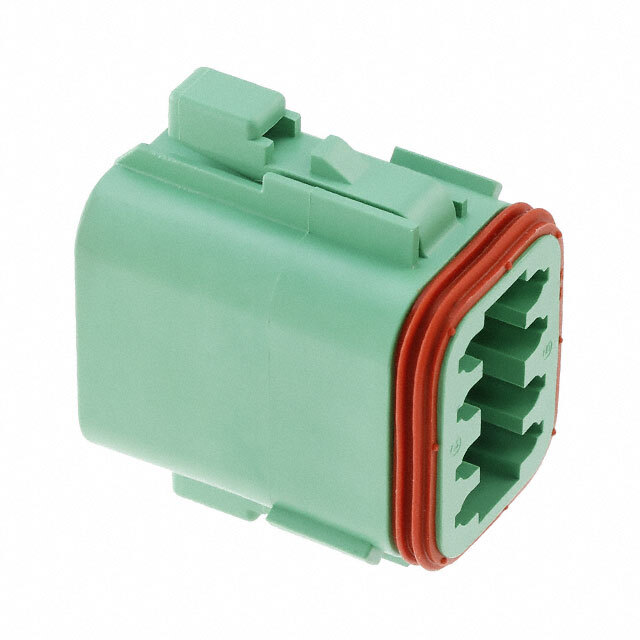
250VDC, 12 positions, right-angle panel mount, IP68/IP6K9K, -55°C to 125°C
Quick Engineering Summary
| Field | Value |
|---|---|
| Manufacturer | TE Connectivity |
| Category | Rectangular Connectors - Headers, Male Pins |
| Package | Bulk |
| Core function | CONN HEADER R/A 12POS 4. |
| Key electrical range | Supply and Demand Status: Shortage; Temperature Range - Operating: -55°C ~ 125°C; Voltage Rating: 250VDC |
| Reported stock | 70 pcs reported — confirm on RFQ |
Can you start a new build on it?
Can you use it in a new build today? Yes—if supply is handled first. Active status and EU RoHS compliance keep TE Connectivity DT13-12PD in play; the real constraint is the shortage flag against stock of 70.
250VDC is an insulation ceiling, not a system answer
250VDC is the listed voltage rating. That sets the insulation ceiling, not the whole electrical case, because creepage, clearance, and mating-system behavior are not included here.
The temperature range runs from -55°C to 125°C, which gives it room for harsh equipment and outdoor harness interfaces. What it does not give you is current budgeting. No current rating is listed, so the thermal limit of a loaded 12-position arrangement remains open.
The weak point is supply, not fit
Supply is the weak point. The format is not. TE Connectivity DT13-12PD is a 12-position, 2-row, board-to-cable/wire header with right-angle, panel-mount, through-hole construction, plus a latch holder and mounting flange.
That combination fits equipment where the board sits behind a panel and the harness mates from the side, rather than free-floating board interconnect inside a tight enclosure. IP68/IP6K9K and the shrouded 4-wall body push it toward exposed or washdown-prone interfaces where sealing and mating protection matter more than compact pitch.
Wrong for current budgeting; right for sealed panel I/O
Wrong for current budgeting. Right for sealed panel I/O.
This part does not work for a design that still needs its connector current limit established from the listing, because no rated current appears here. It does fit a board-to-cable interface when the mechanical brief is already settled: 12 loaded positions, male pins, right-angle through-hole attachment, panel mounting, and latch retention in a sealed form factor.
The physical dimensions back that up. A 4.44mm mating pitch and 6.35mm row spacing are not the profile of a fine-pitch signal header for crowded digital boards, and the 35.26mm insulation height makes the package commitment even clearer. If the enclosure has the depth and the harness architecture calls for a sealed panel entry, TE Connectivity DT13-12PD is a sensible match. If the job is compact internal I/O, it isn't.
Material details help, but only to a point. Copper alloy contacts with nickel on the mating side and tin on the post side show that the mating and termination surfaces were assigned different jobs, yet they do not answer wear life or contact resistance drift because those figures are absent. The 3.10mm post length is more immediate: it fixes the solder-tail geometry on the PCB side, so a board thickness or assembly process built around different tail engagement can reject the part long before any electrical limit does.
The remaining gaps are concrete. You still need the mating connector reference, the panel cutout and full drawing, the pinout or cavity numbering, and the current rating before DT13-12PD is ready for release.
View the Win-Source product page for DT13-12PD.
Key Takeaways for Engineers & Buyers
- Lock the panel and PCB geometry to the 4.44mm pitch, 6.35mm row spacing, and 3.10mm post length before release.
- Treat 250VDC as the insulation ceiling; pull the mating connector and creepage details before assigning the rail.
- Cover the shortage now: reserve stock for pilot and line builds, or DT13-12PD becomes the schedule limiter.