
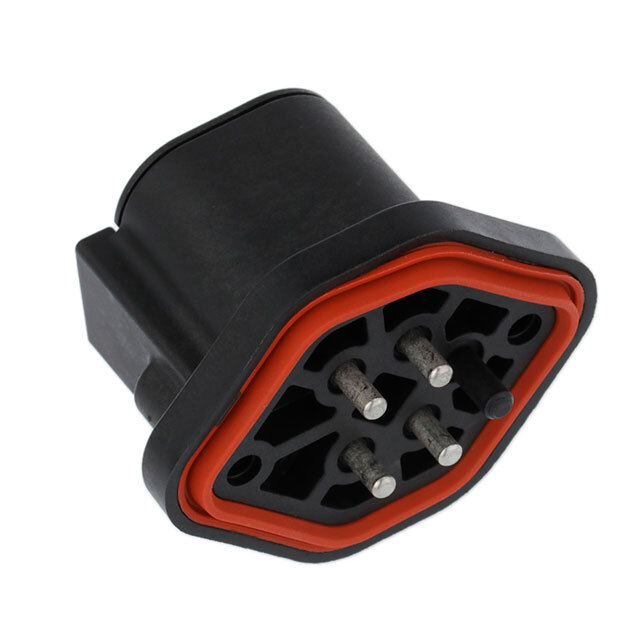
250VDC, 4 positions, right-angle panel-mount through-hole header, -55°C to 125°C operating range
Quick Engineering Summary
| Field | Value |
|---|---|
| Manufacturer | TE Connectivity |
| Category | Rectangular Connectors - Headers, Male Pins |
| Package | Bulk |
| Core function | CONN HEADER R/A 4POS 4. |
| Key electrical range | Supply and Demand Status: Shortage; Temperature Range - Operating: -55°C ~ 125°C; Voltage Rating: 250VDC |
| Reported stock | 2000 pcs reported — confirm on RFQ |
Lifecycle is the weak point, not the connector geometry
The weak point comes first: lifecycle is Unknown and supply status is Shortage. The geometry, by contrast, is unusually well defined for a quick fit decision: 4 positions, 2 rows, 0.175" (4.44mm) pitch, 0.250" (6.35mm) row spacing, right-angle through-hole mounting, panel flange, and a latch holder.
So this is a cautious new design-in, not an automatic no. If your program can absorb lifecycle uncertainty and you can secure near-term material, DT13-4P is specific enough for a board-to-cable interface. If the line needs long-horizon continuity without sourcing disruption, the lifecycle gap matters more than the connector form factor. EU RoHS is compliant, so compliance is not the blocker here.
250VDC is a ceiling, not a system target
250VDC is the key limit. It sets the listed voltage ceiling for DT13-4P, while the -55°C to 125°C operating range sets the temperature boundary, not a promise about self-heating under load.
This fits sealed board-to-wire entry points, not blind high-current bets
Fit is good.
The package reads like a board-edge or enclosure-wall handoff where the connector has to anchor mechanically as well as electrically. Panel mount, through hole, right angle, mounting flange, and shrouded 4-wall all point there more clearly than the generic header label does.
The 4-position, 2-row layout on 0.175" (4.44mm) pitch and 0.250" (6.35mm) row spacing narrows the mating geometry quickly, and the circular male pins matter because they define the mating family and insertion feel more than the word header does. The 0.122" (3.10mm) post length also shows that this is meant to terminate into a board, not float as a loose interconnect feature.
Where DT13-4P stops short is electrical loading. The listing gives a 250VDC rating, but it does not give contact current rating, contact resistance, or dielectric-withstanding figure. That leaves a practical gap: you can place the connector mechanically and understand the voltage ceiling, yet you still cannot close conductor heating, voltage drop, or qualification stress from this page alone. For sustaining designs, that may be acceptable if the mating half and harness are already frozen. For a fresh platform, those missing electrical limits are the difference between a clean release and a field return rooted in connector temperature rise.
The buy decision is about shortage, and the datasheet gaps are real
Availability is the constraint the numbers create. Stock shows 2000 and market status says Shortage, so if DT13-4P is already approved in an existing production build, pull material forward rather than assume routine replenishment.
The missing items are concrete: mating-part identification, current rating, contact resistance, and a drawing or pinout with panel and PCB dimensions. Without those, you know where DT13-4P belongs in the product, but not enough to release the interface details with confidence.
View the Win-Source product page for DT13-4P.
Key Takeaways for Engineers & Buyers
- Lock the footprint to 0.175" (4.44mm) pitch and 0.250" (6.35mm) row spacing before layout release.
- Check the mating connector and latch geometry; the listing gives Latch Holder and shrouded 4-wall, but not the mating half.
- Cover the current build now if DT13-4P is on the BOM; shortage status matters more than the listed 2000 pieces.