
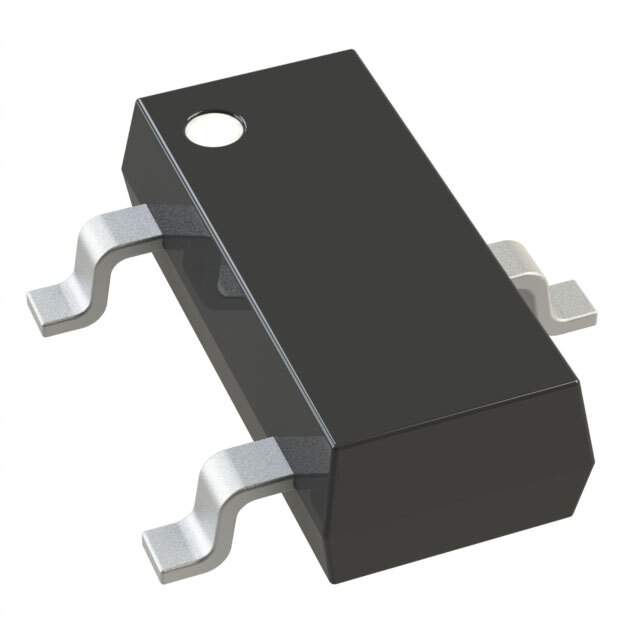
5.5V standoff, 9.5V max clamp, 12A pulse ceiling, dual unidirectional channels in SOT-23-3
Quick Engineering Summary
| Field | Value |
|---|---|
| Manufacturer | Diodes Incorporated |
| Category | TVS - Diodes |
| Package | TO-236-3, SC-59, SOT-23-3 |
| Core function | TVS DIODE 5. |
| Key electrical range | Capacitance @ Frequency: 0.03pF @ 1MHz; Current - Peak Pulse (10/1000µs): 12A (8/20µs); Power Line Protection: Yes; Temperature Range - Operating: -55°C ~ 150°C (TJ) |
| Reported stock | 3000 pcs reported — confirm on RFQ |
5.5V is the number that decides this part
5.5V is the ceiling that puts DT1452-02SOQ-7 on 5V-class lines, not on general rail clamping duty. With a 9.5V maximum clamping voltage, the trade is plain: it stays out of the way on low-voltage interfaces, then limits a surge to a level that can still be too high for nodes with very little overvoltage margin.
That makes the fit fairly specific. DT1452-02SOQ-7 works as a new design-in when the protected line actually lives in that window and when a 2-channel unidirectional TVS in SOT-23-3 suits the board. Active lifecycle helps, and EU RoHS is clean. The open question is the transient behavior beyond those headline limits.
That also narrows where it belongs
That also narrows the placement. Two unidirectional channels in SOT-23-3 point to compact interface protection, not a high-energy entry point. HDMI and USB are named applications, and that lines up with a 5.5V standoff better than any rail that lives near the 7V minimum breakdown.
12A is a surge ceiling, not a free pass
12A is the listed peak pulse current, tied explicitly to 8/20µs. Treat it as a ceiling. It says DT1452-02SOQ-7 is built to catch short transients on signal or low-power lines, but it says nothing about longer pulses, repeated strikes, or the thermal buildup that can turn a survivable event into a reliability problem after enough hits.
The 7V minimum breakdown is just as important to fit. On a nominal 5V interface, it leaves clear separation between normal bias and avalanche turn-on. On anything that normally operates close to that threshold, DT1452-02SOQ-7 stops looking selective and starts looking intrusive. Keep it on low-voltage ports.
Capacitance is where the listing becomes hard to trust at face value. One field gives 0.03pF @ 1MHz, another gives 1.2pF @ 1MHz, and those values imply very different signal-loading behavior on fast interfaces, so this is not a small discrepancy or a rounding artifact. Resolve that conflict before committing DT1452-02SOQ-7 anywhere eye margin is already tight.
The buying constraint is reel quantity
The constraint is packaging. Stock is listed at 3000, packaging is Reel - TR, and the standard package is 3,000.
That suits a production reel buy better than a small lab spin or service stock.
Wrong for a closed review without the missing curves
Wrong for a protection decision that depends on the fine print of the surge path rather than the clamp window. Right for compact 5V-class interface protection once the missing details are filled in.
The gaps are concrete: no pinout, no package drawing, no thermal resistance, and no peak pulse power figure. Reverse-recovery time is also absent; for a TVS, that may be acceptable, but the capacitance conflict isn't. Those omissions are what keep this page from settling layout, thermal, and interface-loading questions on its own.
View the Win-Source product page for DT1452-02SOQ-7.
Key Takeaways for Engineers & Buyers
- Keep DT1452-02SOQ-7 on 5V-class lines; the listed reverse standoff is 5.5V.
- Match assembly to reel usage; ordering is Reel - TR with standard package 3,000.
- Pull the full datasheet for pinout and surge detail before freezing the PCB.