
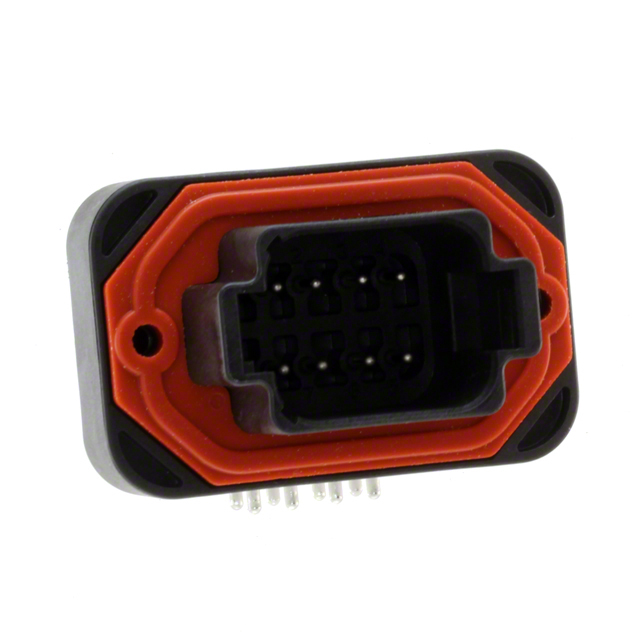
250VDC, 12 positions, 4.44mm pitch, panel-mount through-hole, -55°C to 125°C, IP68/IP6K9K
Quick Engineering Summary
| Field | Value |
|---|---|
| Manufacturer | TE Connectivity |
| Category | Rectangular Connectors - Headers, Male Pins |
| Package | Bulk |
| Core function | CONN HEADER VERT 12POS 4. |
| Key electrical range | Supply and Demand Status: Shortage; Temperature Range - Operating: -55°C ~ 125°C; Voltage Rating: 250VDC |
| Reported stock | 2658 pcs reported — confirm on RFQ |
Not for dense board headers; right for sealed cable entry
If you need a compact board header inside a sheltered enclosure, this is the wrong part. DT15-12PC is a panel-mount, through-hole, shrouded 12-position header with a mounting flange, latch holder, 4.44mm mating pitch, and 9.14mm row spacing, so it fits where a board has to meet a cable harness through a sealed mechanical interface.
That is the case for new design-in. Lifecycle is Active with no stated conflict, and EU RoHS compliance is straightforward. The fit is narrow and clear: board-to-cable or wire interconnects that need a vertical header, all 12 positions loaded, and sealing at the connector interface. It is not a generic pin header.
The numbers constrain mechanics before they constrain anything else
Panel space is the first limit. The 1.185" (30.10mm) insulation height, 0.175" (4.44mm) mating pitch, and 0.360" (9.14mm) row spacing tell you this is neither low-profile nor fine-pitch; those dimensions set enclosure clearance, mating access, and how much board edge you can give up before anything electrical enters the discussion.
The 250VDC rating is a ceiling, not a working point. It answers whether the connector family can sit on higher-voltage harness runs, but it does not settle board creepage, cable insulation choice, or required system margin. The -55°C to 125°C operating range is the other real gate. It keeps DT15-12PC in play for cold-start and hot-soak environments that would eliminate lighter-duty headers, yet contact heating still stays open because no current rating is listed.
250VDC is useful, but not sufficient
250VDC is the decisive figure. DT15-12PC can be considered for higher-voltage interconnect duty, but without a listed current rating, contact resistance, or dielectric withstanding figure, conductor sizing and loaded temperature rise remain open.
Can you keep a running line on DT15-12PC?
Can you actually keep it flowing? That is the first buyer question, and here the answer starts with availability rather than lifecycle.
DT15-12PC is marked Active, but the supply-and-demand status is Shortage. The visible quantity is 2658 in one field while another stock field shows 1328. That supports a sustaining build or a controlled new release, but it does not support treating the part as frictionless supply if your line consumes it steadily over time.
Packaging matters as well. Bulk works for manual kitting and lower-volume harness or box-build work. It is less friendly when the line expects presentation that cuts handling time and orientation mistakes.
Plan the buy.
Tie release quantity to confirmed stock, then reserve this connector for builds that actually need its sealing and panel-mount format, because DT15-12PC is exactly the sort of part that can stall production when it gets specified broadly and purchased casually.
The main gaps are concrete implementation details, not fluff. The listing does not give the full panel cutout or hole pattern drawing, mating contact length, contact finish thickness, or a current rating. Those are the items that close layout, assembly, and load-carrying review.
View the Win-Source product page for DT15-12PC.
Key Takeaways for Engineers & Buyers
- Reserve DT15-12PC early if the build depends on 2658 pieces while shortage status is still posted.
- Use DT15-12PC where 250VDC and IP68/IP6K9K are actual requirements, not just nice-to-have features.
- Pull the full drawing before layout; the listing gives 4.44mm pitch and 9.14mm row spacing, not the full panel or hole pattern.