
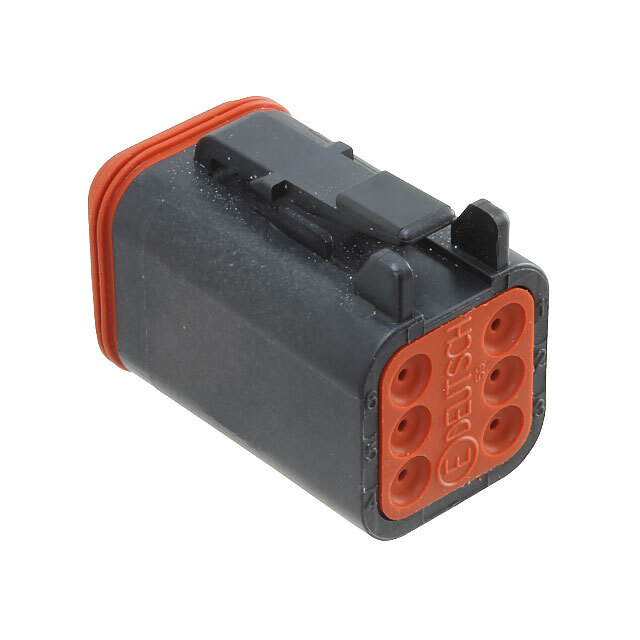
250VDC, 6 positions, 4.44mm pitch, panel-mount through-hole, -55°C to 125°C, IP68/IP6K9K
Quick Engineering Summary
| Field | Value |
|---|---|
| Manufacturer | TE Connectivity |
| Category | Rectangular Connectors - Headers, Male Pins |
| Package | Bulk |
| Core function | CONN HEADER VERT 6POS 4. |
| Key electrical range | Supply and Demand Status: Shortage; Temperature Range - Operating: -55°C ~ 125°C; Voltage Rating: 250VDC |
| Reported stock | 230 pcs reported — confirm on RFQ |
250VDC is useful, but it doesn't finish the fit call
250VDC is the listed ceiling. That clears low-voltage power and signal interconnect work without forcing an immediate insulation rethink.
It still doesn't answer the harder question. DT15-6P-GP01 has no current rating in the listing, so this page cannot settle conductor heating, contact temperature rise, or how much load each position can actually carry.
Mechanically and environmentally, the part is more specific. It is a 6-position, 2-row vertical header on 0.175" (4.44mm) pitch with 0.360" (9.14mm) row spacing, panel mount and through hole, with a mounting flange and latch holder. That points to a sealed board-to-cable entry rather than a generic board header for open indoor electronics.
The weak point is missing current data; the strong point is sealing
No current rating is listed, and for a connector that is the first thing that slows a release. DT15-6P-GP01 may sit comfortably under a 250VDC ceiling, but without an ampacity figure you still cannot tell whether the contact system belongs on light signal lines or on a loaded power branch, which is exactly how field heat problems get designed in behind an acceptable voltage number.
The environmental intent is much clearer. IP68/IP6K9K, a shrouded 4-wall body, and an operating range from -55°C to 125°C place DT15-6P-GP01 in applications where washdown, dust, and temperature swing are normal conditions, not edge cases. Gold on the mating side and tin on the post side also fit a connector that mates in the field but solders to the board.
Use those figures as boundaries. The -55°C to 125°C range tells you the housing and contact system are meant to remain in play across that span, but it does not provide contact resistance drift, insertion force, or current derating across temperature. Those are the missing pieces that decide whether the connector stays cool and serviceable in the actual enclosure.
So the buy call is about shortage, not obsolescence
And that leaves the buying decision pretty plain: lifecycle is Active, EU RoHS is compliant, and the real constraint is supply status marked Shortage with 230 pieces listed.
4.44mm pitch decides the mating family, not the whole drawing
4.44mm pitch narrows the mating interface quickly, and the 0.122" (3.10mm) post length helps with through-hole stack planning. Bulk packaging is the other practical detail. It's workable for manual or lower-volume handling, but less friendly if the line expects connector presentation already organized for faster insertion.
The gaps are concrete. There is no current rating, no contact resistance figure, no mating-cycle life, and no dimensional drawing or pin numbering here. For DT15-6P-GP01, those missing items are what close the review on copper size, harness loading, service wear, and board footprint orientation.
View the Win-Source product page for DT15-6P-GP01.
Key Takeaways for Engineers & Buyers
- Lock the mating layout to 4.44mm pitch and 9.14mm row spacing before committing the panel cutout.
- Treat 250VDC as the ceiling; don’t use DT15-6P-GP01 to settle current capacity because no current rating is listed.
- Cover the shortage now: place the running requirement against the listed 230 pieces or expect a line stop.