
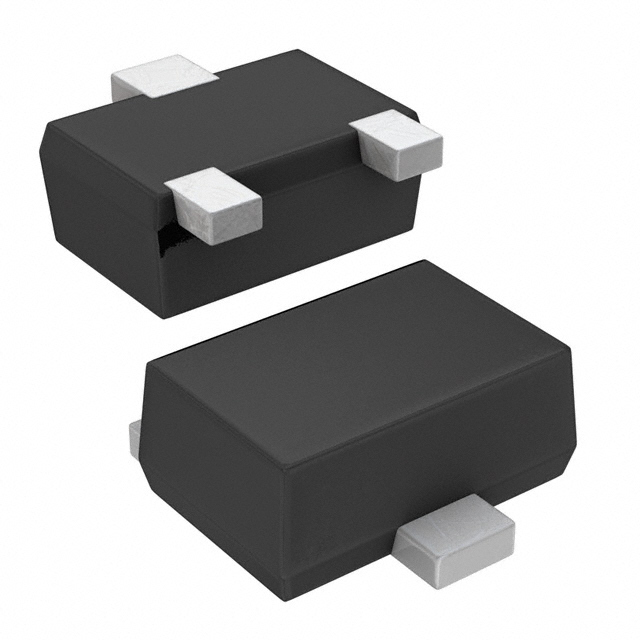
50 V VCEO ceiling, 50 mA Ic ceiling, 150 mW limit, EMT3F (SOT-416FL) package
Quick Engineering Summary
| Field | Value |
|---|---|
| Manufacturer | Rohm Semiconductor |
| Category | Transistors (BJT) - Single, Pre - Biased |
| Package | SC-89, SOT-490 |
| Core function | TRANS PREBIAS PNP 50V EMT3F |
| Key electrical range | Current - Collector (Ic) (Max): 50 mA; DC Current Gain (hFE) (Min) @ Ic, Vce: 35 @ 5mA, 10V; Frequency - Transition: 250 MHz; Power - Max: 150 mW |
| Reported stock | 180000 pcs reported — confirm on RFQ |
50 V is the real gate on where this transistor belongs
50 V is the number that decides where this transistor fits. That collector-emitter breakdown figure is a ceiling, not a working rail target, but it immediately separates DTA014EEBTL from many pre-biased BJTs that top out lower and get eliminated as soon as a control node or pull-up can see a higher transient or a supply that does not behave cleanly.
The rest of the listing keeps the role narrow. Collector current tops out at 50 mA, and power tops out at 150 mW. Short version: control work only. Put those limits together and the part reads as a small-signal switching device, not something meant to carry a meaningful load for long stretches, and in EMT3F (SOT-416FL) the missing thermal-resistance figure leaves less room to guess about ambient headroom than many designers would like.
The built-in 10 kOhms base resistor and 10 kOhms emitter-base resistor are just as important as the voltage rating. They simplify direct drive from logic or bias networks, but they also fix the input behavior up front, so DTA014EEBTL makes sense when you want that resistor network on-die and not when you need to tune it externally.
That is why the overall call stays positive. Active lifecycle, EU RoHS compliance, and MSL 1 (Unlimited) take away the usual commercial friction for new design-in and ongoing production.
That current limit keeps it in signal-path duty
And that 50 mA ceiling is where casual use cases fall away. DTA014EEBTL can switch or bias small loads, level-shift, or serve as an interface transistor where the convenience of a pre-biased PNP matters more than raw current, but it is not the part to place directly on anything that looks like a real actuator, lamp, or relay coil.
The listed saturation figure helps frame the better use case: 150mV @ 500µA, 5mA. It does not tell you what happens at 50 mA, and it does not settle a thermal decision, but it does show the device is characterized for low-current switching with base drive coming through the internal network. The minimum hFE of 35 @ 5mA, 10V points the same way. This belongs in compact bias and switching jobs on a surface-mount board, not in circuits that need adjustable base resistors or broad current margin.
The main buying constraint is package commitment
The constraint is package commitment. Reel - TR in EMT3F (SOT-416FL) and listed stock of 180000 make SMT-line placement straightforward and hand assembly awkward.
The missing thermal and switching data still matters
The weak point is the missing detail, not availability.
For DTA014EEBTL, the gaps that still matter are thermal resistance, derating curve, collector cutoff current, and pinout or package drawing. The 150 mW maximum is only half the thermal story without the thermal path behind it, the absence of collector cutoff current leaves leakage-sensitive bias networks unresolved, and there is no switching-time data beyond the 250 MHz transition frequency, so edge behavior is still an open question when timing matters.
View the Win-Source product page for DTA014EEBTL.
Key Takeaways for Engineers & Buyers
- Keep collector current below the 50 mA ceiling; this device is for small-signal switching, not load drive.
- Budget dissipation against the 150 mW maximum before using DTA014EEBTL as a sustained pull-up or high-side switch.
- Lock reel planning early if DTA014EEBTL is going on a running line; stock is listed at 180000 and packaging is Reel - TR.