
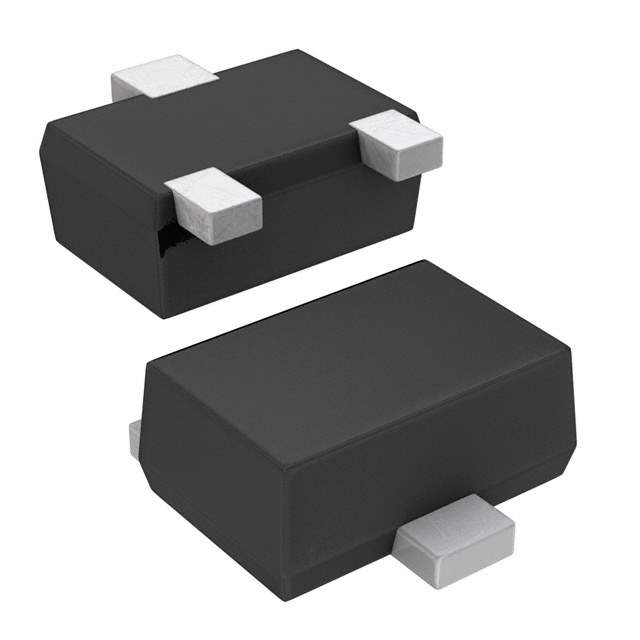
50 V, 100 mA, 150 mW ceilings in EMT3F (SOT-416FL); 100 kOhms is the real design choice
Quick Engineering Summary
| Field | Value |
|---|---|
| Manufacturer | Rohm Semiconductor |
| Category | RF Transistors (BJT) |
| Package | Tape & Reel (TR) |
| Core function | TRANS PREBIAS PNP 50V 0. |
| Key electrical range | Current - Collector (Ic) (Max): 100 mA; Current - Collector Cutoff (Max): 500nA (ICBO); DC Current Gain (hFE) (Min) @ Ic, Vce: 100 @ 5mA, 10V; Frequency - Transition: 250 MHz |
| Reported stock | 21000 pcs reported — confirm on RFQ |
50 V is the first gate, not the whole answer
50 V is the collector-emitter breakdown ceiling, and it decides whether this device belongs on your rail at all. If your node can approach that limit, the listing still leaves transient headroom and avalanche behavior unanswered; it only rules out rails that exceed 50 V.
The supply picture looks steady. DTA015TEBTL is Active, inventory is listed at 21000, and the package is Tape & Reel with a standard package of 3,000, so it reads like a normal production part rather than a cleanup buy. EU RoHS compliant, REACH Unaffected, and MSL 1 (Unlimited) keep assembly straightforward.
The real constraint is dissipation, not gain
Thermal budget is the constraint. A 150 mW maximum power rating, a 100 mA maximum collector current, and an EMT3F (SOT-416FL) body put this part in light switching and biasing work, not in jobs where a small transistor gets picked casually and then asked to absorb more than the package can shed.
The 100 mA collector rating is a ceiling, not a comfort zone. The 150 mW rating is another ceiling, and in a pre-biased transistor this small it will usually end the argument first. One listed saturation point, 250mV at 250µA and 5mA, helps frame low-current switching behavior, but it does not map performance across the rest of the current range. The minimum hFE of 100 at 5mA and 10V is useful at that stated condition and no further.
100 kOhms makes this a circuit choice, not a generic PNP
100 kOhms is the decisive number here. It is the built-in base resistor, and it makes DTA015TEBTL either a neat fit or the wrong transistor before you get far into the schematic.
You choose a pre-biased PNP like this when removing an external resistor from the BOM and placement matters more than later freedom to tune the base network. That trade is the point of the part. If the resistor value is tied to analog trim or timing behavior, DTA015TEBTL fixes that decision at 100 kOhms before layout starts, and there is no room to finesse it afterward without changing parts.
The rest of the listing supports that reading. The device type is a PNP pre-biased transistor, and the package references SC-89, SOT-490, and EMT3F (SOT-416FL), which places it squarely in compact SMT control work. The 250 MHz transition frequency says it is not especially slow, but that single figure does not turn it into an RF power device, especially when the 100 mA and 150 mW ceilings are already defining the usable envelope. In practice, the fit is simple level shifting, small-signal switching, and bias control where the built-in resistor is a feature rather than a limitation.
The missing items are the ones that close the review
Enough to shortlist.
This listing is enough to put DTA015TEBTL on the candidate list, but not enough to finish the electrical review. What is still missing is the pinout, the package drawing, thermal resistance, and any derating curve. Those details decide footprint release, ambient headroom, and how much of the 150 mW ceiling is actually usable on your board. There is also no switching-time data or junction capacitance here, so edge speed and node loading remain open questions.
View the Win-Source product page for DTA015TEBTL.
Key Takeaways for Engineers & Buyers
- Keep VCE below the 50 V ceiling; that number clears rail compatibility, not transient behavior.
- Treat 100 mA collector current and 150 mW power as separate ceilings when sizing the load on DTA015TEBTL.
- Match feeder setup to Tape & Reel with 3,000 standard package quantity before releasing volume builds.