
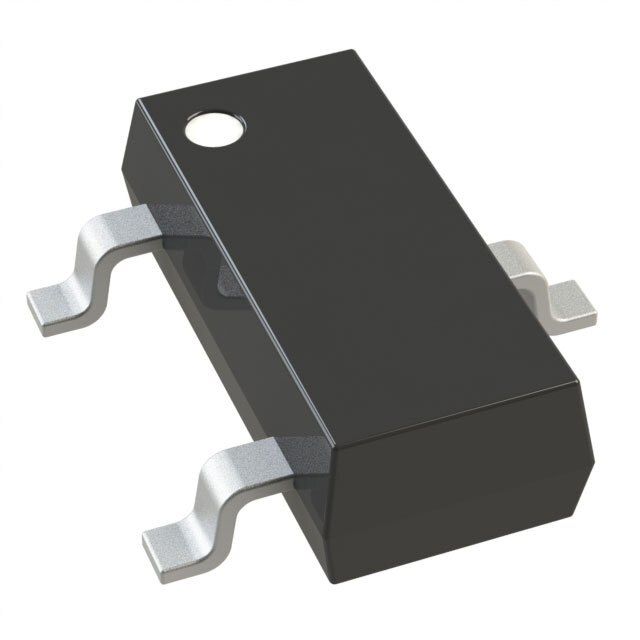
50 V, 100 mA, 150 mW ceilings in SOT-723 decide whether this pre-biased PNP belongs in the signal path
Quick Engineering Summary
| Field | Value |
|---|---|
| Manufacturer | Rohm Semiconductor |
| Category | Transistors (BJT) - Single, Pre - Biased |
| Package | SOT-723 |
| Core function | TRANS PREBIAS PNP 50V 0. |
| Key electrical range | Current - Collector (Ic) (Max): 100 mA; Current - Collector Cutoff (Max): 500nA; DC Current Gain (hFE) (Min) @ Ic, Vce: 20 @ 20mA, 10V; Frequency - Transition: 250 MHz |
| Reported stock | 1 pcs reported — confirm on RFQ |
50 V is the first gate, not the whole answer
50 V is the figure that decides whether DTA023EMT2L can sit on your rail at all. It is a collector-emitter breakdown ceiling, so it settles voltage fit and nothing else. It does not tell you current margin, saturation behavior, or switching loss, and those are the limits that usually decide whether a tiny pre-biased transistor survives real use once the rail voltage is no longer the only question.
The other ceilings are 100 mA collector current and 150 mW power. Hard limits. In a SOT-723 body, those numbers do not imply comfort near both at once in your ambient. The listed 250mV at 1mA, 10mA is still useful because it shows DTA023EMT2L can pull down a small load in saturation without giving away much headroom, but only at that stated test point.
Not for load driving; fine for compact bias-and-switch jobs
Wrong for load driving. A 100 mA collector ceiling and 150 mW power ceiling in SOT-723 shut down the usual temptation to use a pre-biased transistor as a general high-side switch just because the rail is only 50 V.
It fits much better in dense signal conditioning, level shifting, and small on/off functions where the built-in 2.2 kOhms R1 and 2.2 kOhms R2 remove two placements and keep the bias network fixed. That's the trade: if your drive scheme needs different base-current shaping, this part stops fitting quickly.
The stock number is the immediate constraint
The weak point is availability. Active lifecycle and Normal supply status help, but listed stock is 1, so DTA023EMT2L is only a paper fit until reel availability is lined up.
What the listing still doesn't tell you
7078 is the number that raises the first question, because the visible stock field shows 1. That mismatch matters when DTA023EMT2L is sold as Tape & Reel and reel planning affects a real production decision.
The larger gap is electrical detail. There is no pinout here, so schematic capture and footprint mapping still depend on the datasheet. There is no package drawing, so the SOT-723 and VMT3 names alone do not finish land pattern work. There is no thermal resistance or derating curve, which leaves the 150 mW ceiling disconnected from ambient headroom. There is also no switching-time data or junction capacitance, and those are the details that determine whether the listed 250 MHz transition frequency says anything useful about your actual edge-rate budget.
So the page is enough to judge high-level fit, but not enough to close layout or dynamic behavior for DTA023EMT2L.
View the Win-Source product page for DTA023EMT2L.
Key Takeaways for Engineers & Buyers
- Keep VCE below the 50 V breakdown ceiling; that number closes rail fit, not switching behavior.
- Treat 100 mA collector current and 150 mW power as separate ceilings when sizing load and ambient headroom.
- Lock reel planning early; listed stock is 1 and the package is Tape & Reel only.