
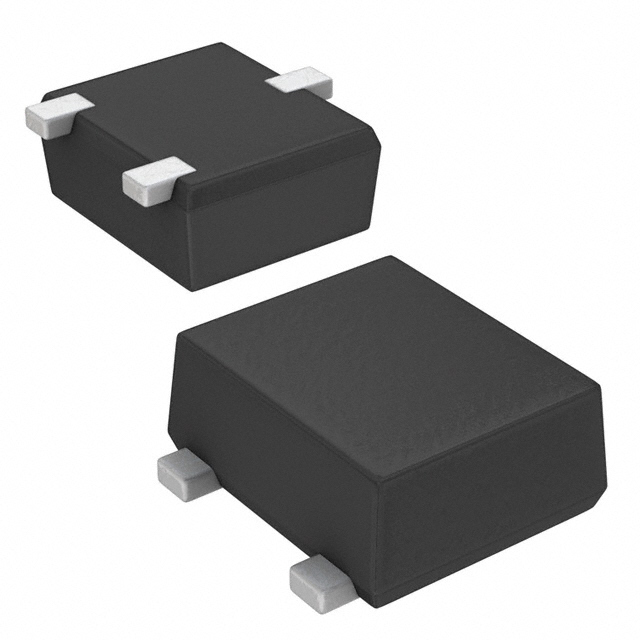
50 V, 100 mA, 150 mW, SOT-723/VMT3: useful resistor network, but tight ceilings
Quick Engineering Summary
| Field | Value |
|---|---|
| Manufacturer | Rohm Semiconductor |
| Category | Transistors (BJT) - Single, Pre - Biased |
| Package | SOT-723 |
| Core function | TRANS PREBIAS PNP 50V 0. |
| Key electrical range | Current - Collector (Ic) (Max): 100 mA; DC Current Gain (hFE) (Min) @ Ic, Vce: 80 @ 5mA, 10V; Frequency - Transition: 250 MHz; Power - Max: 150 mW |
| Reported stock | 1042 pcs reported — confirm on RFQ |
The weak point is supply, not the transistor
The weak point comes first: lifecycle is Unknown and supply is flagged Shortage, so this is not the kind of small-signal transistor you drop into a new program and forget. The better argument is electrical simplicity. DTA023JMT2L is a PNP pre-biased device with R1 at 2.2 kOhms and R2 at 47 kOhms already inside, which can remove two external resistors and clean up a dense control path in SOT-723.
That makes the call fairly clear. For a fresh design, use DTA023JMT2L only when that built-in resistor network is exactly what the circuit wants. For existing production, it is easier to justify because the integrated bias network may already be tied to the logic thresholds and board area. EU RoHS is compliant; lifecycle certainty isn't.
50 V is the rail ceiling that decides the shortlist
50 V is the figure that keeps this device on the shortlist for higher-voltage logic interfacing and small load switching, but it answers only the collector-emitter breakdown question. It says nothing about how much thermal room is left on a real board, and it does not turn the 100 mA collector rating into a comfortable operating point.
The other ceilings matter just as much. The 100 mA collector current is a hard limit, so any design expecting sustained load current near that number is already leaning on a very small package. The 150 mW power rating leaves little dissipation budget before warm ambient or weak copper spreading starts to matter. This one is small.
The listed 150mV @ 500µA, 5mA saturation figure helps, but only at that stated test point. It shows low saturation voltage under the listed drive condition, not what happens elsewhere, and that missing curve is where switching loss and margin arguments usually begin.
The built-in resistors define where it belongs
And that is why the resistor network matters more here than the transition frequency. DTA023JMT2L is not just a generic PNP in a tiny body; it is a PNP with R1 at 2.2 kOhms and R2 at 47 kOhms, so it belongs in circuits that actually want that bias relationship rather than in designs that merely need any small transistor.
That usually points to simple inverter stages, level-shifted control lines, and compact biasing jobs where board area is tight and the convenience of R1 and R2 outweighs the loss of resistor choice. In SOT-723 with a VMT3 device package, DTA023JMT2L fits dense surface-mount control boards better than anything expecting generous thermal mass or easy probing during bring-up.
The hFE minimum of 80 @ 5mA, 10V is enough to show the device is characterized in the small-signal region, but not enough to predict behavior across a wider load range. The 250 MHz transition frequency suggests the transistor itself is not especially slow, yet the integrated resistors and the 150 mW ceiling will shape the real use case first. Get that fit wrong and the failure mode is ordinary but expensive: wrong bias current, weak saturation margin, or a board respin because the fixed resistor values looked convenient on paper.
What is missing before you trust the corner cases
The constraint is missing detail. Pinout or drawing, thermal resistance data, switching figures, and IFSM are still absent, so layout orientation, heat flow, edge-speed behavior, and surge tolerance remain open questions.
View the Win-Source product page for DTA023JMT2L.
Key Takeaways for Engineers & Buyers
- Check that 2.2 kOhms / 47 kOhms matches the drive network before locking DTA023JMT2L into the schematic.
- Treat 100 mA collector current and 150 mW power as hard ceilings, not operating targets.
- Cover the Shortage flag now; place a scheduled buy against the 1042-piece stock position.