
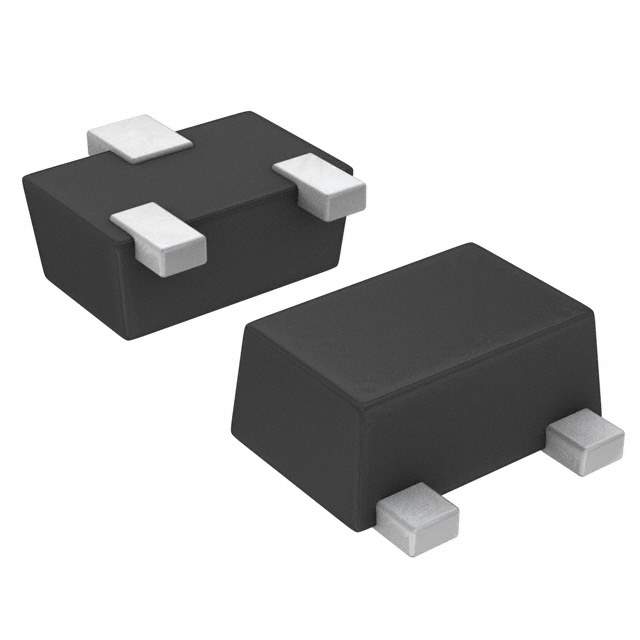
50 V VCEO ceiling, 100 mA collector ceiling, 150 mW limit, in SOT-723/VMT3 with built-in 2.2 kOhms and 10 kOhms
Quick Engineering Summary
| Field | Value |
|---|---|
| Manufacturer | Rohm Semiconductor |
| Category | RF Transistors (BJT) |
| Package | Tape & Reel |
| Core function | TRANS PREBIAS PNP 50V 0. |
| Key electrical range | Current - Collector (Ic) (Max): 100 mA; DC Current Gain (hFE) (Min) @ Ic, Vce: 35 @ 5mA, 10V; Frequency - Transition: 250 MHz; Power - Max: 150 mW |
| Reported stock | 8000 pcs reported — confirm on RFQ |
Still, this one is easy to justify for fresh builds
And the reason is integration, not headline current. DTA023YMT2L is an Active pre-biased PNP with the resistor pair already fixed at 2.2 kOhms for R1 and 10 kOhms for R2, so it fits small-signal switching and bias work where board area and BOM count matter more than transistor tuning freedom.
The real design gates are straightforward. The 50 V collector-emitter breakdown is a ceiling on rail exposure. The 100 mA collector rating is another ceiling, and it does not answer pulse behavior or startup stress because no surge figure is listed. Then comes the 150 mW power limit, which will usually end the conversation first in a SOT-723 body, especially since the listing gives no thermal resistance or derating curve to show how much ambient headroom is actually available.
The listed 150mV saturation at 500µA and 5mA helps, but only at that test point. It shows that DTA023YMT2L can pull a light load down cleanly; it does not map behavior across the rest of the load line. That missing context matters, because a tiny package with fixed bias resistors can be exactly right in one control path and boxed in quickly once dissipation, leakage, or switching speed starts to matter.
For new design-in, the case is solid but narrow. Use DTA023YMT2L when you want a tiny SMT pre-biased PNP and the fixed resistor values work. Skip it when you need bias flexibility, more dissipation room, or switching data the listing does not include.
Not for power switching or bias networks you need to tune
Wrong for loads that lean on collector current or for circuits where the base network must be chosen, not inherited. Right for compact control paths where the built-in 2.2 kOhms and 10 kOhms are the point, and the SOT-723 footprint matters more than discrete resistor freedom.
8000 pieces helps, but the reel is the real buying constraint
8000 pieces is enough to matter. DTA023YMT2L is listed in Tape & Reel with a Standard Package of 8,000, which suits line-friendly volume but ties the buy decision to reel consumption rather than casual bench use.
If this part is headed into production, buy to reel logic and keep DTA023YMT2L aligned with placements that can actually absorb that package quantity.
The missing data is exactly where risk hides
150 mW is the decisive figure. The listing does not give the thermal context that makes it usable. There is no thermal resistance and no derating curve, so ambient headroom remains open. No pinout or package drawing appears here either, and that matters more than usual in SOT-723 because footprint mistakes at this size turn into assembly escapes fast.
The electrical gaps are just as practical. No collector cutoff current is populated, no switching times are listed, and no capacitance figure appears. DTA023YMT2L may still be the right transistor, but those are the numbers that close a real review when leakage, edge speed, or high-impedance behavior matter.
View the Win-Source product page for DTA023YMT2L.
Key Takeaways for Engineers & Buyers
- Keep DTA023YMT2L on rails that stay inside the 50 V collector-emitter ceiling.
- Treat 100 mA collector current and 150 mW as separate ceilings; either one can end the fit.
- Match the bias network to the built-in 2.2 kOhms R1 and 10 kOhms R2 before freezing the BOM.