
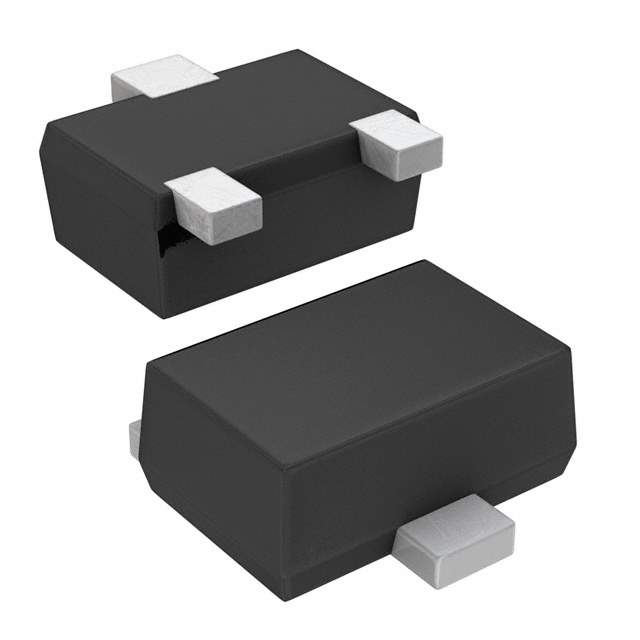
50 V VCEO ceiling, 100 mA collector ceiling, 200 mW limit, SC-85/UMT3F package
Quick Engineering Summary
| Field | Value |
|---|---|
| Manufacturer | Rohm Semiconductor |
| Category | Transistors (BJT) - Single, Pre - Biased |
| Package | SC-85 |
| Core function | TRANS PREBIAS PNP 50V UMT3F |
| Key electrical range | Current - Collector (Ic) (Max): 100 mA; Current - Collector Cutoff (Max): 500nA; DC Current Gain (hFE) (Min) @ Ic, Vce: 35 @ 5mA, 10V; Frequency - Transition: 250 MH |
| Reported stock | 23700 pcs reported — confirm on RFQ |
Not for power switching; fine for compact bias-and-switch jobs
This is the wrong part for anything that leans on current or heat. The 100 mA collector rating is a ceiling, not a working target, and the 200 mW power limit in SC-85 makes clear that DTA023YUBTL belongs in small-signal switching, level shifting, and logic-driven bias networks rather than load driving.
Where it fits is in dense control sections where the integrated 2.2 kOhms base resistor saves parts and placement. DTA023YUBTL is an Active pre-biased PNP with a diode, surface-mount in UMT3F. EU RoHS is covered, and MSL 1 (Unlimited) removes one handling headache on the line.
50 V closes the rail question, not the thermal one
50 V is the collector-emitter breakdown ceiling, so it answers the rail question first. It does not answer the thermal one, because the listing gives no thermal resistance or derating curve, and those are the numbers that decide ambient headroom once dissipation starts to matter.
Vce saturation is listed as 150mV @ 500µA, 5mA. That is useful at that stated test point and no further. It supports low-level switching with modest drive, but it does not justify assuming the same drop near the 100 mA collector ceiling. The 500nA collector cutoff maximum also matters when off-state leakage matters, especially in battery-biased or high-impedance nodes.
The real fit is BOM reduction in dense control circuitry
The constraint is integration without much electrical slack. A built-in 2.2 kOhms base resistor in a SC-85 body changes the board-level trade: you save a resistor and routing, but you also accept the fixed input bias network instead of tuning it around a discrete transistor.
That makes DTA023YUBTL a sensible fit for compact enable lines, inverter stages, pull-up or high-side signal switching, and housekeeping functions where a PNP pre-biased device is wanted more for repeatable assembly than for raw transistor flexibility. The minimum hFE of 35 @ 5mA, 10V helps frame that use case. The gain point is given at light collector current, so the part reads like a control transistor, not a load transistor.
The 250 MH transition frequency points the same way. It says the device is not confined to very slow housekeeping edges, but it still does not replace the missing switching detail, because there is no turn-on or turn-off timing here, no capacitance figure, and no resistor tolerance data for the internal network. Those omissions matter: pre-biased parts are often chosen to remove external components, and once you do that, the internal resistor behavior becomes part of the timing and bias budget.
Buy it as a reel part, and watch the missing review items
And that carries straight into purchasing. DTA023YUBTL is listed in Reel - TR with a standard package of 3,000, while stock shows 23700. If this is going onto a running line, buy to reel usage rather than expecting loose-piece flexibility.
The short list of missing items matters more than another paragraph of specs: pinout, package drawing, thermal resistance, and internal resistor tolerance are absent here. Any one of those can stop a release faster than the Active lifecycle helps it.
View the Win-Source product page for DTA023YUBTL.
Key Takeaways for Engineers & Buyers
- Keep collector current well below the 100 mA ceiling in DTA023YUBTL.
- Check board dissipation against the 200 mW package limit before release.
- Buy on reel: standard package is 3,000 and stock shows 23700.