
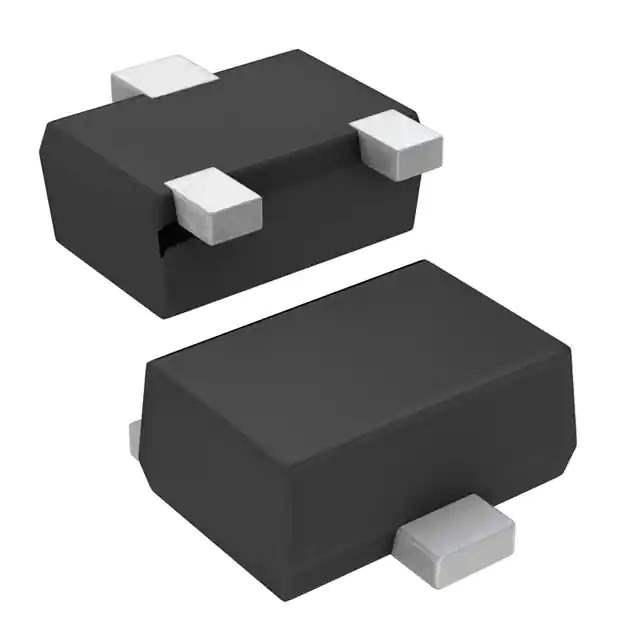
50 V, 100 mA, 150 mW ceilings in EMT3F; the built-in 22 kOhms and 22 kOhms set the drive fit.
Quick Engineering Summary
| Field | Value |
|---|---|
| Manufacturer | Rohm Semiconductor |
| Category | Transistors (BJT) - Single, Pre - Biased |
| Package | Tape & Reel |
| Core function | TRANS PREBIAS PNP 50V 0. |
| Key electrical range | Current - Collector (Ic) (Max): 100 mA; Current - Collector Cutoff (Max): 500nA; DC Current Gain (hFE) (Min) @ Ic, Vce: 60 @ 5mA, 10V; Frequency - Transition: 250 MHz |
| Reported stock | 5750 pcs reported — confirm on RFQ |
50 V is useful, but the smaller ceiling is power
50 V is the attention-grabber, but it is not the limit that decides most uses of this pre-biased small-signal PNP. The tighter ceiling is 150 mW max power, with 100 mA max collector current close behind. Those are ceilings, not operating points, and they rule out relay coils, lamp loads, and other cases that lean on saturation current for long stretches.
What the listing does support is rail-level switching and inversion where current stays modest and the board would rather not spend space on two external bias resistors. The built-in 22 kOhms R1 and 22 kOhms R2 simplify the BOM, but they also lock in the input bias behavior, so if that resistor pair does not suit the drive source, DTA024EEBTL stops being the right choice before voltage rating or package size even enter the discussion.
The constraint is fixed bias, not breakdown voltage
Fixed bias is the first constraint these numbers create. This is a PNP pre-biased transistor with 22 kOhms from base and 22 kOhms from emitter-base, so it belongs in control paths where that internal divider is exactly what you would otherwise place outside the package.
The listed hFE minimum is 60 @ 5mA, 10V, and the listed saturation figure is 150mV @ 500µA, 5mA. Those points place the characterization in the low-current region where digital gating and small-signal switching live. They do not describe behavior near the 100 mA collector ceiling, and they do not fix a design that needs a different base resistor value to hit logic thresholds or turn-off behavior.
Wrong for adjustable drive paths, right for dense small-signal boards
Wrong for circuits that need freedom to tune base drive. DTA024EEBTL fits compact surface-mount control sections, level shifting, and simple load gating where board area matters more than bias flexibility because the resistor network is already chosen.
The package details support that use. EMT3F (SOT-416FL) and SC-89, SOT-490 point to a very small surface-mount footprint, and MSL 1 (Unlimited) helps on assembly handling. The 250 MHz transition frequency is listed, but without switching waveforms or capacitance, it does not by itself qualify the part for fast edge work.
The missing data is exactly what closes the review
The weak point is documentation depth. Pinout, package drawing, thermal resistance, and the derating curve are still needed to close layout and ambient headroom with confidence.
Can you keep a running line on DTA024EEBTL?
Can you buy this as a real production part and keep it moving? Yes, if you treat it like a reel-fed line item rather than a bench sample. Lifecycle is Active across the listed signals, stock quantity is 5750, and the standard package is 3,000 pcs, so DTA024EEBTL fits a current build when your usage lines up with tape-and-reel handling and you are not trying to cover a wide spread of bias cases with one transistor.
There is a sourcing point worth stating plainly. This is a specific pre-biased PNP, and the internal 22 kOhms / 22 kOhms network is not a cosmetic detail. If your schematic depends on that ratio, DTA024EEBTL is either the fit or it is not. Do not treat it like a generic small-signal BJT during AVL cleanup, because the package can match while the bias behavior does not.
Compliance is straightforward: EU RoHS is compliant and REACH is Unaffected. That keeps the buy decision centered on the real question, which is whether your line needs this exact resistor-integrated behavior often enough to justify carrying it as a distinct item.
View the Win-Source product page for DTA024EEBTL.
Key Takeaways for Engineers & Buyers
- Match the drive network to the built-in 22 kOhms R1 and 22 kOhms R2 before freezing the bias scheme.
- Keep DTA024EEBTL out of paths that need more than the 100 mA collector ceiling or 150 mW power ceiling.
- Buy in reel-aware quantities: standard package is 3,000 pcs, with 5750 currently listed.