
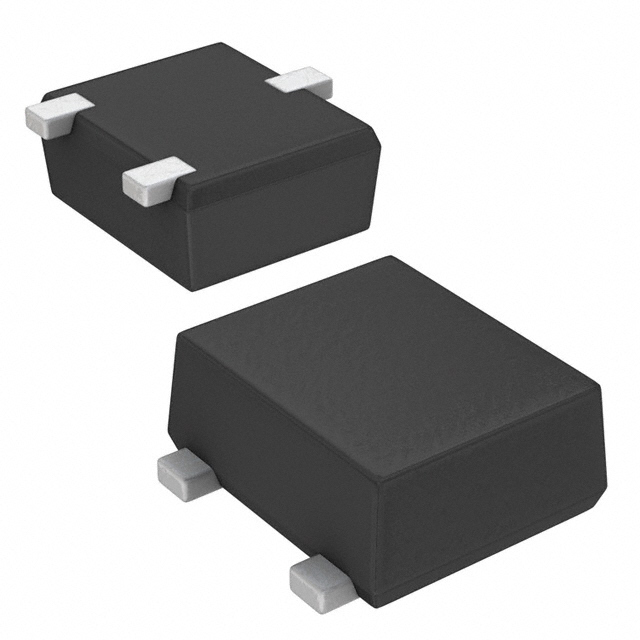
50 V VCEO ceiling, 30 mA collector ceiling, 150 mW limit, SOT-723 pre-biased PNP with 22 kOhms/22 kOhms
Quick Engineering Summary
| Field | Value |
|---|---|
| Manufacturer | Rohm Semiconductor |
| Category | Transistors (BJT) - Single, Pre - Biased |
| Package | SOT-723 |
| Core function | TRANS PREBIAS PNP 50V VMT3 |
| Key electrical range | Current - Collector (Ic) (Max): 30 mA; DC Current Gain (hFE) (Min) @ Ic, Vce: 60 @ 5mA, 10V; Frequency - Transition: 250 MHz; Power - Max: 150 mW |
| Reported stock | 16000 pcs reported — confirm on RFQ |
Not for load drive; fine for tiny high-side signal switching
This is the wrong transistor for anything that wants real load current. The 30 mA collector ceiling and 150 mW power ceiling rule out relay coils, LED strings, and any stage expected to absorb abuse.
It fits compact signal switching instead. DTA024EMT2L is a PNP pre-biased transistor with R1 and R2 both at 22 kOhms, in SOT-723 with a VMT3 supplier package, so it suits boards where resistor count and footprint matter more than raw current. Active lifecycle, Normal supply and demand status, and EU RoHS all line up, making it a reasonable new design-in for small control paths rather than power paths.
The hard limit is current, not voltage
Current is the real constraint. The 50 V collector-emitter breakdown is a ceiling, while the 30 mA collector ceiling is what rules out heavier loads first.
Can you keep a line running on it?
Can you get it and build with it? Yes. Stock quantity is listed at 16000, packaging is Tape & Reel, and lifecycle is Active, so DTA024EMT2L does not argue against itself on sourcing.
For reel-fed SMT builds that already want a pre-biased PNP in SOT-723, it drops in cleanly. If your line depends on loose-piece handling or a different footprint, this part adds friction before it adds value.
What the listed numbers settle, and what they don’t
And the useful numbers are narrower than they first appear. The 150mV VCE(sat) max at 500µA and 5mA characterizes DTA024EMT2L for low-current switching, not for the top end of its 30 mA collector ceiling, so that saturation figure should not be read as a promise across every load point you care about.
The minimum hFE of 60 at 5mA and 10V is bounded too. It helps when your circuit sits near that test condition, but it does not answer gain spread elsewhere, and with a pre-biased transistor the internal 22 kOhms and 22 kOhms resistors are part of the switching behavior whether you want them or not.
That is the real fit call: use DTA024EMT2L when those resistor values support the drive source you already have, not when you need freedom to tune base bias externally. Several concrete items are still missing from the listing, including pinout, package drawing, thermal resistance, and collector cutoff current. On a part this small, those are not side notes. Pinout and drawing decide whether the footprint is safe to release, while thermal resistance decides how much ambient headroom the 150 mW ceiling really leaves on your board.
View the Win-Source product page for DTA024EMT2L.
Key Takeaways for Engineers & Buyers
- Keep collector current below the 30 mA ceiling; this device belongs in signal switching, not load drive.
- Use the built-in 22 kOhms R1 and 22 kOhms R2 as part of the bias plan; they are the reason to pick DTA024EMT2L.
- Pull the full datasheet for pinout and thermal detail before layout; SOT-723 leaves little room for guessing.