
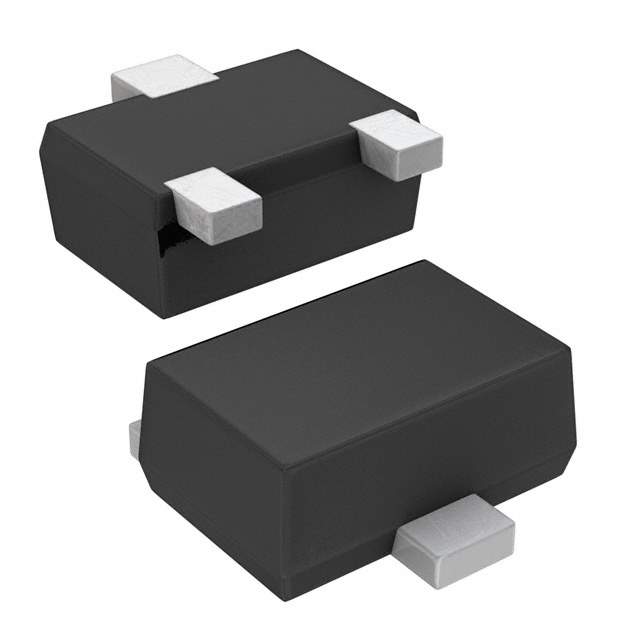
50 V, 30 mA, 200 mW pre-biased PNP in UMT3F; package and current ceiling decide the fit.
Quick Engineering Summary
| Field | Value |
|---|---|
| Manufacturer | Rohm Semiconductor |
| Category | Transistors (BJT) - Single, Pre - Biased |
| Package | UMT3F |
| Core function | TRANS PREBIAS PNP 50V UMT3F |
| Key electrical range | Supply and Demand Status: Limited |
| Reported stock | 3000 pcs reported — confirm on RFQ |
50 V helps, but 30 mA is the real limit
50 V sounds roomy. In practice, the 30 mA collector-current ceiling and 200 mW power ceiling set the fit much faster than voltage does. Active lifecycle, EU RoHS, and MSL 1 keep DTA024EUBTL viable for new design-in.
Can you actually keep a line running on it?
Can you buy it without turning every build into an expedite? That's the first question a buyer will ask, and the answer here is mixed.
On the stable side, lifecycle is Active, stock quantity is 3000, package is Reel - TR, and quantity per package is 3000. That supports automated assembly and avoids the nuisance of piecing together small remnants for production. The supply picture is less comfortable. Lead time is listed at 19 Weeks, and supply-and-demand status is Limited, so this is a component to schedule early against the build plan rather than leave for the last MRP pass, especially when the electrical fit depends on a pre-biased PNP in this exact package style.
There is a second sourcing signal worth taking seriously: fake threat in the open market is 90 pct. That does not change whether DTA024EUBTL works in the circuit, but it does change how carefully it needs to be purchased when authorized inventory tightens. Use traceable channels and avoid spot-market cleanup buys if supply gets thin.
Not for load driving; right for small biased interfaces
Load driving is not its job. The 30 mA collector-current ceiling and 200 mW power ceiling keep DTA024EUBTL in signal-level switching, level shifting, and input conditioning, where the built-in bias resistors can save two placements and keep the BOM tight.
Those internal resistors are the point. R1 is 22 kOhms and R2 is 22 kOhms, so this belongs in circuits designed for a pre-biased PNP, not as a casual substitute for a plain small-signal transistor. The listed Vce saturation ceiling is 150 mV at 500 µA and 5 mA, useful as a low-current switching reference and not much more. It does not describe behavior near the 30 mA ceiling. The 250 MHz transition frequency says the transistor itself is not unusually slow, but it still doesn't turn this into a power or pulse-handling device.
The missing data is exactly what closes the review
The weak point is documentation depth. The headline numbers are enough to sort DTA024EUBTL into the right class, but not enough to close edge cases.
The listing does not include pinout, package drawing, or thermal resistance, and those are the details that decide whether a release is safe. Pinout and drawing determine whether the UMT3F land pattern and orientation are correct. Thermal resistance determines how much ambient headroom the 200 mW ceiling really leaves once the board and enclosure are fixed. Collector cutoff current is also absent, which leaves leakage-sensitive bias networks unresolved. A derating curve is missing too, and that gap sits squarely between a bench pass and a production temperature corner.
View the Win-Source product page for DTA024EUBTL.
Key Takeaways for Engineers & Buyers
- Lock the UMT3F footprint before release; this listing also names SC-85.
- Treat 30 mA collector current and 200 mW as ceilings, not operating targets.
- Place the buy early if DTA024EUBTL is on a build plan; lead time is 19 Weeks.