
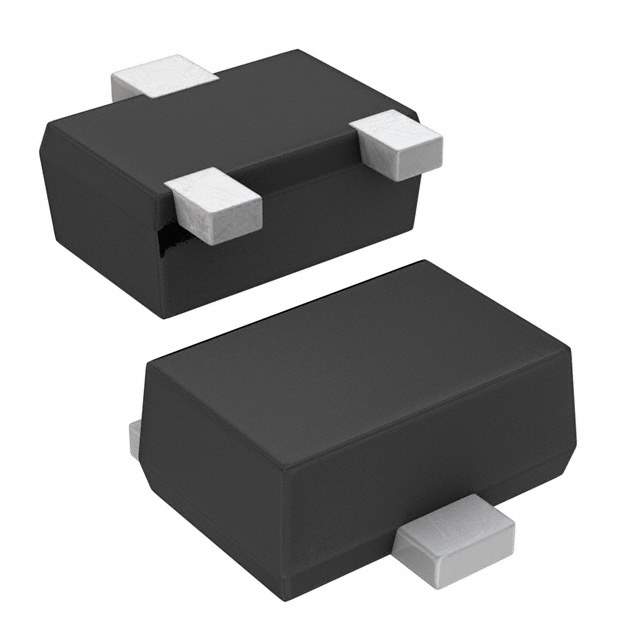
50 V, 100 mA, 150 mW in EMT3F (SOT-416FL); bias fit and lead time decide it
Quick Engineering Summary
| Field | Value |
|---|---|
| Manufacturer | Rohm Semiconductor |
| Category | Transistors (BJT) - Single, Pre - Biased |
| Package | EMT3F (SOT-416FL) |
| Core function | TRANS PREBIAS PNP 50V 0. |
| Key electrical range | Supply and Demand Status: Limited |
| Reported stock | 6000 pcs reported — confirm on RFQ |
The lead time is the weak point; the part itself is usable
The weak point is 51 Weeks, not the transistor limits. Lifecycle is Active with low risk and no conflict, so it remains a valid new design-in choice if your schedule can absorb a long replenishment cycle and reel-based buying.
On the electrical side, the listing points to a specific role: a pre-biased PNP in EMT3F (SOT-416FL) with built-in R1 and R2. That helps when you want to drop two external resistors and keep the footprint tight. EU RoHS is compliant, MSL is 3 (168 Hours), and neither changes the fact that a thin supply window can still drive the decision.
What actually decides the buy here?
What do you need the resistor network to do? That is the first real buying question, because it decides fit before the headline voltage ever does. The listing gives R1 at 22 kOhms and R2 at 47 kOhms. Those values set base-drive behavior and the off-state bias path, so they determine whether the device drops cleanly into a logic-driven high-side or level-shift function, or whether the fixed network pushes against your intended threshold and current budget.
Then come the ceilings. The 50 V collector-emitter breakdown is a hard ceiling on rail exposure, not a comfortable operating point for every 50 V switching job. It rules out rails above 50 V, but it does not answer switching-loss, transient, or thermal questions because those curves are not in the listing. The 100 mA collector current is also a ceiling, which places the device in signal and control paths rather than load switching you intend to run hard. The 150 mW power limit makes that even clearer, because in a tiny EMT3F body the thermal budget disappears quickly if you treat the current rating like a normal target.
The smaller numbers sharpen the picture. VCE(sat) is listed at 150 mV at 500 µA and 5 mA, useful for light-current switching, but it says nothing about saturation near the 100 mA ceiling. hFE is listed as 80 at 5mA and 10V, enough to show the intended operating neighborhood, not enough to support a broad gain assumption across current and temperature. Buy it for compact biased switching. Not for current-heavy margin.
So keep it in control paths, not power paths
So that points straight to board-level housekeeping. DTA024XEBTL fits logic inversion, pull-up or pull-down stages with fixed biasing, and small-signal gating where a PNP pre-biased device saves placement and routing. The 250 MHz transition frequency says it is not a sluggish general-purpose transistor, but that number alone does not qualify it for fast-edge work when capacitance and switching data are missing.
The limits also draw a clean boundary. Don’t use DTA024XEBTL where the design depends on deep saturation at currents far above the 5 mA point given for VCE(sat), or where the rail sits close to the 50 V ceiling and transient behavior will decide field life. EMT3F (SOT-416FL) is a compact surface-mount package, not much of a thermal sink.
The buying constraint is reel math and timing
The constraint is reel math and timing. Lead time is 51 Weeks with Limited supply status, while stock quantity is 6000 and quantity per package is 3000, both on TR, so the practical move is to line the build plan up with full reels and secure coverage early if DTA024XEBTL is headed into an existing production line or a near-term release.
MSL 3 (168 Hours) matters after reels are opened too, because a package this small can turn casual floor handling into avoidable assembly friction.
The missing data is the real review stopper
The gaps are concrete. Pinout, package drawing, RθJC, junction capacitance, and switching times are not here, so the listing cannot settle edge-rate behavior or thermal headroom near the 150 mW ceiling.
View the Win-Source product page for DTA024XEBTL.
Key Takeaways for Engineers & Buyers
- Match the built-in 22 kOhms and 47 kOhms network to the drive rail before freezing DTA024XEBTL.
- Treat 100 mA and 150 mW as ceilings; keep DTA024XEBTL out of load paths that lean on saturation current.
- Book reel quantities early: package is TR, 3000 per package, with 51 Weeks lead time and Limited supply status.