
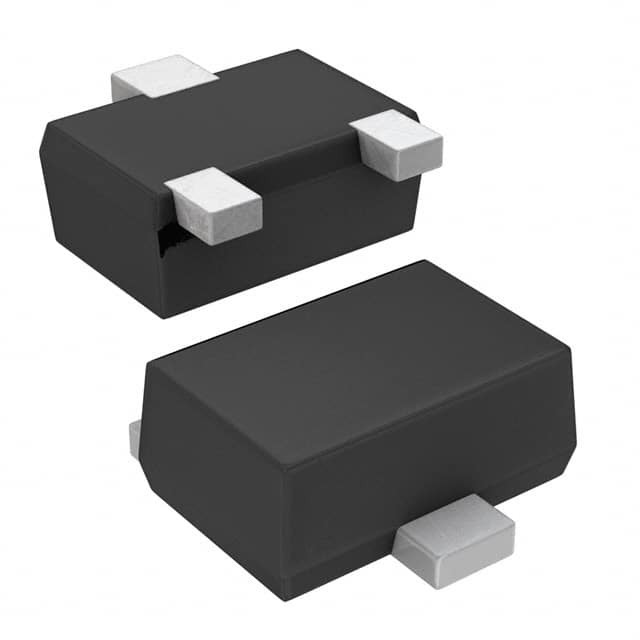
50 V, 100 mA, 150 mW in EMT3F: package and power limits decide whether this pre-biased PNP fits
Quick Engineering Summary
| Field | Value |
|---|---|
| Manufacturer | Rohm Semiconductor |
| Category | Transistors (BJT) - Single, Pre - Biased |
| Package | EMT3F (SOT-416FL) |
| Core function | TRANS PREBIAS PNP 50V 0. |
| Key electrical range | Supply and Demand Status: Limited |
| Reported stock | 19300 pcs reported — confirm on RFQ |
Active status is not the hard part here
19300 pieces on hand helps, but Limited supply status and a 51 Weeks lead time are the real planning signals. Lifecycle is Active with no conflict, and EU RoHS compliance plus MSL 1 remove two common handling concerns.
The package and power ceiling set the real boundary
This is a small-signal part.
The 150 mW maximum matters more than the 100 mA collector current ceiling if you are tempted to use DTA043EEBTL as a general-purpose high-side switch because the current number looks workable. In EMT3F (SOT-416FL), that power figure is a hard limit, and the listed 150 mV Vce(sat) at 500 µA and 5 mA only describes one low-current switching point. The 50 V collector-emitter breakdown is the other gate to clear; it suits higher-voltage logic and bias networks, but it says nothing about surge behavior or inductive abuse.
Can you keep a running line on it?
Can you buy it without drama? Yes, but not as a just-in-time line item.
The reel quantity is 3000, stock quantity is 19300, and supply is flagged Limited. That mix supports an existing build or a new release placed now, not one left until the last PO window when the assembly schedule is tight. Use the reel format to your advantage and align demand in full reels where you can. The 51 Weeks lead time is what can stall a line, not the Active lifecycle.
The built-in resistors are the reason to choose it
4.7 kOhms is the key figure.
DTA043EEBTL is a pre-biased PNP with R1 and R2 both listed at 4.7 kOhms, so it fits compact biasing and level-shift work where removing two external resistors and keeping placement tight in an EMT3F footprint matters. The minimum hFE of 20 at 5 mA and 10 V anchors the gain claim at a modest operating point, not at the 100 mA ceiling. The 250 MHz transition frequency says it is not a plodding transistor, but that number alone does not settle switching-loss or edge-shape questions.
What the listing still doesn’t answer
Heavy load switching is the wrong job for this part, and designs that need broad thermal margin or a lot of documented dynamic behavior will run into unanswered questions quickly.
What it does suit is dense control circuitry, bias networks, and small interface stages where the built-in resistor network is the point and current stays comfortably below the top end. That case is straightforward enough, but the listing still leaves out details that decide whether the part behaves quietly on a real board or turns into a bring-up revisit.
There is no pinout here, no package drawing, and no thermal resistance figure, so land pattern, orientation, and ambient headroom are still open. There is also no collector cutoff current value despite the field being present, and no switching-time data, which leaves leakage-sensitive bias paths and edge-speed expectations unresolved. In a very small pre-biased transistor, those are concrete gaps, not paperwork.
View the Win-Source product page for DTA043EEBTL.
Key Takeaways for Engineers & Buyers
- Lock the EMT3F (SOT-416FL) footprint before releasing the PCB.
- Budget around the 150 mW maximum, not the 100 mA maximum alone.
- Place the buy early if DTA043EEBTL is needed for production; lead time is 51 Weeks.