
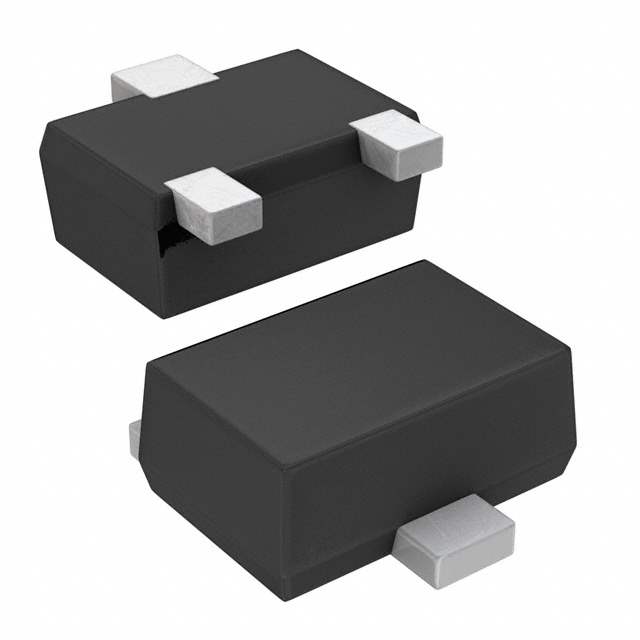
50V VCEO, 100mA collector ceiling, 200mW dissipation limit, UMT3F pre-biased PNP
Quick Engineering Summary
| Field | Value |
|---|---|
| Manufacturer | Rohm Semiconductor |
| Category | Transistors (BJT) - Single, Pre - Biased |
| Package | UMT3F |
| Core function | TRANS PREBIAS PNP 50V UMT3F |
| Key electrical range | Frequency - Transition: 250MHz; Maximum Current Collector: 100mA; Maximum Power Dissipation: 200mW; Supply and Demand Status: Balance |
| Reported stock | 6500 pcs reported — confirm on RFQ |
Use it, but stay inside the ceilings
Good candidate.
The lifecycle call is straightforward. DTA043EUBTL is an Active pre-biased PNP, so it fits new design-in as well as sustaining builds when the board already wants UMT3F and the 50V VCEO, 100mA collector current, and 200mW dissipation ceilings match the job.
Those numbers define the boundary, not the target, and they still leave real design questions open because the listing does not include a derating curve or thermal resistance. The integrated bias network narrows the use case just as much: R1 is 4.7k and R2 is 4.7k, so this part suits compact high-side switching and interface stages that benefit from the built-in resistor pair, while circuits that need externally tuned base drive should look elsewhere.
The 250MHz transition frequency is listed, but it does less to place the part than the resistor network and the package do. EU RoHS is listed too, so compliance is not the issue here.
Not for power switching
Start with the mismatch. DTA043EUBTL is not for loads that run up against the 100mA collector ceiling or designs that treat 200mW as normal operating room.
It fits small-signal switching on boards that already want an SMD pre-biased PNP with the built-in 4.7k and 4.7k network.
The low VCE(sat) helps only at light drive
The weak point comes first: the context is thin. The useful part is that one switching number is present.
The listing gives a maximum VCE(sat) of 150mV at 500µA and 5mA. That is a ceiling at that stated test condition, not a promise at the 100mA collector ceiling, so it supports a narrower conclusion: DTA043EUBTL can switch modest collector current with low saturation voltage when the base-drive condition matches the listing.
The gain figure has the same limitation. hFE is given as 20 @ 5mA, 10V, which places the part in the small-signal region but does not predict behavior across the full collector-current range. If the design depends on gain spread, deep saturation behavior, or thermal headroom near the dissipation limit, the missing details still matter.
Can you keep a line running on it?
What would stop a build first? Not lifecycle. DTA043EUBTL is Active, packaging is Reel - TR, and stock is listed at 6500, so for an assembly flow already set for UMT3F on tape, this is a normal production buy rather than a last-time scramble.
What is missing is more concrete: pinout, package drawing, thermal resistance, and collector cutoff current. Those are the gaps that decide board fit, thermal headroom, and off-state leakage.
View the Win-Source product page for DTA043EUBTL.
Key Takeaways for Engineers & Buyers
- Keep DTA043EUBTL on rails that stay inside the 50V VCEO ceiling.
- Budget collector load against the 100mA maximum and 200mW dissipation ceiling together.
- Lay out for UMT3F and buy on Reel - TR if the line is set up for tape feed.