
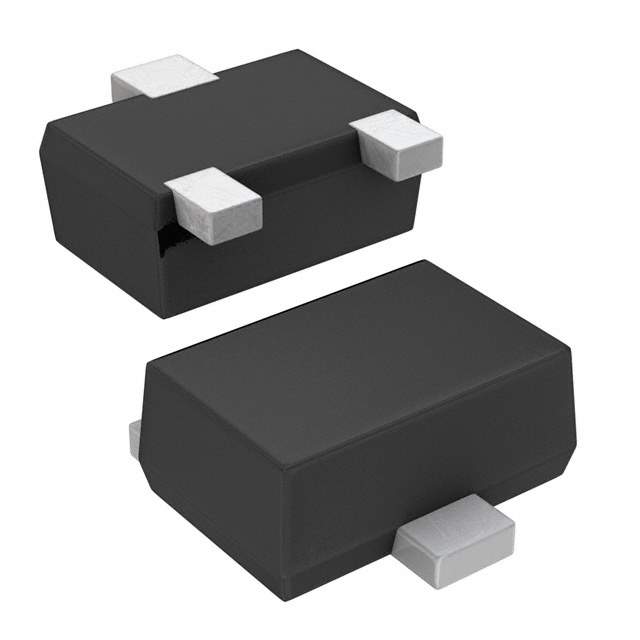
50V VCEO, 100mA collector ceiling, 150mW dissipation ceiling, EMT3F (SOT-416FL) package
Quick Engineering Summary
| Field | Value |
|---|---|
| Manufacturer | Rohm Semiconductor |
| Category | Transistors (BJT) - Single, Pre - Biased |
| Package | EMT3F (SOT-416FL) |
| Core function | TRANS PREBIAS PNP 50V 0. |
| Key electrical range | Frequency - Transition: 250MHz; Maximum Current Collector: 100mA; Maximum Power Dissipation: 150mW; Supply and Demand Status: Sufficient |
| Reported stock | 186000 pcs reported — confirm on RFQ |
Can you design DTA043ZEBTL in today?
Can you put it into a new build without creating a supply problem? Yes. Active status, 186000 in stock, and Reel - TR packaging make it a credible choice for volume SMT assembly rather than a sustaining-only buy.
The real filter is circuit fit. DTA043ZEBTL is a PNP - Pre-Biased transistor with R1 at 4.7k and R2 at 47k already fixed inside the device, so it belongs in bias-and-switch functions that want that exact resistor pair, not in circuits that need freedom to tune base drive externally.
The 150mW ceiling matters more than the 100mA headline
The weak point comes first: 150mW is a tight dissipation ceiling. Only after that limit is respected do the stronger numbers matter, because a pre-biased transistor in EMT3F (SOT-416FL) can run out of thermal room before the 100mA maximum collector current looks usable on paper.
That 100mA figure is a ceiling, not a working point. It marks DTA043ZEBTL as a part for light load switching and bias control, not for loads that lean on collector current continuously and expect thermal slack. The 50V VCEO maximum collector-emitter breakdown voltage is also a ceiling; it answers the first rail-voltage question, but it says nothing about switching loss, transient behavior, or safe ambient headroom because the derating curve is not listed.
One operating clue does help. Max Vce(sat) is 150mV @ 500μA, 5mA, which shows the device can pull low with modest saturation voltage at that stated drive and load point. Past 5mA collector current, though, the listing does not give the curves that would show how quickly margin disappears. The hFE figure, 80 @ 5mA, 10V, reinforces the same read: this is a small-signal transistor, not a power switch, and the missing thermal and saturation curves still set the real design window.
Wrong for adjustable base drive, right for compact bias switching
Wrong for circuits that need a user-chosen base resistor. That decision is already locked in with 4.7k for R1 and 47k for R2, so DTA043ZEBTL works when those values simplify the schematic and board, and it works poorly when turn-on current, threshold shaping, or leakage behavior calls for a different resistor ratio.
The package points the same way. EMT3F (SOT-416FL) and SMD (SMT) mounting suit dense control sections, level shifting, and small-signal gating where a discrete transistor plus two external resistors would waste area. The 250MHz transition frequency keeps it from looking sluggish, but that number alone does not qualify it for RF work or fast edge switching because the listing does not include capacitance or switching times.
Buy the reel, but don't skip the missing curves
The constraint is not supply but missing design detail. Reel - TR packaging and 186000 in stock support a running line, so the buy decision is straightforward if the resistor pair already matches the circuit.
What still blocks full signoff is the absent information that turns limits into a usable design window. The listing does not include pinout, package drawing, thermal resistance, or collector cutoff current. Those gaps drive footprint release, ambient headroom, and off-state behavior more than another pass through the 50V or 100mA ceilings.
View the Win-Source product page for DTA043ZEBTL.
Key Takeaways for Engineers & Buyers
- Keep DTA043ZEBTL on rails that stay inside the 50V VCEO ceiling.
- Budget heat from the 150mW dissipation ceiling before using the 100mA collector limit.
- Match the built-in 4.7k R1 and 47k R2 to the drive network before freezing the BOM.