
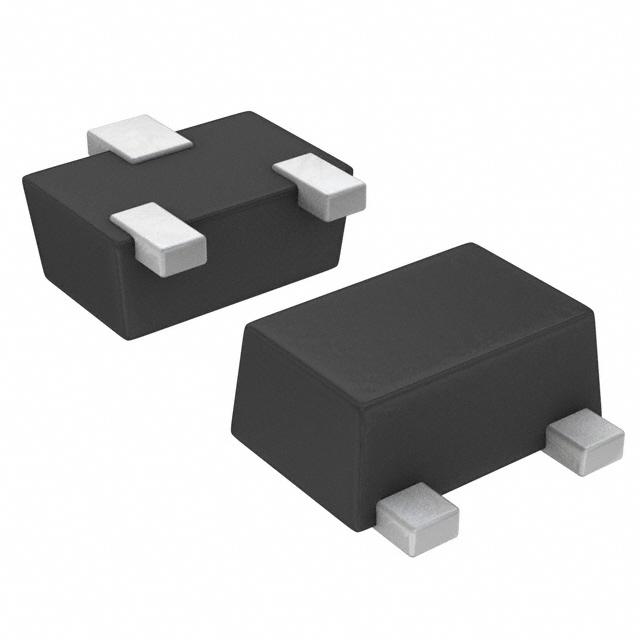
50V VCEO ceiling, 30mA collector-current ceiling, 150mW limit, VMT3 package
Quick Engineering Summary
| Field | Value |
|---|---|
| Manufacturer | Rohm Semiconductor |
| Category | Transistors (BJT) - Single, Pre - Biased |
| Package | VMT3 |
| Core function | TRANS PREBIAS PNP 50V VMT3 |
| Key electrical range | Frequency - Transition: 250MHz; Maximum Current Collector: 30mA; Maximum Power Dissipation: 150mW; Supply and Demand Status: Balance |
| Reported stock | 8000 pcs reported — confirm on RFQ |
Not for load drive; fine for compact level inversion
Wrong job first: this is not a power switch. The 30mA maximum collector current is a ceiling, and the 150mW maximum power dissipation is another ceiling, so heavier loads are out before layout even starts.
It fits much better in small-signal switching where the bias network is already inside the part. DTA044EMT2L is a PNP pre-biased transistor in VMT3 with R1 = 47k and R2 = 47k, so it suits dense control paths where saving board area and external resistors matters more than current capability. Active lifecycle and EU RoHS support new design-in, but only when the circuit actually wants those built-in resistor values instead of a discrete transistor with external bias parts.
The weak point is current headroom, not voltage
Current headroom is the weak point. A 30mA collector-current maximum is a hard ceiling, so DTA044EMT2L belongs in signal paths, not as a general high-side PNP you drop in and expect to ride through startup or fault conditions.
Voltage is the stronger number. The 50V VCEO ceiling gives useful rail margin for higher-voltage control nodes, but it does not turn the part into a power switch. The listed 150mV VCE(sat) at 500µA and 5mA shows it is characterized in a light-current switching condition, which helps when you are cleaning up logic inversion or pull-up switching and tells you very little about behavior near the 30mA ceiling. The 80 hFE minimum at 5mA, 10V points the same way: this part is specified where signal currents live.
Can you keep a running line on it?
Can you actually keep it on the line? Yes. Stock is 8000, packaging is Reel - TR, and lifecycle is Active with no conflict.
What the listing still doesn't tell you
150mW is the decisive number, because without thermal detail it is only a package ceiling, not a usable ambient design target. DTA044EMT2L is in VMT3, and the row also points to SOT-723, but the listing still stops short of the details that close out placement, heat, and switching questions.
Thermal data is the first gap. There is no thermal resistance and no derating curve, so you cannot translate that 150mW limit into real ambient headroom on a crowded board. There is also no pinout or package drawing here, so footprint confirmation still depends on the datasheet even with the package names present.
And the switching picture stays thin. Frequency transition is listed as 250MHz, but there is no capacitance data and no switching-time data, so that number alone does not tell you how DTA044EMT2L will behave in an edge-sensitive interface. Collector cutoff current is also absent, leaving leakage unanswered for pull-up paths that must stay quiet when off.
View the Win-Source product page for DTA044EMT2L.
Key Takeaways for Engineers & Buyers
- Keep collector current below the 30mA ceiling; this part is not for relay, lamp, or solenoid drive.
- Use the built-in 47k/47k bias network only where that resistor ratio matches the drive logic you want.
- Buy on reel if DTA044EMT2L is going to the line; packaging is TR and stock is 8000.