
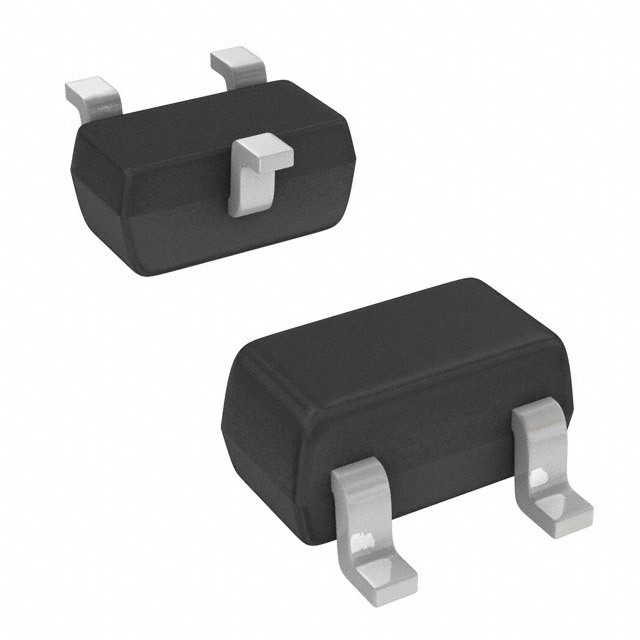
Active pre-biased PNP with 50 V VCEO ceiling, 60 mA collector limit, and EMT3F package
Quick Engineering Summary
| Field | Value |
|---|---|
| Manufacturer | Rohm Semiconductor |
| Category | Transistors (BJT) - Single, Pre - Biased |
| Package | SC-89, SOT-490 |
| Core function | TRANS PREBIAS PNP 50V EMT3F |
| Key electrical range | Current - Collector (Ic) (Max): 60 mA; Current - Collector Cutoff (Max): 500nA (ICBO); DC Current Gain (hFE) (Min) @ Ic, Vce: 100 @ 5mA, 10V; Frequency - Transition: 250 MHz |
| Reported stock | 3000 pcs reported — confirm on RFQ |
Can you design DTA044TEBTL into a new board?
Can this go into a new board without drama? Yes, if the job is small-signal switching and the built-in bias network actually matches the circuit.
DTA044TEBTL is an Active pre-biased PNP in EMT3F (SOT-416FL), which makes the new-design case pretty simple on dense surface-mount control boards: you save external base-bias parts and keep the footprint small. EU RoHS is compliant, and the lifecycle status is cleanly Active.
The limits set the boundaries. The 50 V collector-emitter breakdown is a ceiling for rail exposure, not a place to operate by default, and the 60 mA collector rating is a ceiling as well. That rules out relay, lamp, and similar load-driving roles before thermal questions even start.
The real decision is current and heat, not gain
And that is the point that matters next. DTA044TEBTL stops looking like a generic small transistor once the power budget enters the picture, because 150 mW is the maximum and a pre-biased device in a tiny package can use that up faster than the schematic suggests.
The 60 mA collector limit tells you what class of load it may switch, but not how much margin remains at ambient. The listed 150mV VCE(sat) at 500µA and 5mA is useful because it ties switching behavior to a real test condition, yet it still leaves open what saturation looks like as you push toward the 60 mA ceiling. The 100 hFE minimum at 5mA and 10V helps in that same small-signal region, and not much beyond it. Near the top of the current or power envelope, gain is no longer the deciding number.
The constraint is the built-in bias network
The constraint is fixed bias. R1 is 47 kOhms, and only R1 is included, so you are not starting with a bare PNP and shaping the base network around your logic source; you are taking the transistor and one resistor value together, and that choice decides a lot before layout even begins.
That can be a clean fit in compact level-shift, pull-up, and simple high-side signal-gating work where the control source and the intended collector current already line up with the internal bias choice. It is a weaker fit when the design needs tighter control of base drive across operating corners, or when turn-off behavior and leakage budget matter more than cutting BOM count.
The 500nA collector cutoff maximum supports low-leakage signal paths, but it is still only one leakage number, not a full off-state picture. The 250 MHz transition frequency also needs restraint in how it is read: it does not make DTA044TEBTL a general RF transistor. In context, with the pre-bias structure and the small-signal current limits, it mainly says the device is not inherently slow for logic-adjacent switching. Use it where board area and resistor integration matter more than custom bias tuning.
What the listing still doesn't answer
Still incomplete.
The missing items are concrete ones: pinout, package drawing, thermal resistance, and any derating curve. DTA044TEBTL also lacks a capacitance figure here, so if switching speed or charge storage matters in your circuit, this page does not settle it.
View the Win-Source product page for DTA044TEBTL.
Key Takeaways for Engineers & Buyers
- Keep collector current below the 60 mA ceiling; this part is for small-signal switching, not load drive.
- Budget dissipation against the 150 mW maximum before using DTA044TEBTL in always-on bias paths.
- Plan replenishment around the listed 3000 stock if DTA044TEBTL is going onto a running build.